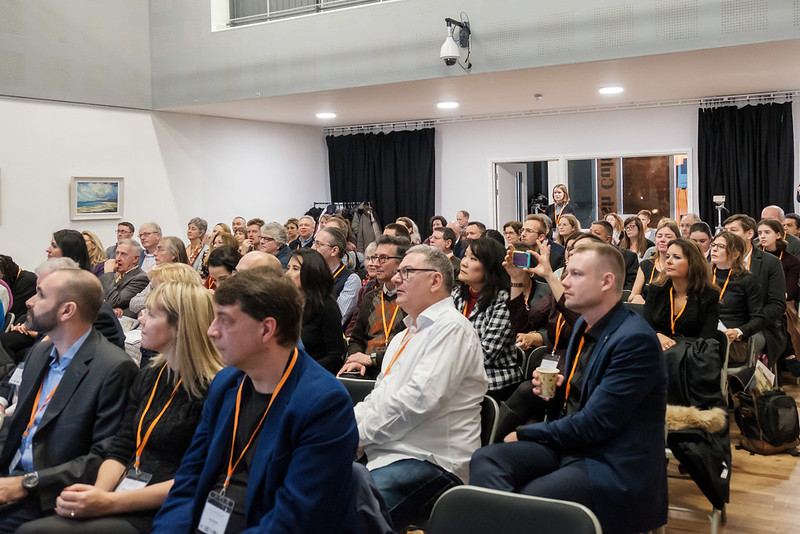
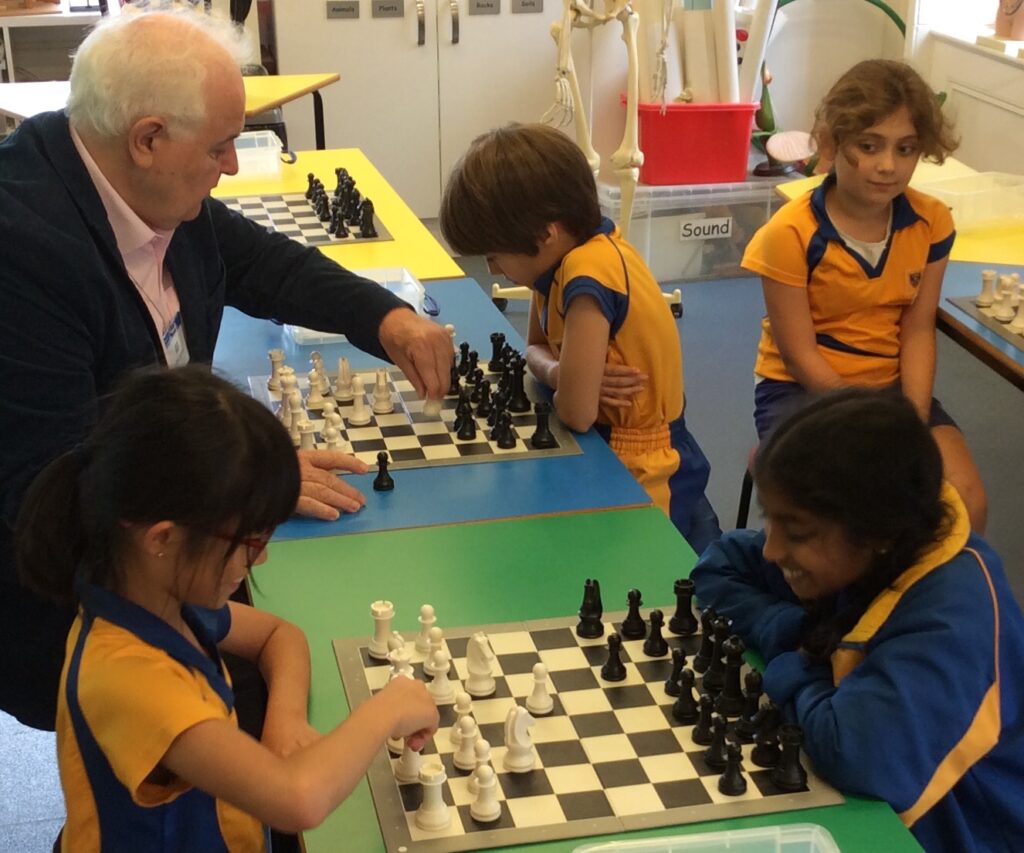
Three members of the club, Peter Andrews, Stephen Moss and John Foley along with another contemporary decided to visit their their old college one summer’s day to enjoy the atmosphere and to recapture some of their past. Another member of the club, David Maycock, filmed the day. The resulting video provides a diverse set of personal stories. These are not to be taken as representative of current college life. One of the themes is how different student life was half a century ago compared with now. Some viewers found the video insightful and even delightful.
Other videos from the day are in the pipeline. We are also contemplating producing a video about chess players.
Silverio Abasolo scores 5.5/6 against a powerful field to win the second blitz tournament of the summer at the Willoughby Arms
The Kingston Blitz series continued with 21 players from Kingston, Surbiton and Richmond chess clubs congregating on Monday 17 July for six rounds of 7+3 blitz. A strong field was assembled, with seven players rated above 2000, plus a few dangerous juniors lurking for scalps.
It was one of those juniors – Kingston’s fast-improving Jaden Mistry – who set the early pace, with impressive victories over 2000+ rated players Will Taylor and Julian Way. An impressive feat, all but wrapping up the giantkiller prize with four rounds to spare.
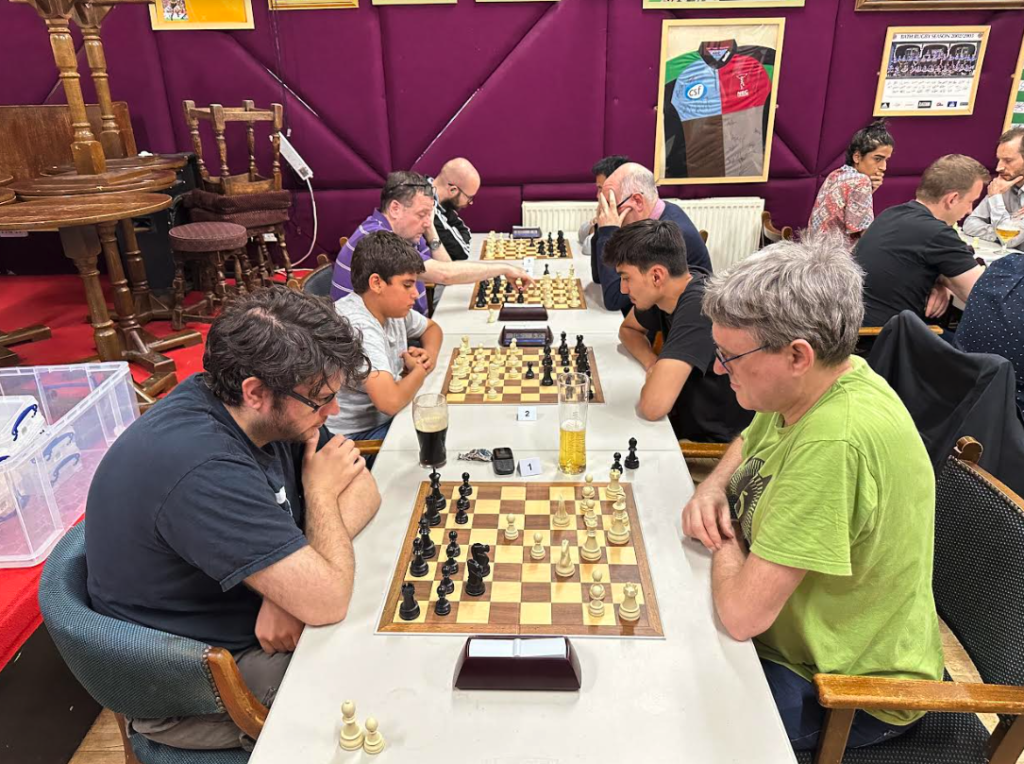
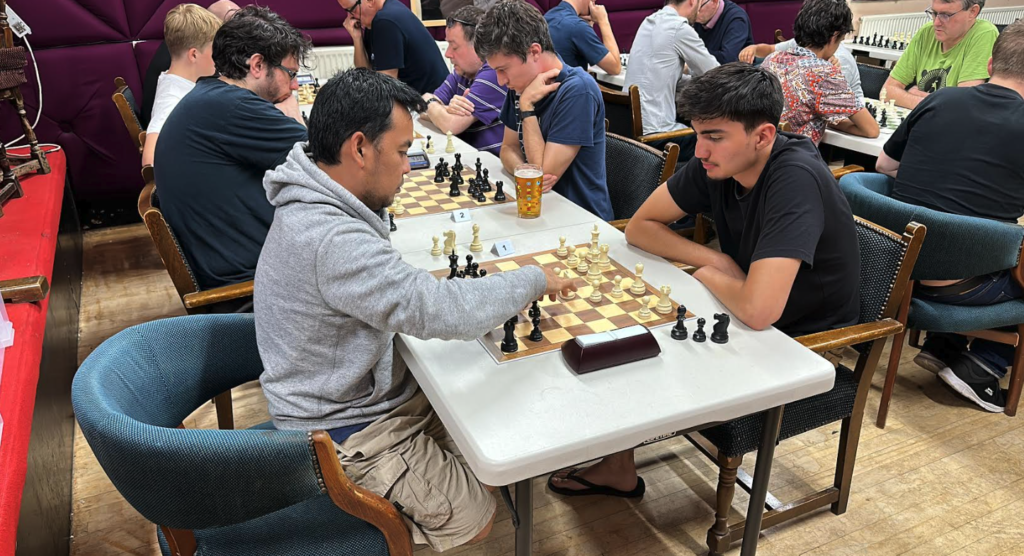
MIke Healey (foreground, left) faces Graham Alcock on top board, with the giantkilling Jaden Mistry beyond him
Round 3 saw the first clash of the titans, as Peter Lalić and Silverio Abasolo faced off in fierce fashion. With both down to their final three seconds, Silverio played at lightning pace, building his time back up to 30 seconds before managing to force his pawns to promotion to clinch the game.
Meanwhile, Mike Healey and David Maycock had successfully navigated the first three rounds with perfect scores and met on top board in round 4. Mike opened up his kingside, putting pressure on David’s defences with rooks on a1 and b1 threatening from range, and eventually smashed through to pick up the exchange. Mike then began to force home his material advantage, grabbing pawns, but David, who never gives up, battled on and managed to fork Mike’s rook and king, turning the tables and securing victory. “You always manage a swindle, David,” chirped Peter Lalić.
Silverio Abasolo (left) gets the better of David Maycock in their crucial fifth-round game
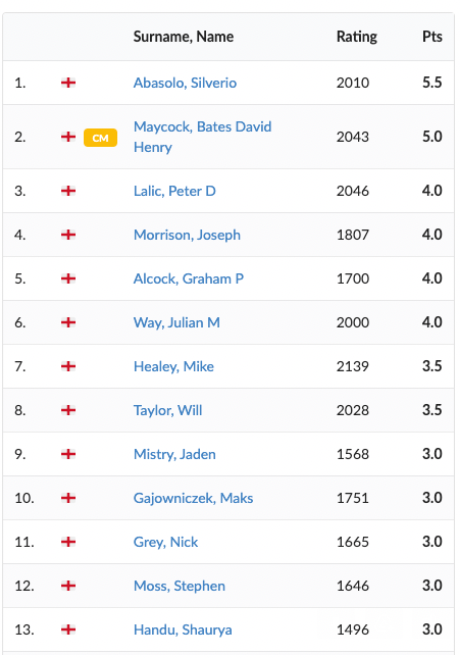
David (4/4) would now face Silverio (3.5/4) in what looked to be a fifth-round title decider, and it was Silverio, playing with the black pieces, who prevailed. In the final round, Silverio was up against Joseph Morrison, a talented Surbiton junior who put up another excellent Kingston Blitz performance, gaining his third consecutive U2000 grading prize. Something tells me he won’t be eligible for this category for much longer. However, it was the impressive Abasolo who came out on top, winning the tournament with an unbeaten 5.5/6.
The event was held at Monty’s Nepalese Restaurant in Kingston on 29 June 2023
One week after our AGM, 21 members gathered for the annual club dinner, this time at a Nepalese restaurant in a central location in Kingston, to celebrate the best season in our history. To facilitate conversation, there was a seating plan which placed members alongside others of a similar age and rating. This technique seems to have worked because a memorable evening was enjoyed by all.
The highlight of the proceedings was the prize-giving. This year we dispensed with our former categories, such as the player who achieved the best performance. Instead we focused on one captain and one player who made the crucial difference. David Rowson received the prize for Captain of the Year for having steered our first-team players to win both Surrey League Division 1 and Thames Valley League Division 1. The prize for Player of the Year went to Silverio Abasolo. His results during the season were admirable, but the crucial one was his game against IM Chris Baker which he managed to win from a rather dubious position to enable Kingston to retain the Alexander Cup – the premier knockout cup for the Surrey League.
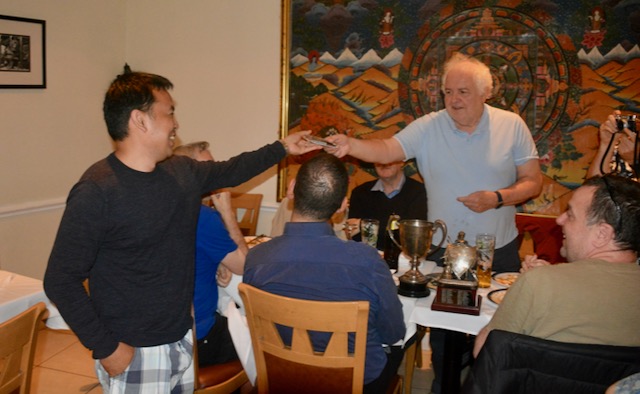
Silverio Abasolo receiving the player of the year award from club president John Foley. Photograph: Jon Eckert
This season Kingston also won the knockout cup for the Thames Valley League, as well as Division X in the Thames Valley League under the stewardship of Stephen Daines. To add icing to the cake, our 4NCL team, having started the season in Division 4, won promotion to Division 2 (a third-division team having pulled out, allowing accelerated promotion).
The prizes were handed out by club president John Foley. Unfortunately the new secretary had forgotten to bring the glittering baubles, so a bar of chocolate was handed over as an exchangeable token instead. The president made an engaging and witty speech setting out the facts above. When he finally sat down after 15 minutes, there was relief amongst those assembled who had been warned by the secretary to expect a speech lasting at least an hour.
Vladimir Li scores 5.5/6 to see off a strong field in the first of a series of blitzes at the Willoughby Arms planned for the summer
After a successful pilot in April, competitive blitz returned to the Willoughby Arms on Monday 19 June as Kingston Chess Club hosted the first of a series of summer blitz tournaments. It was a six-round Swiss with the “long” (for blitz!) time control of seven minutes plus a three-second increment per move. Twenty-two Kingstonians welcomed four players from neighbouring Surbiton Chess Club – we are keen to open these events to other local clubs whenever possible – in a 26-player field.
Round one went to form, with the more experienced players successfully fending off the recent influx of Kingston juniors, who enthusiastically battled away all evening. The highlight of the second round was a delightful (except for his opponent) smothered mate by Josh Lea, whose forced queen sac on g1 was followed by Nf2++, leaving Jimmy Kerr’s king helplessly stranded in the corner. “Just like you do in the puzzles!”, Josh remarked wittily. Philidor, after whom this mating pattern is named, would no doubt share Josh’s pleasure. Henceforth, we will call this Lea’s Legacy.
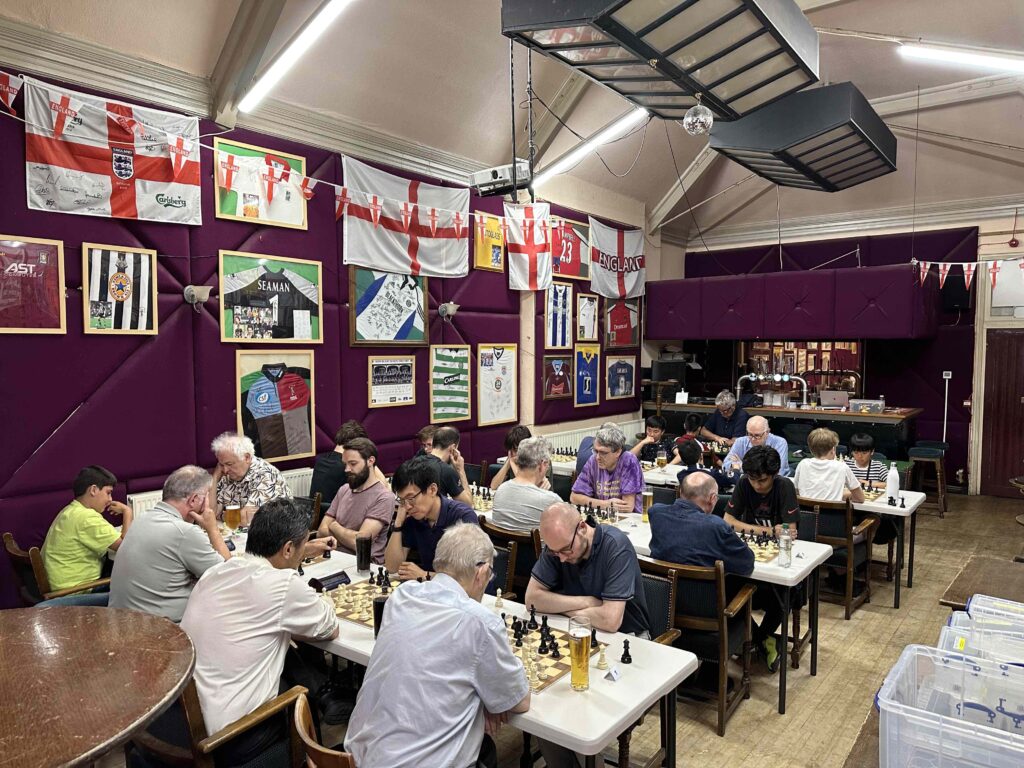
The playing room at the Willoughby is packed as 26 hopefuls do battle in the first Kingston Summer Blitz
The first upset came in round 3 as club president John Foley got the better of reigning Kingston blitz champion Peter Lalić. John has annotated this interesting game. A less interesting game played out on board 3, where Alan Scrimgour’s queen and king fork on move five saw an early resignation and wry smile from Surbiton’s Graham Alcock. A distinctly unneighbourly gesture from the Kingston chair.
In round 4, Foley claimed another scalp, this time of Kingston star David Maycock, who flagged in time trouble. That put Foley, who claims to be only a moderate blitz player, on the perfect score of 4/4, sharing the lead with Vladimir Li, whose victory against Alan Scrimgour also took him to 4/4.
At the same time, the action was hotting up on the lower boards – in every sense, as it was a very warm evening – with the usual blitz madness of spectacular blunders, swindles and flagging in winning positions. Nick Grey was unfortunate to lose on time against Stephen Moss as he was about to deliver the coup de grâce, in a game Nick had completely dominated. What a cruel form of chess blitz is.
Foley and Li faced off in round 5, in what looked to be the tournament decider. And it was Li who prevailed, putting the Kingston president in an unbreakable bind to go a full point ahead of the chasing pack. Li went on to draw with Peter Lalić in an entertaining and richly tactical final-round game to claim outright first prize with an unbeaten 5.5/6. All in all, another successful running of the Kingston Blitz, which was played in great spirit. We will be back on Monday 17 July for the next edition.
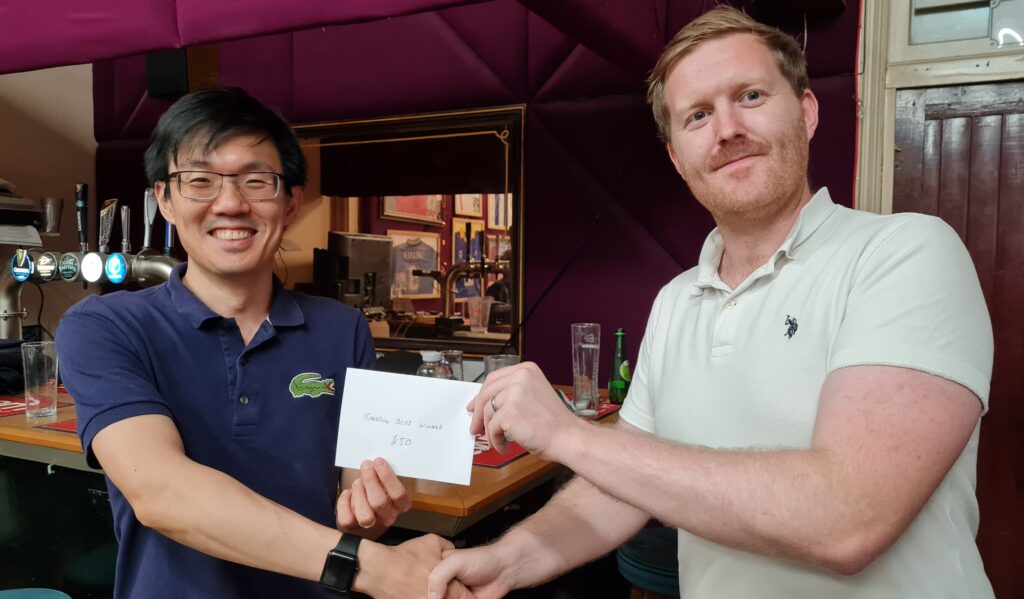
Vladimir Li (left) receives his prize from Gregor Smith for winning the first Kingston Summer Blitz
Prize winners
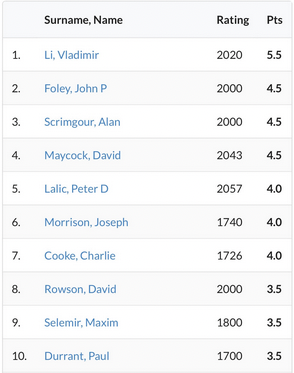
1st Vladimir Li (5.5/6) (prize = £50) 2nd= John Foley (4.5/6) 2nd= Alan Scrimgour (4.5/6) 2nd= David Maycock (4.5/6) U2000 prize – Jojo Morrison (4/6) U1600 prize – Jaden Mistry/Josh Lea (3/6) Giantkiller prize – John Foley
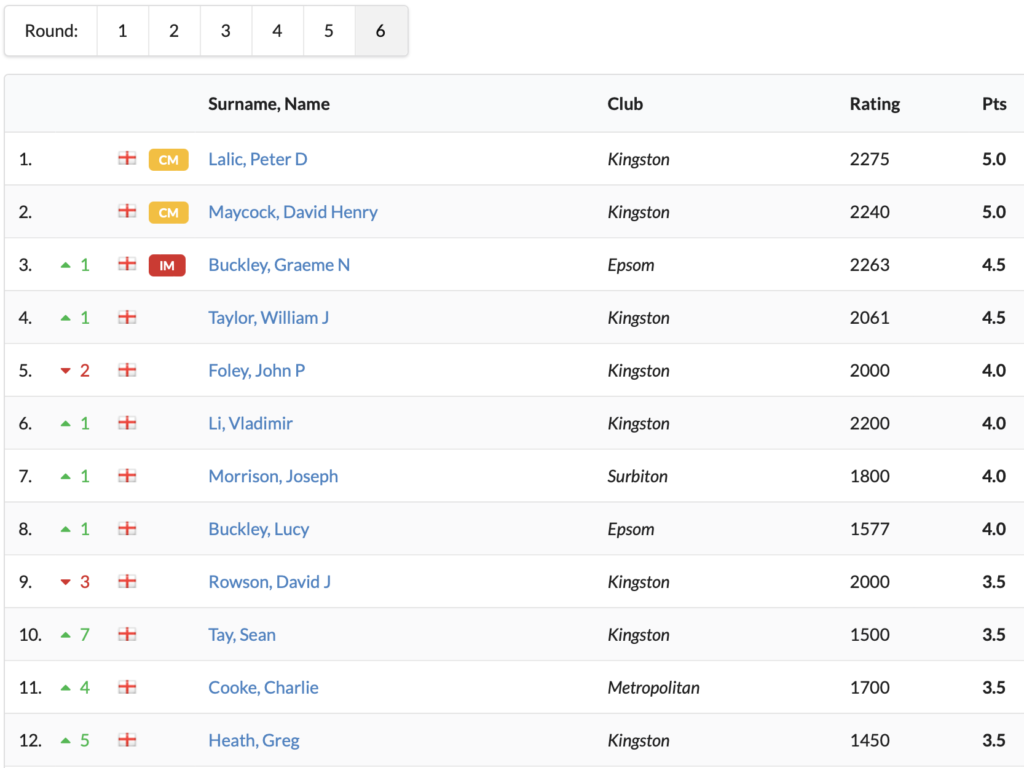
Top 10
Report by Gregor Smith, Kingston Summer Blitz organiser
Peter Lalić wins the inaugural event in a thrilling Armageddon play-off with close friend (and deadliest rival) David Maycock
Thirty players and assorted spectators gathered for the inaugural Kingston Easter Blitz played on Easter Monday. Gregor Smith, whose brainchild the event was, controlled the evening impeccably. The time control was 7 minutes per game plus 3 seconds increment per move. This is equivalent to 20 minutes per game, which is the maximum allowed for a game to qualify as a blitz. Gregor, as an official English Chess Federation ratings officer, will submit the games to the national listing.
The games were played on spacious modern trestle tables with new competition boards and sets. The time between rounds was only five minutes – enough to order a drink at the bar and look at the standings, which were displayed on a large screen at the end of the room. We used pairing software that we had first encountered last month at the London Chess Conference, which its developers attended. After each game finished, a hand signal (usually a polite one) was sufficient to notify Gregor of the result, which he then immediately updated on the pairings screen.
One participant said that he had an alternative blitz he could have attended, but he preferred Kingston because of our efficiency – there are no delays between rounds. The modern pairing software and the large screen make all the difference.
There were plenty of exciting games. In the final round, as if preordained, to force the tournament to extra time David Maycock, on 4/5, had to beat Peter Lalić, who was on 5/5, which he duly did. The play-off was then held surrounded by the biggest crowd seen upstairs at the Willoughby Arms since England were involved in a penalty shoot-out. (This is a football-loving pub – hence the flags and memorabilia which festoon the playing room.) The Armageddon format meant that the players bid to be White by giving away some time. They settled on Peter (four minutes) v David (five minutes).
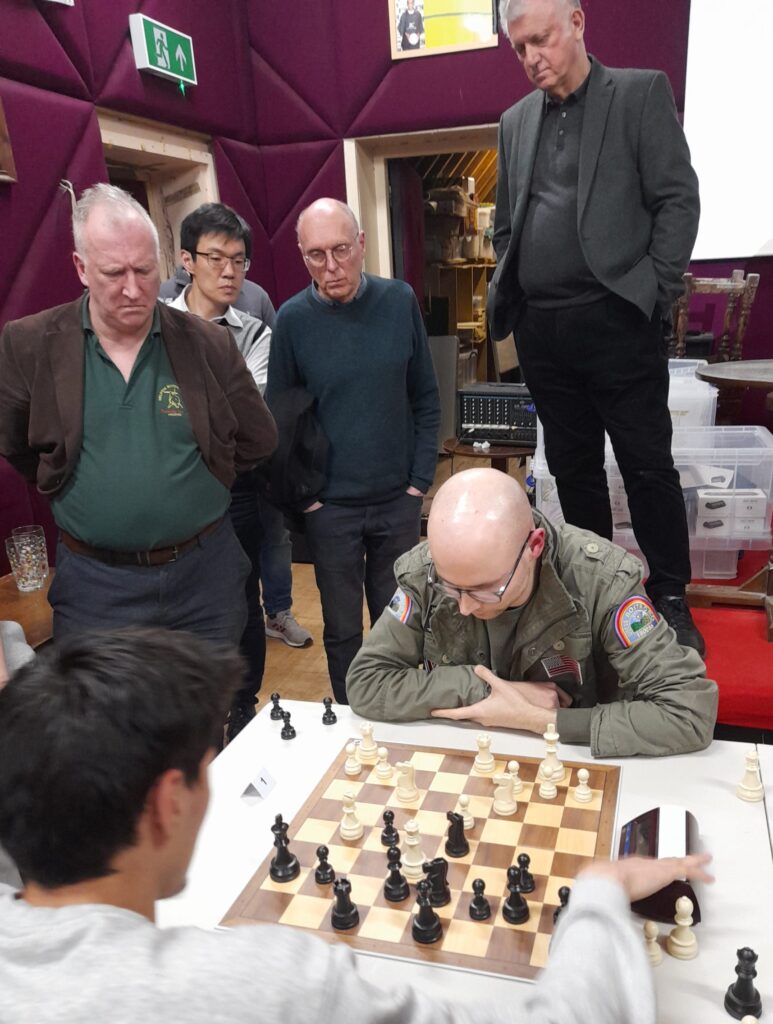
Armageddon! David Maycock and Peter Lalić, appropriately dressed in battle fatigues, fight it out for first prize
Peter won convincingly with a sacrificial attack and collected the first prize of £50. What does Peter play in the position below?
An engine suggests 12. Nxd5, with some neat tactics to follow: 12…Bxg5 13. h4 Bh6 14. Qe4 g6 15. Ne7+ Qxe7 16. Qxb7, giving White a small plus, but in blitz (and certainly in Armageddon with no increment – a recipe for chess chaos!) the route-one approach can be more effective. Peter needs no second invitation to sac a piece, and played 12. Bxh7+!? Objectively the position is level, but in blitz the initiative counts for a lot. The game proceeded: 12…Kxh7 13. Qh4+ Kg6 14. Qe4+ f5 15. Qxe6+ Kh7 16. Nxd5 Bxg5 17. Nc3 Bf6 18. Qxf5+ Kh8 19. Rd3 Qe8 20. Re1.
David is in trouble here, but far from lost. 20… Qd8 or 20… Qc8 just about hold, but he is worrying about keeping control of the e8-h5 diagonal and plays 20… Qf7??, which pretty well loses on the spot to 21. Ne5! To avoid mate, Black has to relinquish his queen. An intense game played in great spirit, and after the rivalry the two players (who have done so much to galvanise Kingston over the past two seasons) could revert to being friends. Armageddon, as the name suggests, is not, however, recommended for the faint-hearted.
The under-2000 rating prize (a chocolate confection) went to JoJo Morrison on countback over Lucy Buckley with a commendable 4/6. Greg Heath won the U1500 grading prize. The giant-killer prize (beating someone 400 Elo points higher) went to Jaden Mistry, who beat Byron Eslava in the first round. Stephen Moss would have been the recipient had he kept his nerve (or perhaps lost his moral compass) against IM Graeme Buckley. This is all the more remarkable given that Stephen was playing on the increment with only a few seconds to make his moves for much of the game.
Stephen Moss (left) agreeing a draw in a winning position against IM Graeme Buckley
Stephen agreed a draw in the final position.
Stephen had nothing to lose by capturing the g-pawn, leaving him with three pawns against a knight. According the the endgame tablebase, this is a win for White. As Graeme pointed out, there was no rush even to capture the pawn; simply advancing the a-pawn wins.
Stephen explained that he would not have felt comfortable taking the point given that he had been penalised one minute for an earlier infringement in the game. This saintly level of piety will see Stephen gain fast-track entry at the pearly gates (though not to the British blitz championship). However, Stephen had a point because earlier he was about to lose on time as he dithered over a move. Having decided not to move the piece to the tentatively chosen square – he realised he was moving his king into check, which is itself illegal of course – he returned it to its starting point and pressed the clock. This was also illegal and so the arbiter was called over.
During the intervening time, Stephen managed to compose himself and find a move. This is a rare example of someone being penalised for an illegal non-move. During a later game, Stephen declined a draw offer with a grumpy “No”, which also immediately made him feel guilty. Methinks Stephen is never going to break into the world’s top 10,000 players unless he is prepared to lower his ethical standards.
When the London Chess Conference was first held in 2013, it was supposed to be a one-off, but it is still going strong 10 years later. What is the secret of its success, and what can we expect at next month’s event?
John Foley
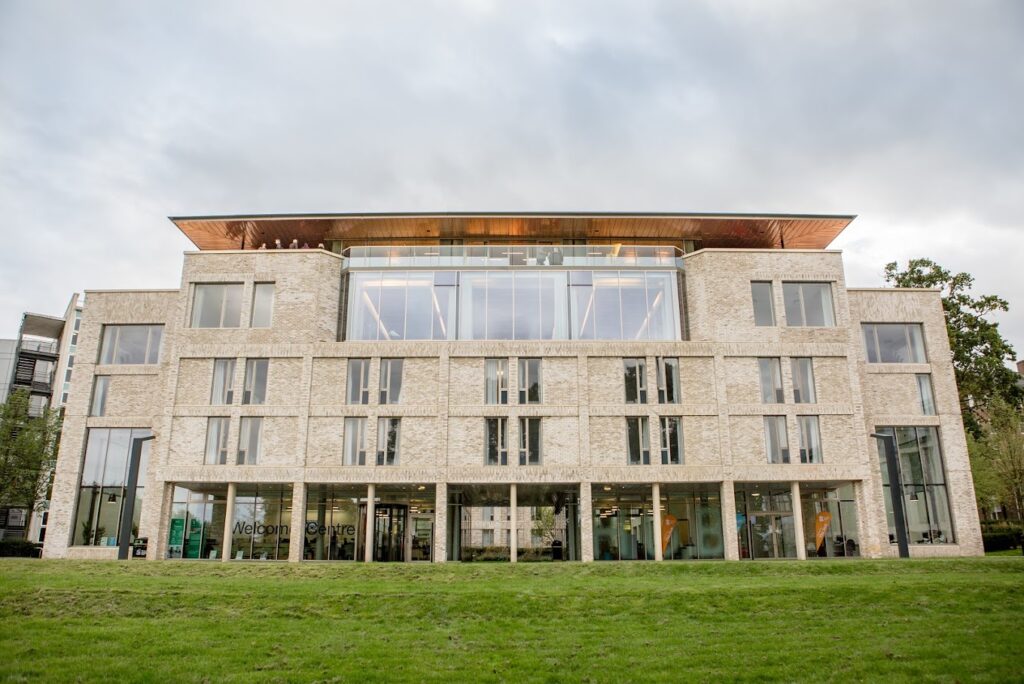
The London Chess Conference, which will place from 17-19 March, is a gathering of some of the leading lights in chess and education from around the world. The venue is the sparkling, newly-built Elm Grove Conference Centre at the University of Roehampton in south-west London. This year the theme of the conference is Chess and STEM. We examine how chess teaching can be adapted to help children to learn about Science, Technology, Engineering and Mathematics. There are places available for those wishing to attend the conference. For more details and to register, visit the conference website.
STEM subjects are seen as fundamental to careers in the 21st century, and any methods that assist children to learn are to be welcomed. If STEM are the vital academic academic subjects, then the vital skills that are needed in order to succeed in the future are the 4C’s: critical thinking, communication, collaboration and creativity. We expect to see examples of how chess helps children to acquire these skills.
The range of sponsors indicates the importance of the event. The partner sponsors, whose backing ensured the event took place, are the International Chess Federation (FIDE), the European Chess Union (ECU) and Chess in Schools and Communities (CSC). In addition, we have received sponsorship from the English Chess Federation, ChessKid, Chessable, Chess Manager and ChessForEdu. Chess and Bridge has also committed material support. As a result, we are able to secure the attendance of noted international experts to present at the conference.
Elm Grove Conference Centre, University of Roehampton
The conference started in 2013 alongside the London Chess Classic. The two events were co-located at Olympia until 2017. Due to the growth of the events, the conference was held separately at the Irish Cultural Centre in Hammersmith in 2018 and 2019. The Covid pandemic forced the conference to be run online in 2020. Finally, we are able to meet in person again at Roehampton. The conference themes reflect the wide range of intersections between chess and the spheres of culture and education.
2013 Chess and Education
2014. Chess and Mathematics
2015 Chess and Society
2016 The Didactics of Chess
2017 Scholastic Chess
2018 The Future of Chess in Education
2019 Chess and Female Empowerment
2020 ChessTech
2023 Chess and STEM
The number of attendees has grown each year, and 140 people registered for the last in-person conference in 2019. These included some of the movers and shakers of the chess education world, including officials from FIDE, ECU and other international representative bodies, officials from national chess federations, politicians and policy makers, managers of chess education projects including Erasmus Plus, organisers of school chess teaching, chess tutors, chess trainers, teachers, chess authors and journalists.
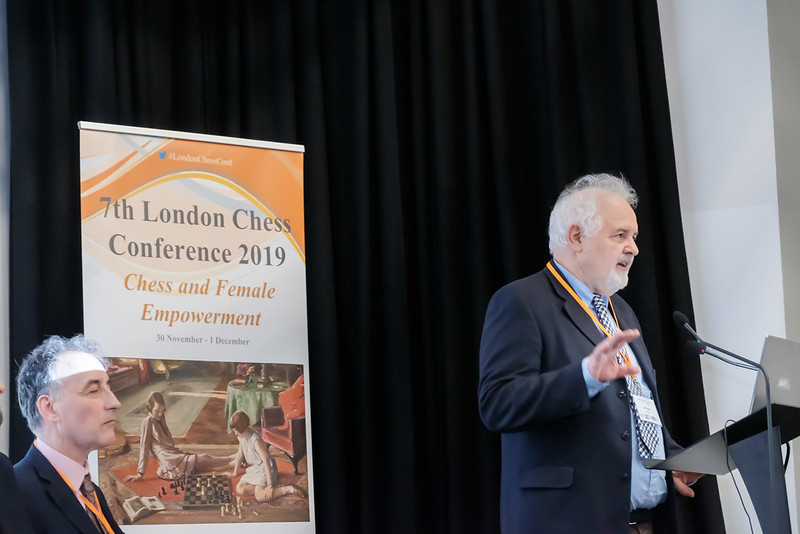
John Foley opening the 2019 conference, with Malcolm Pein sitting behind. Photograph: John Saunders
This year, the format of the conference continues to evolve. We have moved to a hybrid format so that some talks will be presented digitally – either from a remote presenter or in some cases pre-recorded. Pre-recording guarantees that the playout does not suffer from poor internet problems. It is also more useful when the language is not English and subtitles or a voiceover is required.
The opening event of the conference, on the afternoon of Friday 17 March, consists of a seminar on pre-school chess. The first part will comprise digital presentations and the second part will comprise in-person presentations. This seminar has been organised by FIDE and is probably the most expert gathering on early-years chess that has ever taken place.
The conference proper kicks off on the morning of Saturday 18 March with opening speeches by Dana Reizniece-Ozola, the chief executive of FIDE (and former finance minister of Latvia), and Malcom Pein, the chief executive of CSC as well as a board member of the European Chess Union.
FIDE started sponsoring the conference in 2019 and now treats the conference as the world’s premier chess and education conference. It has expanded the scope of the conference with the early-years seminar and has enabled several important chess officials from outside Europe to attend the event. The conference sequence would not have been possible without the continuing support of CSC, which has sponsored the event from the beginning. ECU has been supporting the event since 2016 and we are grateful to Jesper Bergmark Hall, chair of the ECU Education Commission, and Theodoros Tsorbatzoglou. ECU’s general secretary, for their unwavering commitment.
Dana and Malcolm are followed by Jerry Nash, chairman of the FIDE Education Commission, who will focus on how chess develops critical thinking, which is the foundation of the scientific method. Thereafter the day is structured around each of the STEM disciplines, with experts exploring the different ways in which chess engages a specific discipline.
For science, we have Mark Lawrenson from STEM UK, the network of teachers who teach STEM subjects. A physics teacher, he provides insights into how to inculcate children with structured ways of thinking. We will also hear about the Chessable research awards from Alexey Root – the application of chess-related ideas to real-world problems.
Audience at the 2019 conference. Photograph: John Saunders
For technology, Boris Bruhn from Hamburg and a member of the FIDE Education Commission will give an overview of classroom technology used for chess. This includes how to make use of the large interactive screens as well as digital devices held by the pupils. Taking into account all of the software available, this is a large undertaking. Mike Klein (aka FunMasterMike), along with Carey Fan, will give an extensive overview of ChessKid, the leading software platform for learning chess.
For engineering, Rolf Niemann from the science centre at Lund University will show us how to control a robot using coding. A chessboard is a convenient space on which to drive a robot given its built-in co-ordinate system. Chess offers a ready-made domain for the practice of controlled movement rather than having to fabricate an artificial environment. Paolo Sartorelli will describe the new project Chess and Artificial Intelligence which is being funded by Erasmus Plus. Paweł Kacprzak will show us some AI in action – the ability to scan a document or indeed a chessboard and convert that into a digital format where it can link to a chess engine or a video about that very position. It has to be said that chess naturally lends itself to artificial intelligence. This was recognised by Alan Turing, who developed the world’s first chess evaluation algorithm.
For mathematics, Tiago Hirth from Ludus, the maths and games centre, at Lisbon University and Monika Musilek from Haus der Mathematik, the mathematics teacher training institute in Vienna, will talk about their work together investigating how children learn mathematics through play. They will show some strategy games which the participants will have a chance to try.
On Sunday 19 March, the conference looks at broader topics. The first session in the morning will look at how chess and games can help children who are struggling with academic subjects. We will hear from Marion Schöttelndreier, who is an assistant school principal with particular responsibility for science and technology at a secondary school in Lund, Sweden, who will outline some of the notable social benefits of chess. Mikkel Nørgaard from Skoleskak in Denmark will show how chess can in some cases improve mental health. Anastasia Sorokina will talk about the Infinite Chess Project, which finds ways to relate to children with some forms of autism. Brigitta Peszleg from ChessPlus will show some strategy games, such as Halma, which bring joy to all ages and makes learning effortless.
The second session looks at chess teacher training. Currently, there seems to be a lack of interest by schools in the professional accreditation of chess teachers, but the trend is that some formal training will be required, especially as the qualifications endorsed by official chess bodies gain credibility. The speakers include teacher trainers who have taught the basic European course (known as ECU101) and FIDE’s introductory course for teachers known as the Preparation of Teachers course. Other approaches to teacher training will also be covered.
Teaching chess to Year 4s
After lunch, there is an opportunity to hear about innovative chess projects from around the world. The session will be headed by the former education minister of Georgia, Mikheil Chkhenkeli, where chess has been incorporated into the curriculum. In a round-table discussion, we will hear from speakers from Armenia, Germany, England, Romania, North Macedonia, India, Pakistan, Sri Lanka and Botswana.
Overall, it is an ambitious conference which, like a good chess move, tries to achieve several objectives at the same time. It brings together people who are genuinely committed to having games available to STEM teachers. People will come away having had their preconceptions blown away by the infectious enthusiasm of chess proponents from around the world.
It has been 10 years since the first London Chess Conference. It was originally the brainchild of Stefan Löffler and Malcolm Pein, and was only supposed to be a one-off. Its longevity is due to the fact that people liked it and want to come back again. It is the unique mix of people that gives the event its magic. The programmes are devised to capture the current state of play in the worlds of chess and education. Yet attendees value more the opportunity to meet others with whom they share a common interest – a community of practitioners.
Networking is done during breaks, in the evening, at side rooms, and even coming and going to the airport. New projects are hatched and collaborations begun. We can point to several major projects and methods which would not have occurred had it not been for the London Chess Conference. Ultimately the success of the conference is due to the perception and belief that we need to keep trying for the benefit of children everywhere so that they will become thinkers of the future.
It takes a lot of work to construct a professional event. I am proud that it is still running after 10 years and has achieved a measure of international recognition. Many people are involved in making it happen. This year, recognition for their contributions is due to Brigitta Peszleg, Leila Raivio, Rita Atkins, Kate Cooke, Etienne Mensch, Karel van Delft, John Upham and Stefan Löffler.
The keen-eyed reader will notice that the London Chess Conference is organised by ChessPlus Limited. This is the name of the chess consultancy which provides training for chess teachers. The pedagogical approach condenses many years of experience from chess teachers across Europe to integrate chess into the educational framework. ChessPlus runs a programme of courses comprising The Smart Method to Teach Chess, Chess and Mathematics, Chess and Logic, Chess and Critical Thinking and so on.
John Foley is director of the London Chess Conference
Feast of fighting chess makes the Fide-rated all-play-all tournament a success, and the hope is that this will be the first of many such tournaments hosted by the Kingston club
Peter Lalić showed impressive control in sharp positions to score 7/9. Photograph: Brendan O’Gorman
Fittingly, a Kingston player lifted the trophy in the 1st Kingston Invitational, played at Kingston University between 20 and 24 July. Peter Lalić, who has had a phenomenal season for the club, scored 7/9 to win the tournament, half a point ahead of IM Peter Large and another Kingstonian, the fast-rising 18-year-old star David Maycock.
Lalić recorded a tournament performance rating of 2355 and gained a hatful of Fide rating points – enough (subject to official confirmation) to take him through the Fide 2200 barrier which allows him to claim a candidate master title. Maycock also gained a dozen or so Fide points in his quest for a Fide master title.
David Maycock played an impressive tournament to tie for second place. Photograph: Brendan O’Gorman
The chess really was as hot as the weather, with only 13 draws in the 45 games and wins for Black outnumbering wins for White by 17 to 15. All the players should be applauded for their fighting spirit. Everyone seemed capable of beating everyone else on their day, and no one came through the tournament unscathed. IM Peter Large lost two games – to Michael Healey in the opening round and Maycock in round seven, but he recovered strongly and defeated the highly rated Steven Jones in the final round to tie for second place.
Peter Large lost his opening game but recovered to share second place. Photograph: Brendan O’Gorman
Peter Finn played some wonderfully dynamic chess, and was unlucky to lose on time against Healey in round three. Healey, his mind perhaps wandering to thoughts of India (he is due to captain the Welsh women’s team in the Olympiad in Chennai), had a disappointing performance overall, but his swashbuckling brand of chess was as captivating as ever – even if a little too gung-ho for his own good at times – and his tournament was bookended by superb victories over Peter Large and Akshaya Kalaiyalahan. His first-round win against Large was awarded the best game prize by judge Vladimir Li.
Akshaya Kalaiyalahan enjoyed a superb victory over David Maycock. Photograph: Brendan O’Gorman
Kalaiyalahan was coming back after a long layoff and using the event to prepare for the Olympiad, where she will play for England. She lost to Lalić in the opening round and was beaten by Tim Seymour in round four, but had solid draws with Will Taylor, Finn and Large before winning an excellent game against Maycock – his only loss of the tournament. Her team-mate, Zoe Varney, also enjoyed a fine win over Healey, describing it as one of the best games she had ever played.
Peter Lalić receiving the winner’s trophy from Kingston Chess Club president John Foley. Photograph: Leila Raivio
Generally, the tournament ran smoothly and Kingston University were excellent hosts, the only blip coming on Saturday evening when players and arbiters almost got locked into the venue. The Kingston club intends to repeat – and perhaps even expand – the tournament next year. The novelty of an all-play-all and the relative scarcity of Fide games in London makes an event such as this an attractive proposition for players, and the club believes it will be able to attract a high calibre of entrants to the planned 2nd Kingston Invitational in July 2023.
Worries that the windowless Willoughby was going to be too warm for five days of tough classical chess necessitates a switch to Kingston University
The current heatwave, which looks like it will continue into next week, has caused the organisers to change the venue for the 1st Kingston Invitational from Kingston Chess Club’s usual venue, the Willoughby Arms in north Kingston, to Kingston University. The upside of the club’s playing room at the Willoughby is that its thick padded walls – rock bands use to practise there – and lack of windows make it soundproof, so ideal for chess. The downside is that it is incredibly stuffy in this weather. Hence the move, a week ahead of the scheduled start of the five-day 10-player all-play-all, which runs from Wednesday 20 July to Sunday 24 July, to the rather airier Room 1119 in the Main Building of the university’s Penrhyn Road campus.
The field for the Fide-rated event remains unchanged:
IM Peter Large [Fide 2299, ECF 2353] Steven Jones [Fide 2251, ECF 2339] CM David Henry Maycock Bates [Fide 2240, ECF 2295] FM Akshaya Kalaiyalahan [Fide 2158, ECF 2212] NM Peter Lalić [Fide 2151, ECF 2269] Michael Healey [Fide 2147, ECF 2281] Timothy Seymour [Fide 2076, ECF 2145] WCM Zoe Varney [Fide 2045, ECF 2094] Peter Finn [Fide 2038, ECF 2176] William Taylor [Fide 1959, ECF 2095]
The tournament controller will be Adam Raoof, working alongside arbiters Mark Hogarth and Angus James. There will be nine games, spread over five days: two games a day on the first four days, with the final game on Sunday. The pairings have already been made available to the participants. Start times of the games from Wednesday to Saturday will be 11am and 4pm. The game on Sunday will also start at 11am. The time control is 90 minutes with a 30-second increment. The prize fund is £250 to the winner, £100 for second, £50 for third. There will be a £50 best game prize, to be judged by Vladimir Li, one of the strongest players at the Kingston club.
IM Graeme Buckley comes top in a very competitive field in the first of a planned series of Kingston blitz tournaments
The first Kingston Blitz tournament of the summer, held on Monday 4 July, attracted a strong field. We welcomed several players new to the club – IM Graeme Buckley, his daughter Emma, Silverio Abasolo and Byron Eslava (a fitting surname for a chessplayer). The tournament was smoothly run by Julian Way, whose paper-based pairings worked out perfectly. Greg Heath, our new secretary, as ever provided essential support.
In the first round the higher-rated players had few problems, with the exception of myself, as my king was perilously placed for a time against Emma Buckley. Emma did not find a way to exploit this, but overall she performed very well and finished with 3/6. Silverio and Byron arrived late, so received first-round byes. It only became evident later that the second-round match-up of these new arrivals, won by Byron, was a key moment with regard to the final tournament placings.
Buckley v Rowson, the board one match-up in round two, was another defining clash. At one point I nursed illusions that my perceived positional pluses would be compensation enough for the pawn I had accidentally sacrificed, but Graeme’s strength in the crucial last phase of the game told.
Peter Lalić had a fine tournament, but was pipped for first place by his stepfather, IM Graeme Buckley
Round four featured a repeat of the Buckley-Lalić family duel from the Kingston-Epsom match, which had ended in a hard-fought draw. This time it again went to the wire, with Graeme having queen and bishop against Peter’s queen. Peter was hoping for a draw under the 50-move rule, with Greg counting, but Graeme got in a pawn move and eventually finished up the winner.
Meanwhile, Silverio Abasolo had recovered from his round two loss and was the next to face Buckley. He showed his skills in achieving a two-pawn advantage, but Buckley forced a repetition of position. In the final round Buckley defeated Gregor Smith, who also enjoyed an excellent tournament, to become the outright winner of the blitz, while Peter beat me and Silverio won on time against David Maycock. Thus the final leading scores were:
Graeme Buckley: 5.5/6 Peter Lalić: 5 Silverio Abasolo and David Rowson: 4 Byron Eslava: 3.5 David Maycock, Emma Buckley and Gregor Smith: 3
Special mention must also be made of young Jaden Mistry, who again showed great promise in scoring 2 points, and David Shalom, who scored 2.5.
The overall impression was of a very successful start to a planned series of blitz tournaments. As one player commented, the structure added a competitive edge which is lacking when people just play random skittles games. I, for one, am looking forward to the next blitz.
A 10-player all-play-all will be held at the Willoughby Arms in Kingston from 20-24 July, with the aim of giving strong players much-needed Fide-rated games
Kingston Chess Club is pleased to announce that the inaugural Kingston Invitational will be held at the Willoughby Arms, 47 Willoughby Rd, Kingston upon Thames KT2 6LN from Wednesday 20 July to Sunday 24 July. The event will be a 10-player all-play-all. The games will be Fide-rated. Adam Raoof has kindly agreed to be chief arbiter. Recently qualified arbiters Mark Hogarth and Angus James, both distinguished members of neighbouring Surbiton Chess Club, will work alongside Adam.
This is the field for the 1st Kingston Invitational, and we thank all the players for agreeing to participate:
IM Peter Large [Fide 2299, ECF 2353] Steven Jones [Fide 2251, ECF 2339] CM David Henry Maycock Bates [Fide 2240, ECF 2295] FM Akshaya Kalaiyalahan [Fide 2158, ECF 2212] NM Peter Lalić [Fide 2151, ECF 2269] Michael Healey [Fide 2147, ECF 2281] Timothy Seymour [Fide 2076, ECF 2145] WCM Zoe Varney [Fide 2045, ECF 2094] Peter Finn [Fide 2038, ECF 2176] William Taylor [Fide 1959, ECF 2095]
There will be nine games, spread over five days: two games a day on the first four days, with the final game on Sunday. The pairings have already been made available to the participants. Start times of the games from Wednesday to Saturday will be 11am and 4pm. The game on Sunday will also start at 11am. The time control is 90 minutes with a 30-second increment. There is no entry fee, and entries are by invitation. The prize fund is: £250 to the winner, £100 for second, £50 for third. There will be a £50 best game prize, to be judged by Vladimir Li, one of the strongest players at the Kingston club.
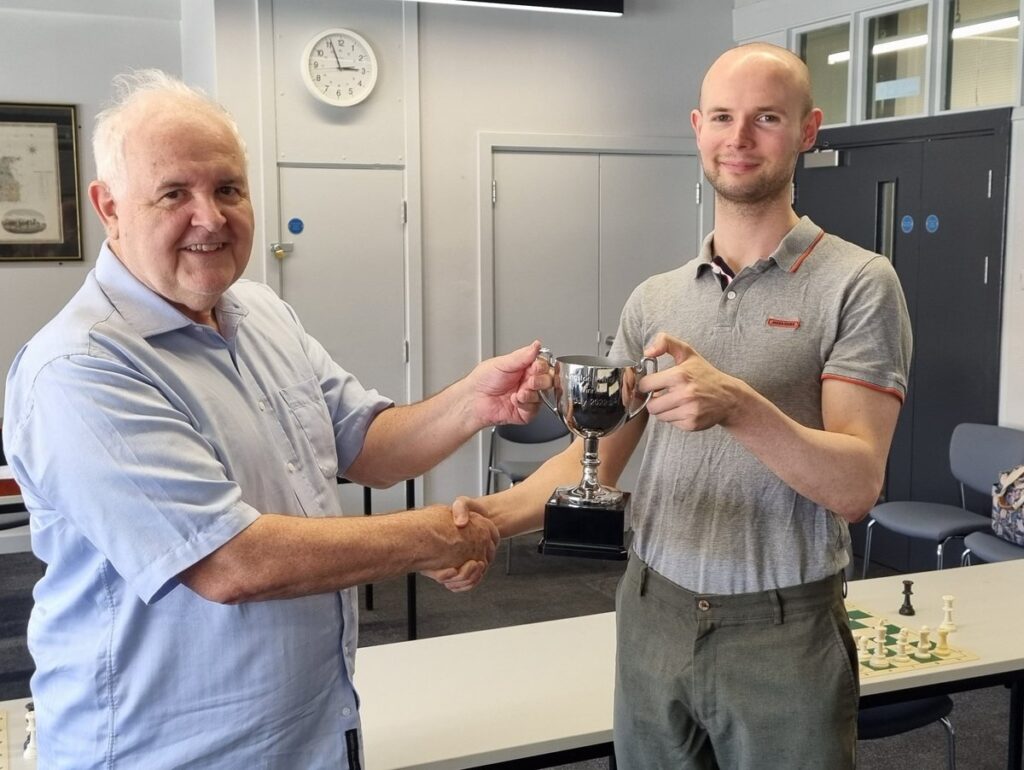
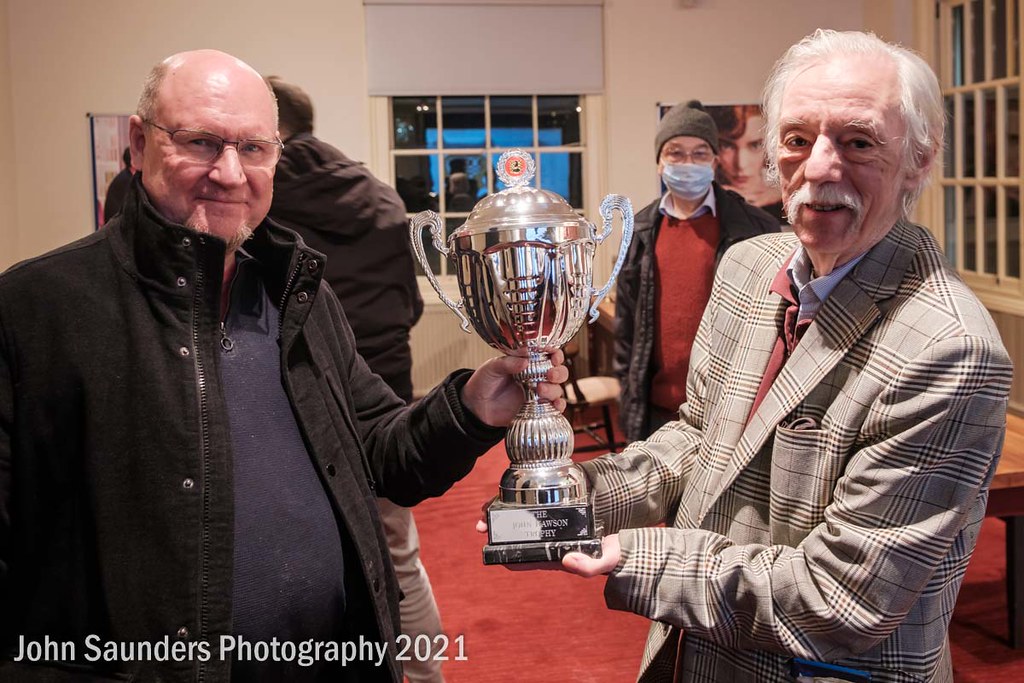
The tournament’s top-rated player, Peter Large (left), receiving the John Hawson Trophy from Kevin Thurlow
The tournament has been founded with the aim of giving Kingston’s leading players some much-needed Fide-rated games and competition with strong players from other clubs. We hope to make the tournament an annual summer event and, if we can, to offer title norms at future tournaments.
This is very much a test event, and we will use what we learn this time to hone future editions. Already, there is a suggestion that we could introduce more groups of 10 of different strengths – borrowing from Wijk aan Zee’s tried-and-trusted model – and we might also look at running a tournament with just one game a day to be played at a longer time control.
But that is all for the future. For the moment, we hope this will be a successful tournament that produces some excellent fighting chess. Akshaya Kalaiyalahan and Zoe Varney will be playing as part of their preparation for the Olympiad in India that begins a few days after our slightly more modest tournament ends. We wish them well in the Olympiad, and hope these games do indeed ready them for the battles to come.
Spectators are welcome to come along to the Willoughby at any time during the tournament, though, in the unlikely event that we are inundated by chess aficionados, the arbiters will use their discretion on the number that can be admitted to the playing room at any one time. The Friday-morning clash between Kingston team-mates Peter Lalić and David Maycock is particularly keenly anticipated, so expect traffic jams in south-west London on that day.
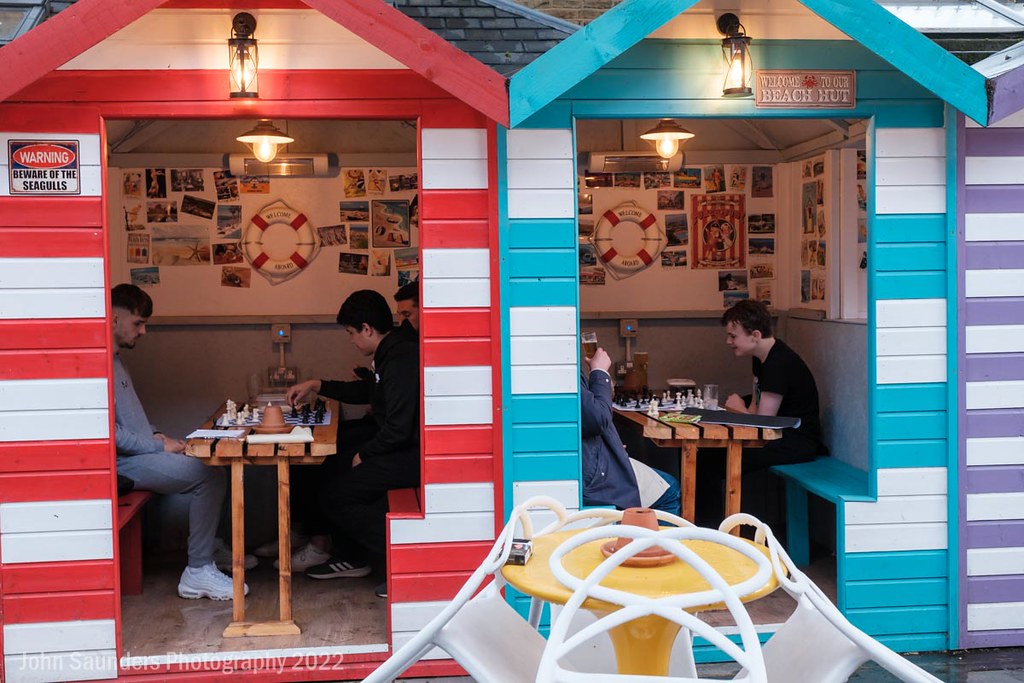
Chess sets will be provided for visitors who would like to play some social chess in the bar or pub garden, which has some very pleasant beach huts in which you can shelter and play chess in the event of rain. Let’s make this a convivial festival of chess.
Stephen Moss
Life’s a beach for players at the Willoughby Arms, home of Kingston Chess and (Virtual) Swimming Club