Category Archives: National

Matches and games from National and Regional competitions involving Kingston players

Kingston are London champions for second year in a row

5th SCCU London Team Rapid Chess Championships played at St Luke’s Church, Hampstead on 27 June 2026

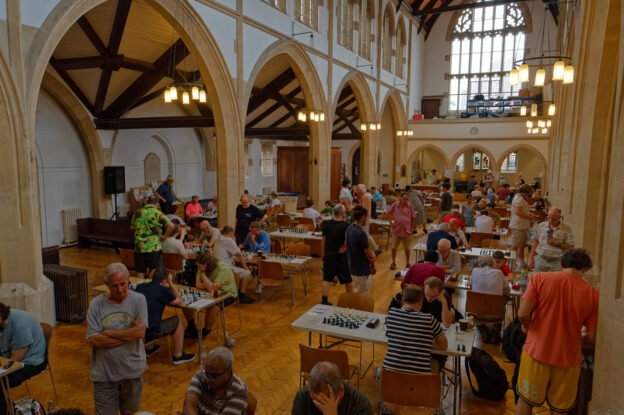
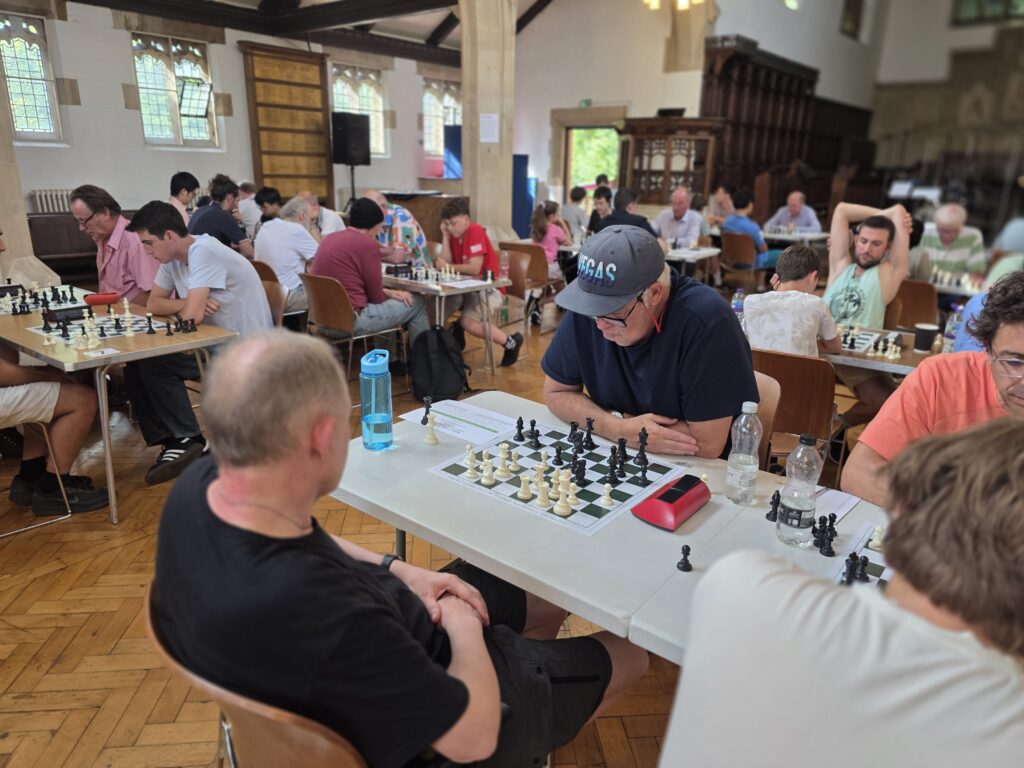
Above: Interior of St Luke’s (photograph: Brendan O’Gorman)

Kingston again won the major prize at this year’s London Team Championships organised by the Southern Counties Chess Association. The Major tournament comprised six rounds for teams of four, constrained to a team average rating of 2100 or less.  

Our team in the Major comprised the new line-up of IM Peter Large, Ash Stewart, John Foley and Martyn Jones. The only member of our previous victorious squad was John, who played one game as a reserve in 2025. We were sporting a slightly diminished team compared to last year’s stars (Supratit Banerjee, Peter Lalić, Vladimir Li, John Bussmann), but Kingston secretary Alan Scrimgour did well to put together two teams, using his calculator for some fine tuning in team selection.

It all came down to the final game of the final round where a player from another team had to find checkmate with a bishop and knight against a king under extreme time pressure. Exciting stuff in the rarefied world of chess.

The rapidplay time control was 25 minutes plus 5 seconds increment per move. Due to late withdrawals only four evenly matched teams competed: in rating order, Streatham & Brixton (hereafter Streatham), Richmond & Twickenham (hereafter Richmond), Kingston, and Barnet Juniors (hereafter Barnet). The event was organised as a double-headed round robin: each team played each other twice, the second time with colours reversed. The first two teams were formidable opponents well known to us from league chess.

Rounds 1 and 2

In the opening double-header, Kingston faced the top-ranked Streatham. We were delighted to dispose of our rivals, winning the first match 3-1 and drawing the back-to-back match 2-2 with no losses. My opponent, Essex player John Hodgson, brother of grandmaster Julian, informed me that we had played each other six times since our first game as schoolboys in 1972, all draws. This was suspiciously detailed information indicating some deep preparation, but fortunately not that deep as we continued our tradition by agreeing to two draws after some cagey play.  

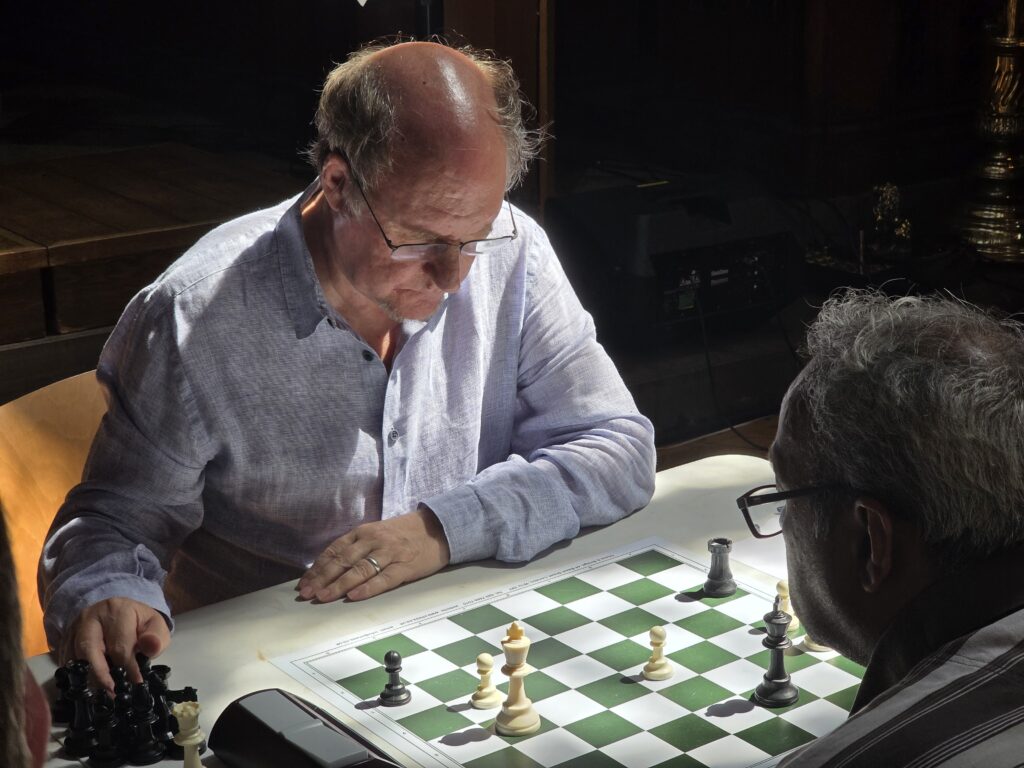
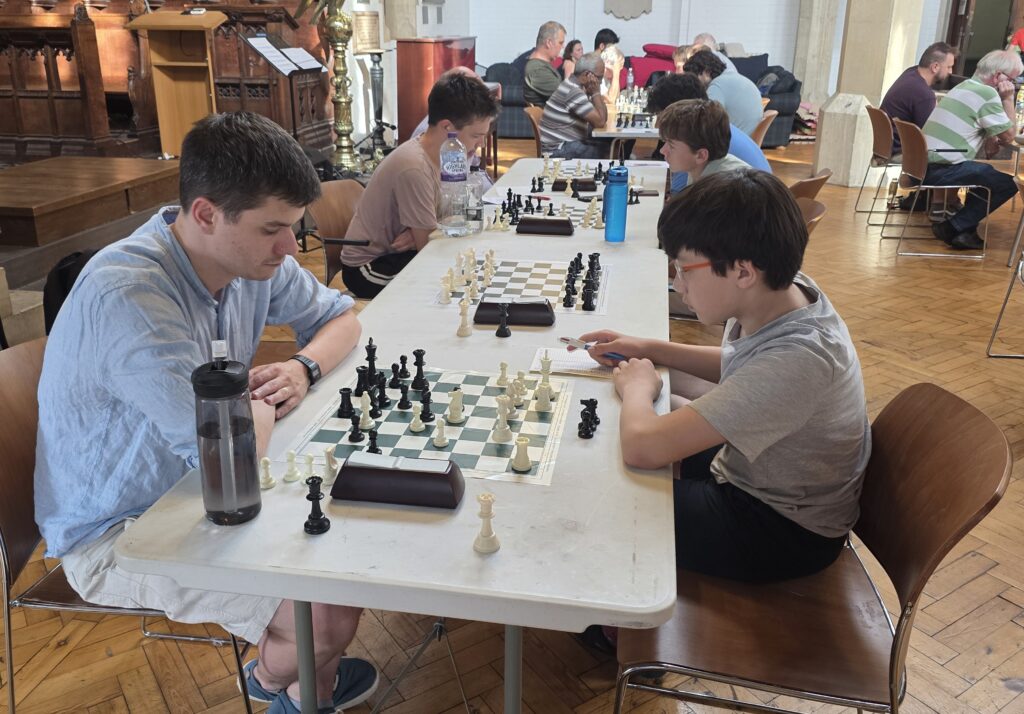
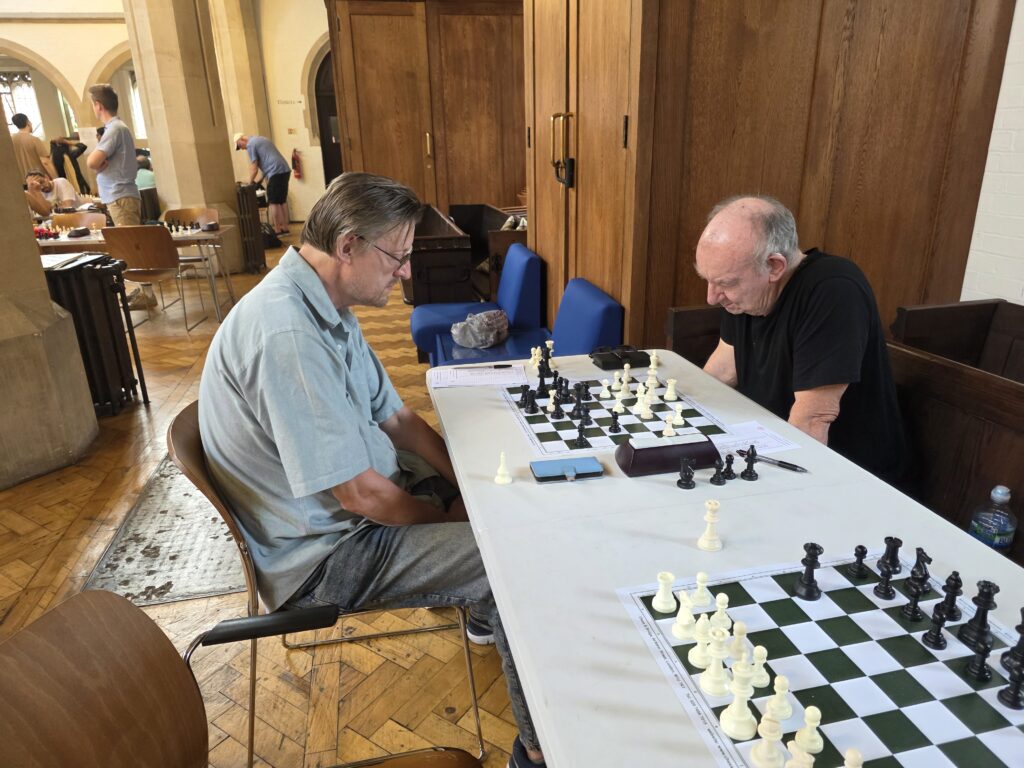
Peter Large against Venkat Tiruchirapalli in Round 1. Photograph: John Foley

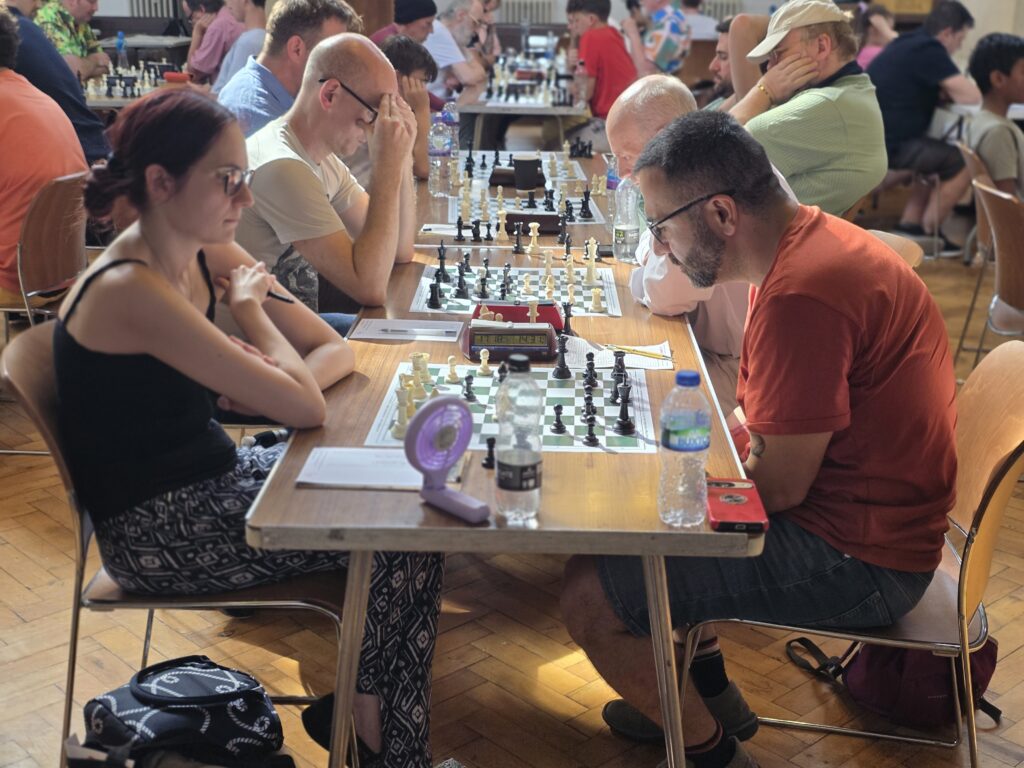
Kingston might have done even better in the second match if Martyn Jones wasn’t such a nice fellow.  His opponent’s phone beeped, which means a loss at this level of chess. The organisers reminded us of this in their introductory speech, but by the time the sound had traversed the airwaves, bouncing off the pillar arcade, to us at the other end of the church beneath the altar, the information was unintelligible – not least because of the dozens of whirring personal fans in the suffocating heat. Martyn allowed the game to continue without objection. As captain on the day, I belatedly advised the team along the lines of No More Mr Nice Guy.  Of course, no phones made a beep thereafter.

Rounds 3 and 4

The next double-header was a derby against Richmond where we fared badly, scoring a 3-1 loss and a 2-2 draw. We fondly remembered Gavin Wall, the Richmond stalwart who sadly passed away a month after last year’s’ tournament from a suspected heart attack. Mike Healey scored twice against Peter Large on top board, which didn’t help Peter’s mood.

In Round 4, Richmond’s Caspar Bates (playing Black) surprised Ash with a piece sacrifice for two pawns. At first, Ash thought it was a mistake and didn’t want to believe that he had overlooked the fork tactic. After some thought, he found the rebuttal shown below. His win enabled Kingston to draw the match.

Rounds 5 and 6

Going into round 5, we knew were were on 50% but, absent the standings, we did not know whether we had any chance of the title. We feared the Barnet Juniors led by Yu Rock (who had a tournament performance rating of 2386, having notched up victories against each of the other top boards) and Lion Lebedev because they were clearly stronger than their ratings. The first of the matches against them was a 2-2 draw, so we were still on 50% – not very propitious for a title contender. 

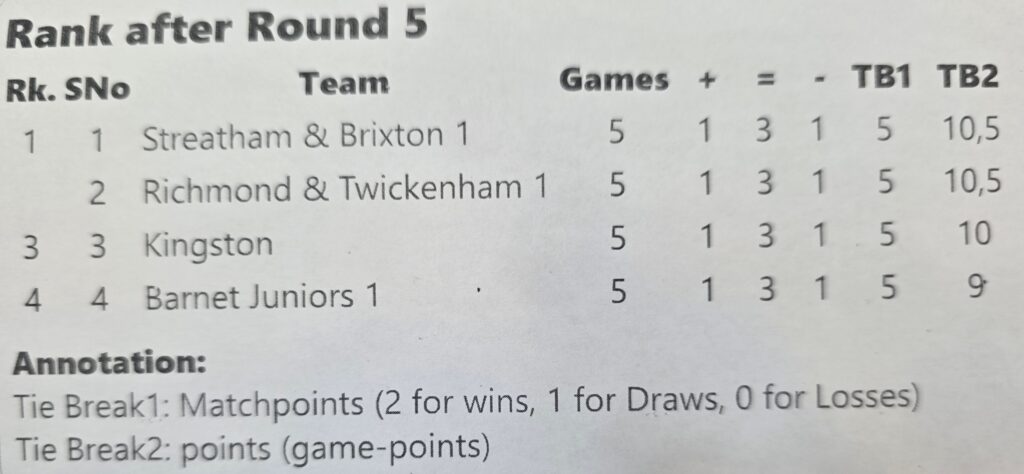
The tournament could not have been closer after five rounds

The current standings (above) were published for the first time just as we went into the last round. Surprisingly, each team was on five match points, having contrived to neutralise each other. Kingston was lying third on tie-break; Streatham and Richmond were half a game point ahead of us and we were one game point ahead of Barnet. We had to win the final match and hope other results went in our favour to have any chance of winning the championship.  

My young opponent had beaten me in round 5 and offered an early draw in the final round, which I declined. I went for a kingside attack and (to my surprise) won quickly.

Martyn Jones winning his fifth point in the final game. Photograph: John Foley

Martyn modestly thought he was fortunate to win in round 5 against the talented Hubert Bates, who then appears to have lost confidence and surrendered in round 6. Kingston were 2-0 up awaiting the results of the top two boards, which both looked drawish. What was happening in the other match?

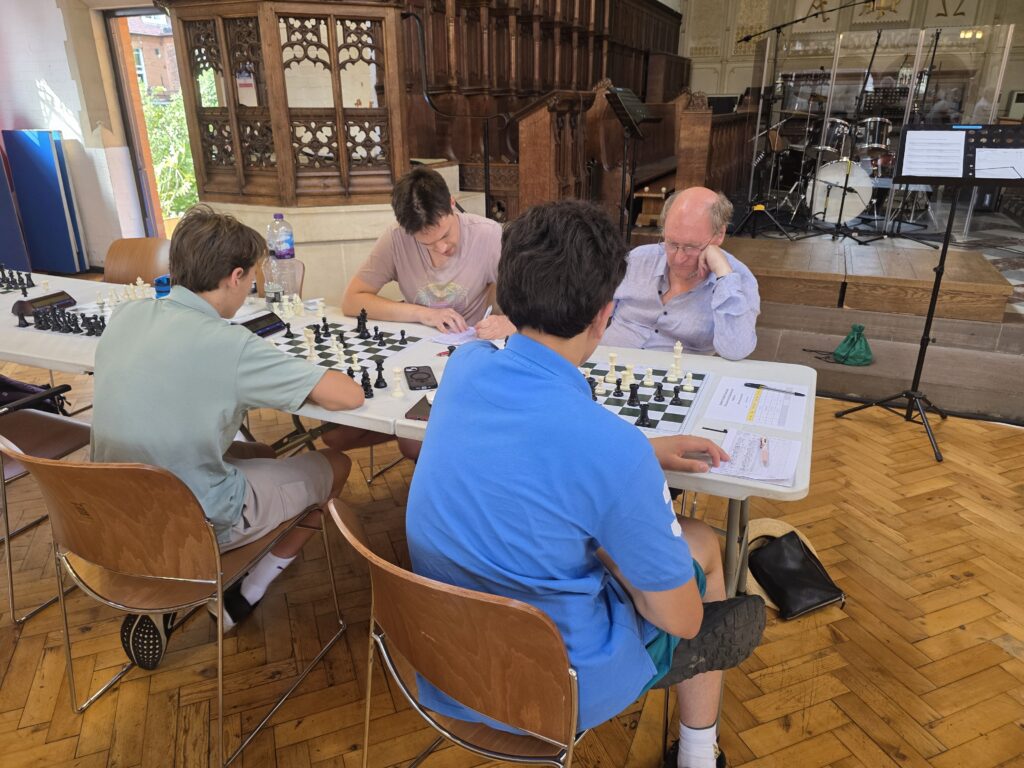
Final two games in round 6, in which Ash Stewart and Peter Large secured draws to guarantee overall victory. Photograph: John Foley

Richmond were 2-1 down against Brixton and relying on Caspar Bates to checkmate Streatham’s Andrew Stone’s king with a knight and bishop in order to draw the match. This is a tricky challenge and not many people know the technique for an endgame which occurs only once every 6,000 games. Extra pressure arises because of the 50-move rule, which allows a player to claim a draw if 50 consecutive moves have passed for both sides without any captures or pawn movements. 

I volunteered to record the move count using tally marks not just because I am a qualified arbiter but also because I was keen that there was a correct move count in such a vital game – vital to Kingston. Impressively, even though both players were on the increment, Caspar managed to deliver checkmate after 23 moves and so their match was drawn. Back at the other table, Peter and Ash brought home draws, so winning our Barnet match.

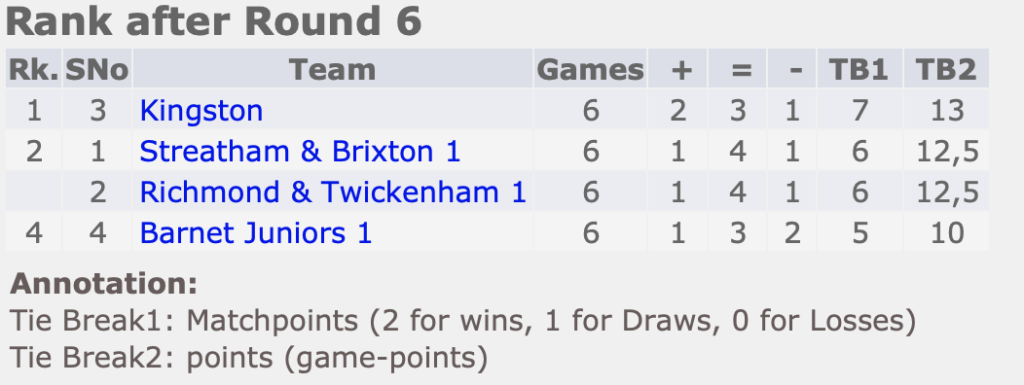
The final result was that we scored seven match points, pipping Streatham and Richmond with six points and a spirited Barnet Juniors team on five points.  The closeness of the result may be better gleaned from the game score – we scored 13 game points compared to 12.5 for each of Streatham and Richmond. We won with an overall game score of just 54%.

Prize-giving

This victory was quite unexpected given the closeness of the teams going into the final round. Peter Large felt it was somewhat undeserved from his point of view.  A man of high chess standards, he decided to depart before the award presentation. Martyn Jones also had to leave as he is soon to be a father.

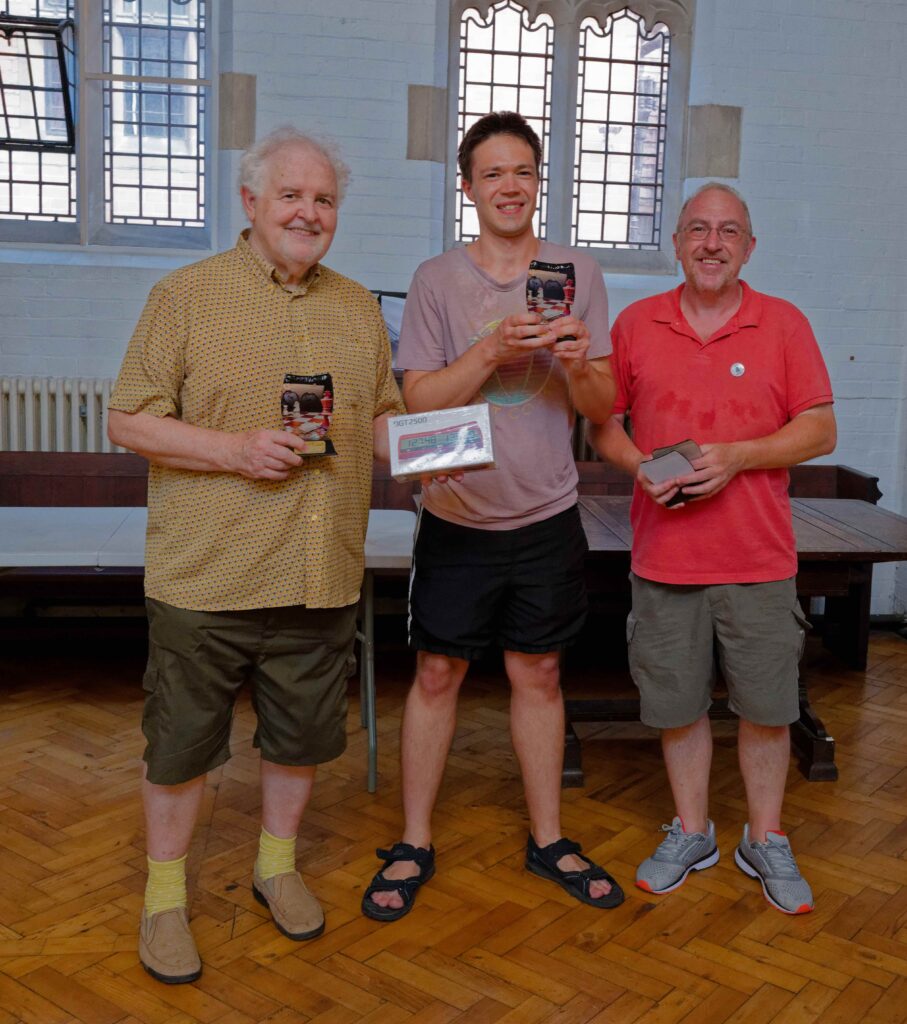
The remaining winning team members, John Foley and Ash Stewart, presented with shields by SCCU president David Lettington (right). Photograph: Brendan O’Gorman

Each winning team member received a shield. Martyn had also won the trophy for the best overall performance in the Major sector, having scored 5/6.  The contribution of Ash Stewart on 4½/6 meant that, between them, our boards 4 and 2 scored 73% of Kingston’s points. Congratulations to them for their stellar performances.

Our second team, comprising Jon Eckert, Constantin Liesch, Stephen Moss and Aytek Koyun, played in the Intermediate section. They outperformed their starting rank by rising up two places to 10th out of 12.  Particular mention to the plus scorers – Aytek with 4/6 and Stephen with 3/5.

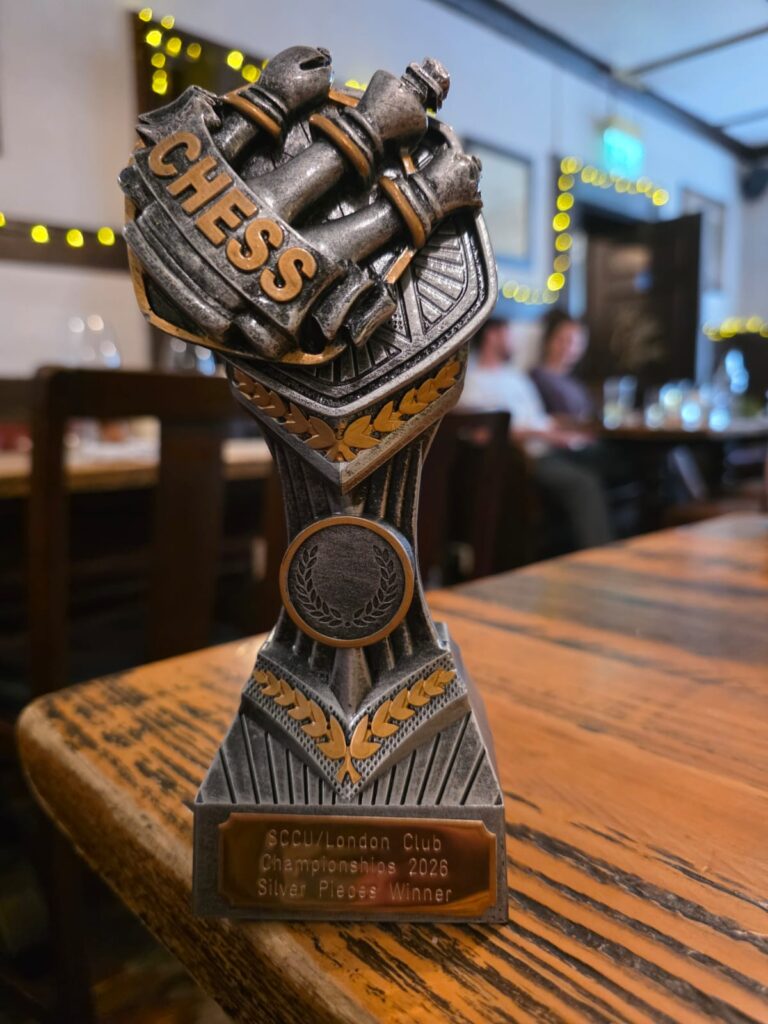
The Silver Piece trophy won by Martyn Jones. Photograph: John Foley

Aftermath

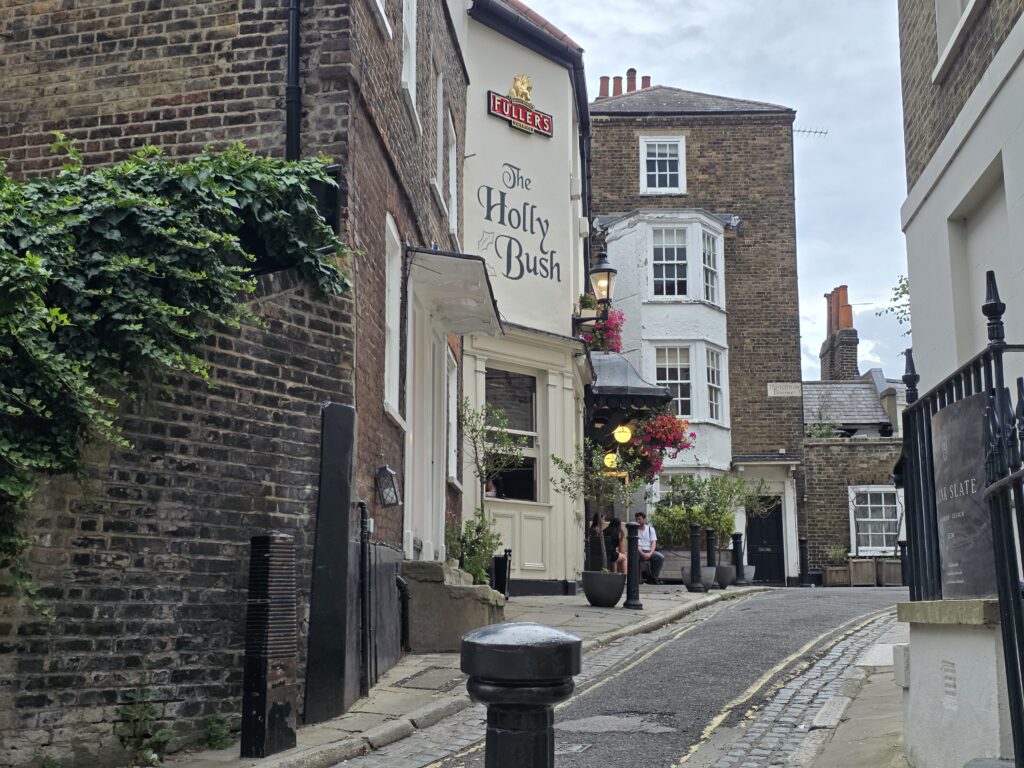
After the prize ceremony, Ash, Stephen Moss and myself decamped to the charming Holly Bush pub in Hampstead where we made good our dehydration. The club plan is to visit all the pubs in Hampstead one by one each year. Stephen was a member of our second team team and was muttering something about his one defeat being a loss on time in what he insisted was a “totally won” position, an all-too-common refrain.

The Holly Bush pub. Photograph: John Foley

And also

Familiar Kingstonian faces at the event who were not playing for Kingston included Genc Tasbasi, Ed Mospan, Tom Mayers, Mike Healey, Robin Haldane, Tony Hughes, Maks Gajowniczek, Graham Keane and Marcus Baker. We are grateful to tournament controller Adam Raoof and organiser David Gilbert (who declared this his final outing as championship organiser after suffering a heart attack in the summer).

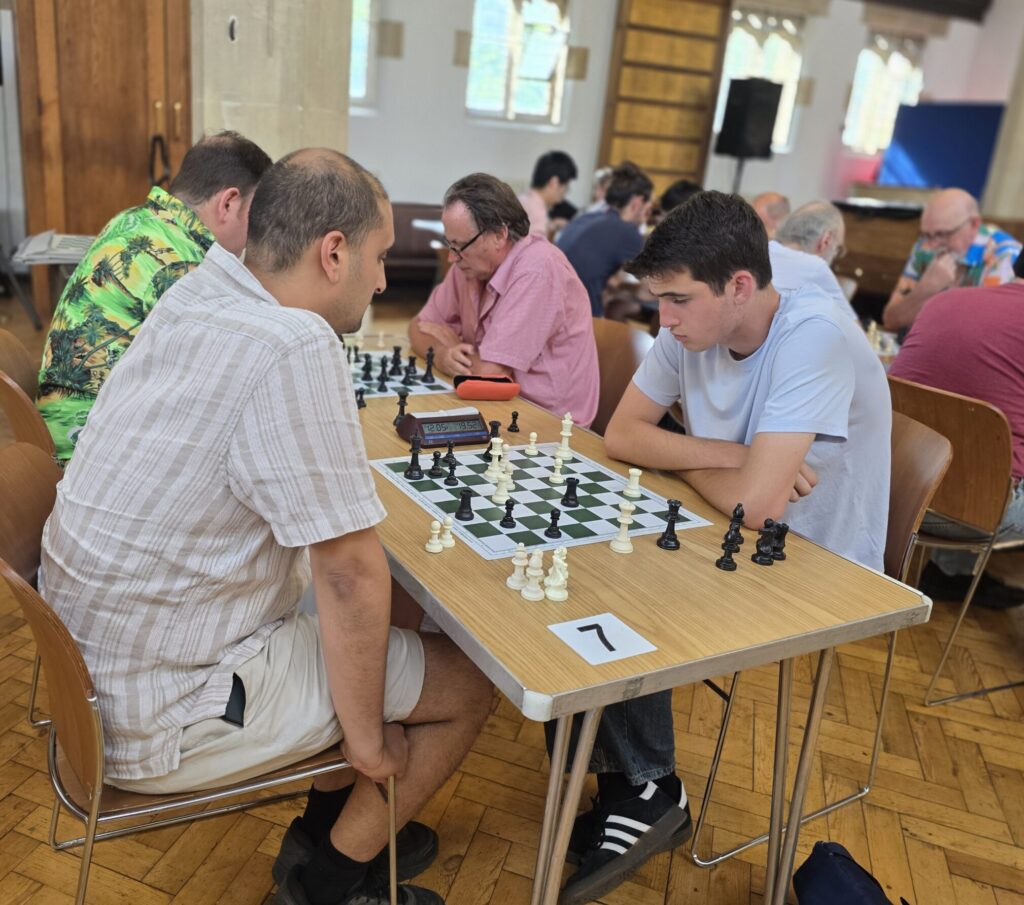
Top left: Genc Tasbasi; middle: Stephen Moss; right: Ed Mospan; bottom: Constantin Liesch (front right) and Jon Eckert (in pink shirt). Photographs: John Foley

Epic final weekend leaves CSC/Kingston riding high

The climax of the 4NCL season saw our first team soar to second place in division 1, while our second team were at last promoted from division 3

Photograph above of the CSC/Kingston 1 team which played on Saturday and Sunday (from left): Vladyslav Larkin, David Maycock, Roland Bezuidenhout, Jakub Kosakowksi, Ameet Ghasi, Harry Grieve, Zain Patel, Liwia Jarocka

The final weekend of the 2025/26 4NCL season – the long early May bank holiday weekend – saw CSC/Kingston 1 playing in Daventry and the squad’s second and third teams in Coventry. Each faced three tough matches over three days, and the results could hardly have been better.

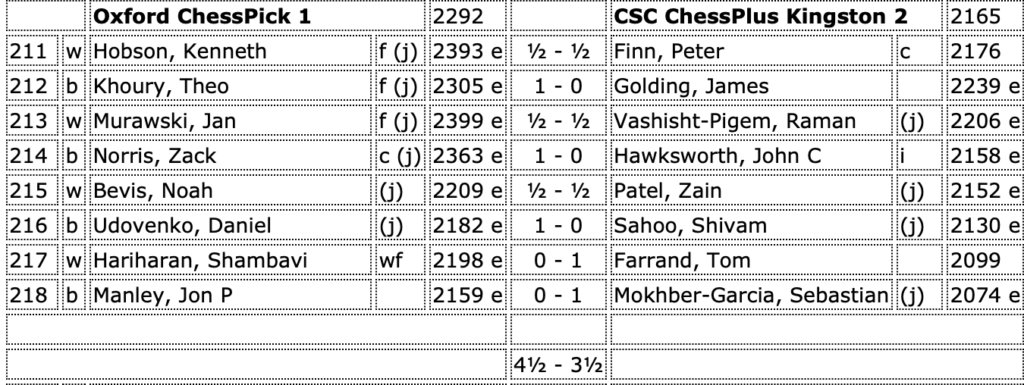
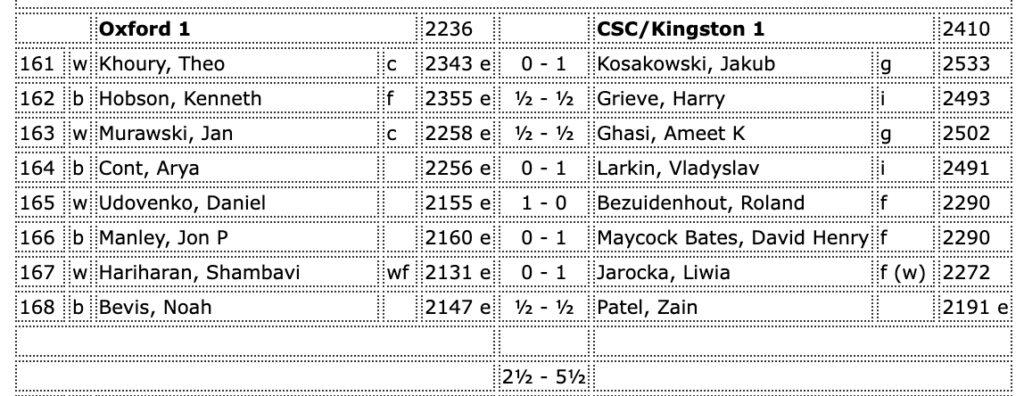
The first team began on Saturday with a match against Oxford 1, who had some very talented young players. CSC/Kingston had a rating advantage, but it was far from one-way traffic. Oxford juniors Kenneth Hobson and Jan Murawski got draws with IM Harry Grieve and GM Ameet Ghasi respectively and Daniel Udovenko overturned FM Roland Bezuidenhout in a tricky rook endgame on board 5. But the extra firepower of the CSC/Kingston team eventually told, and we ran out winners by 5.5-2.5.

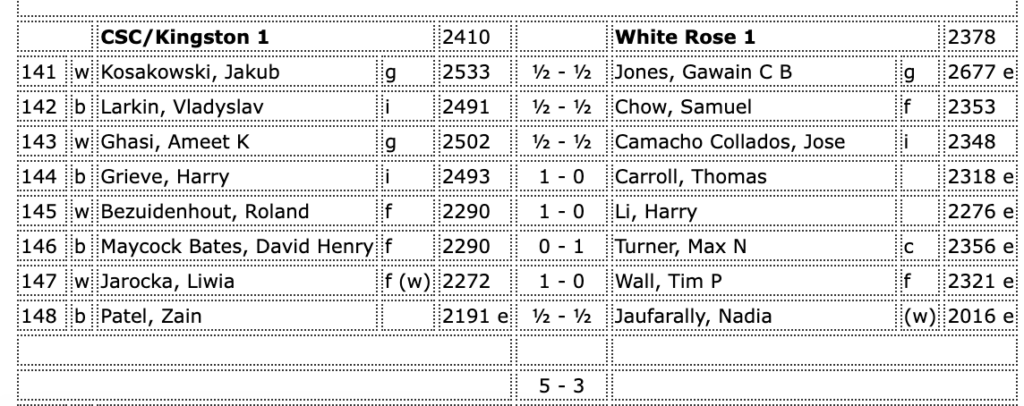
The team had another success on Sunday, beating a strong White Rose 1 team 5-3. CSC/Kingston’s Polish GM Jakub Kosakowski held the 2677-rated GM Gawain Jones to a draw on top board, and victories by Harry Grieve, Roland Bezuidenhout and Liwia Jarocka sealed an impressive victory, which guaranteed CSC/Kingston 1 would have a high placing in the final table.

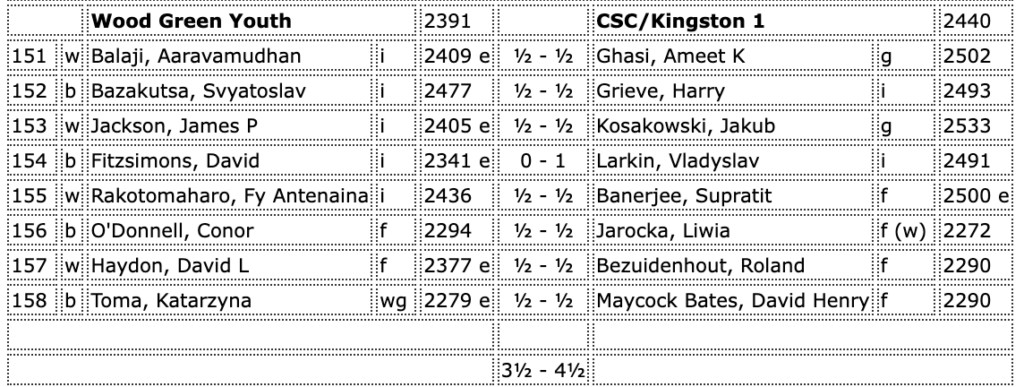
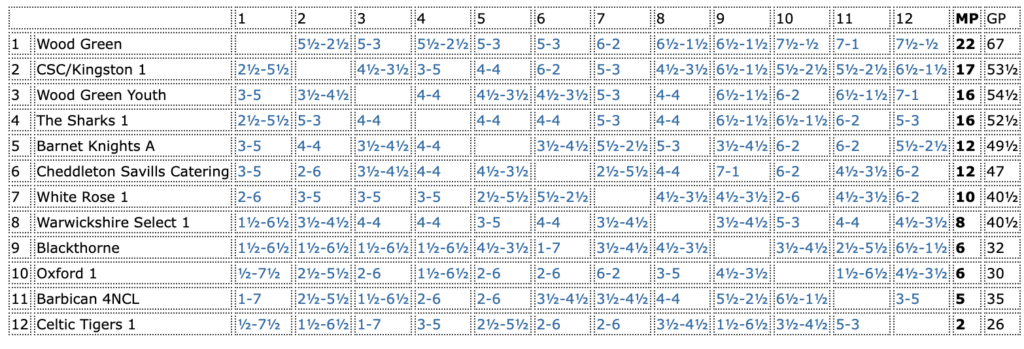
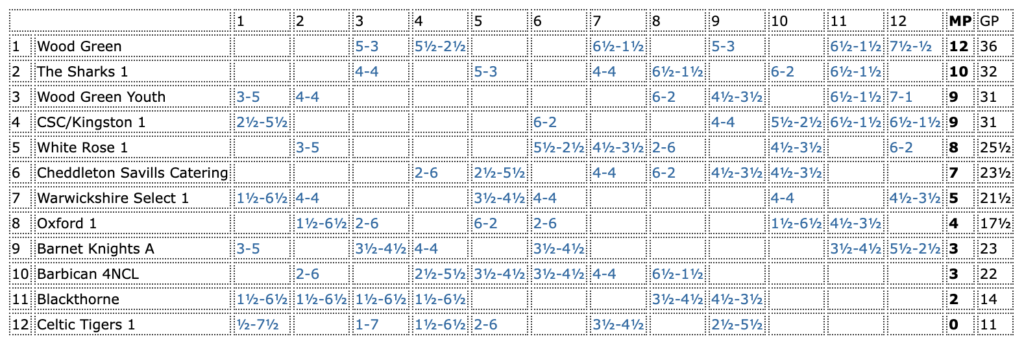
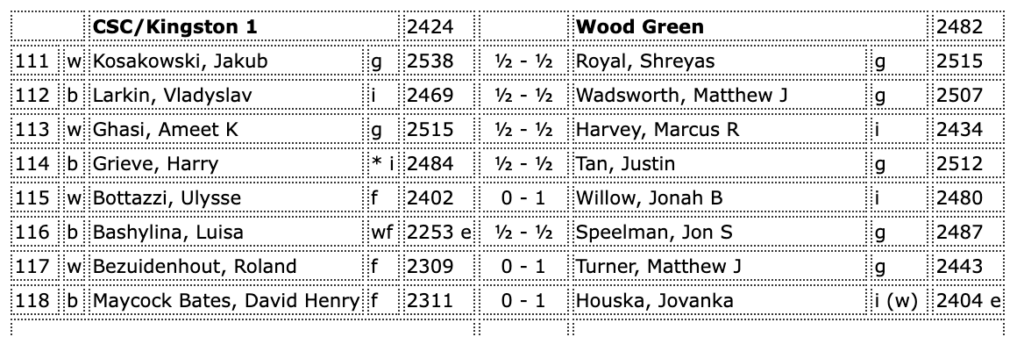
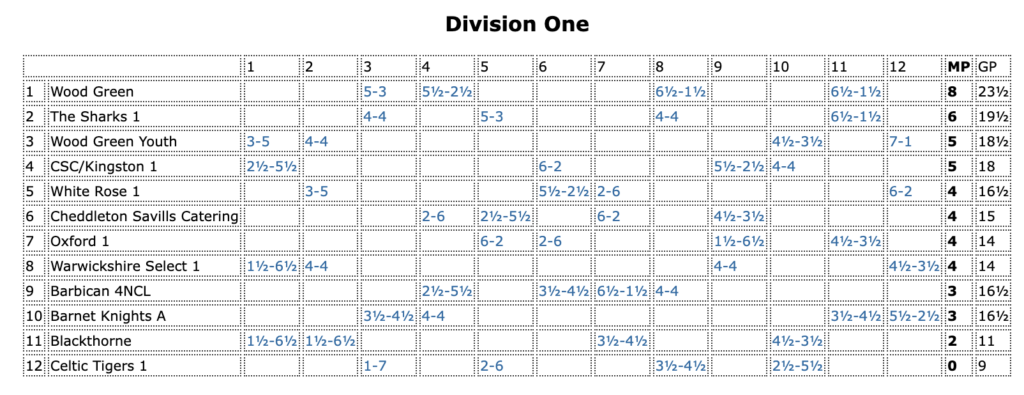
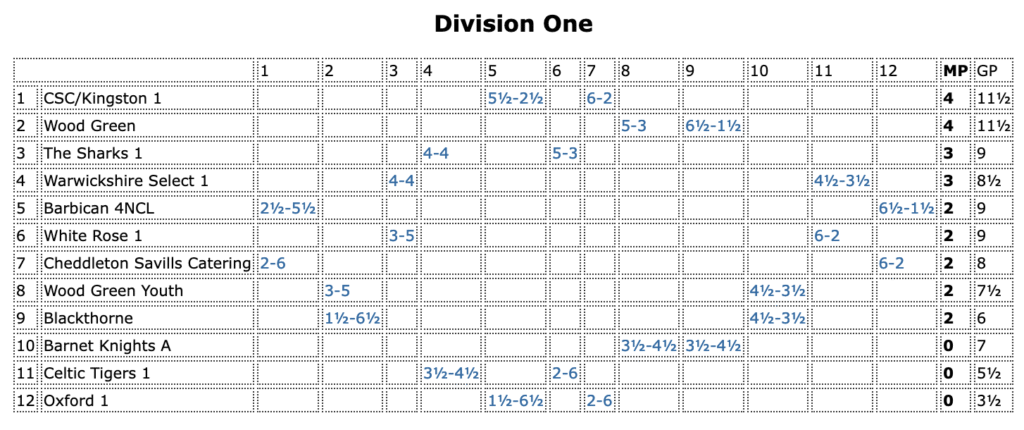
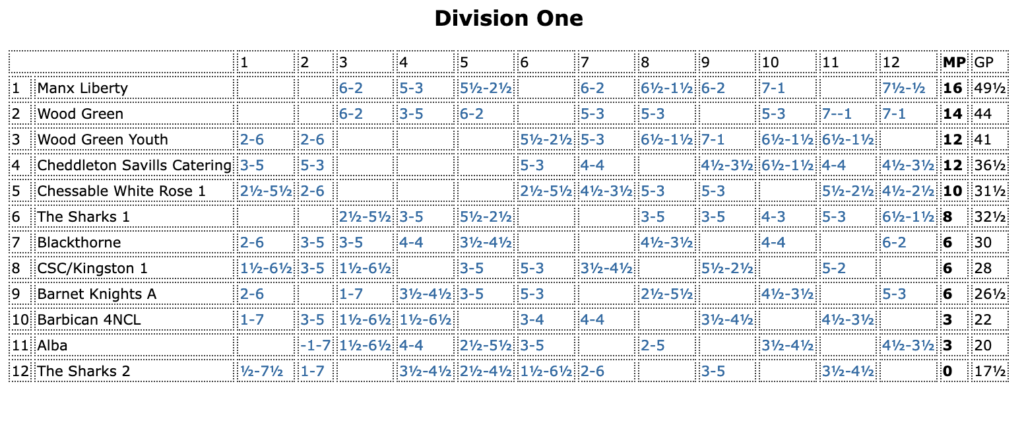
Just how high was not clear until Bank Holiday Monday, when victory in the crunch match against the powerful Wood Green Youth and the fact that high-flying Sharks 1 could only draw with Cheddleton allowed CSC/Kingston 1 to leapfrog both into second place in the table. It was admittedly a fairly distant second place – the senior Wood Green team, who brought in super-GM Michael Adams for the final weekend, won all 11 of its matches across the season and took the title at a canter – but it still represented a tremendous achievement in only our second season in the top flight.

There were seven draws in the CSC/Kingston v Wood Green Youth match (including one on board 5 for Supratit Banerjee, who had come in from a training camp in Munich especially to play), but a smooth win by Ukrainian IM Vladyslav Larkin on board 4 against Irish IM David Fitzsimons sealed the match and second place in the table for CSC/Kingston. A wonderful end to an unforgettable season in which our talented young team performed heroically.

Final Division 1 table

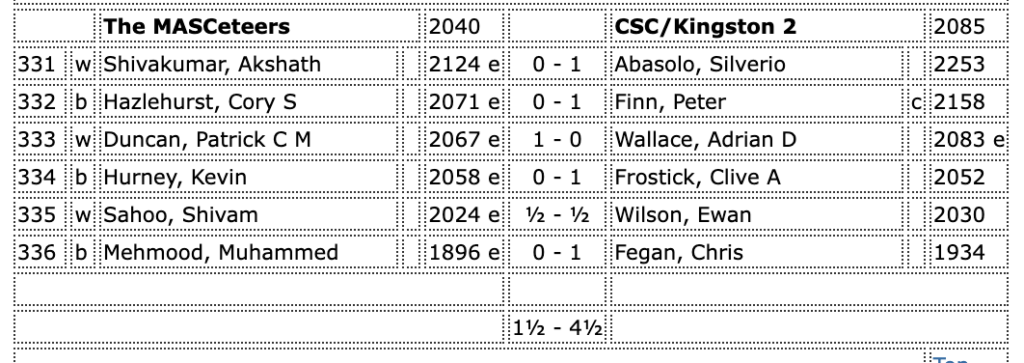
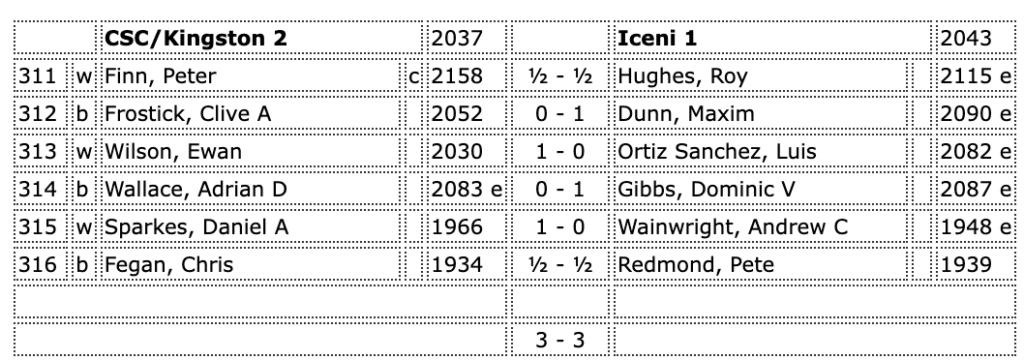
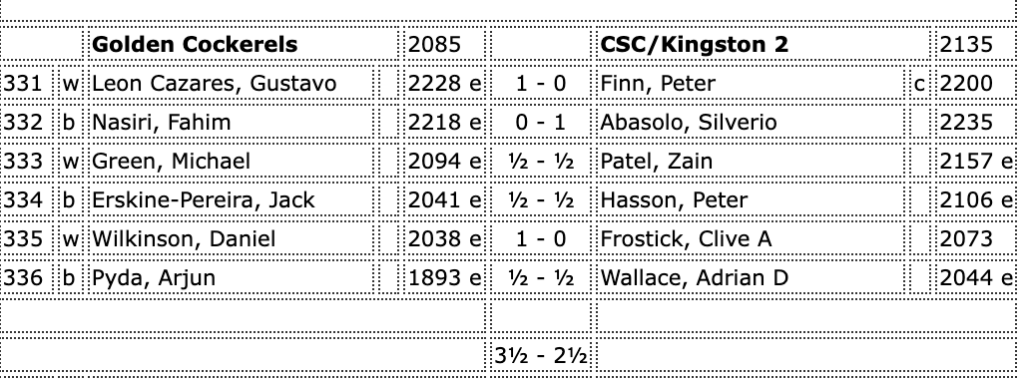
The CSC/Kingston second team has been knocking on the door of promotion from division 3 for several seasons, and finally achieved it with two victories on Saturday and Sunday and a heart-stopping draw on Monday. The first two matches were won fairly comfortably, with Silverio Abasolo, Peter Finn and Clive Frostick all scoring 2/2, but the final game against Iceni (with Silverio unavailable) was very tough.

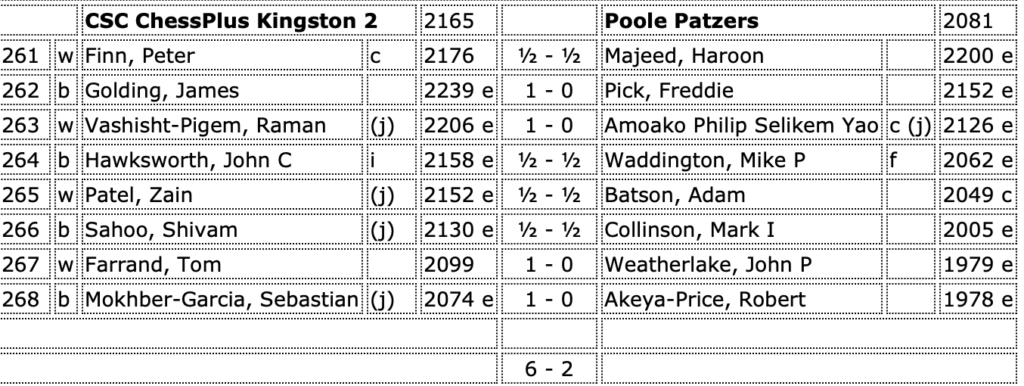
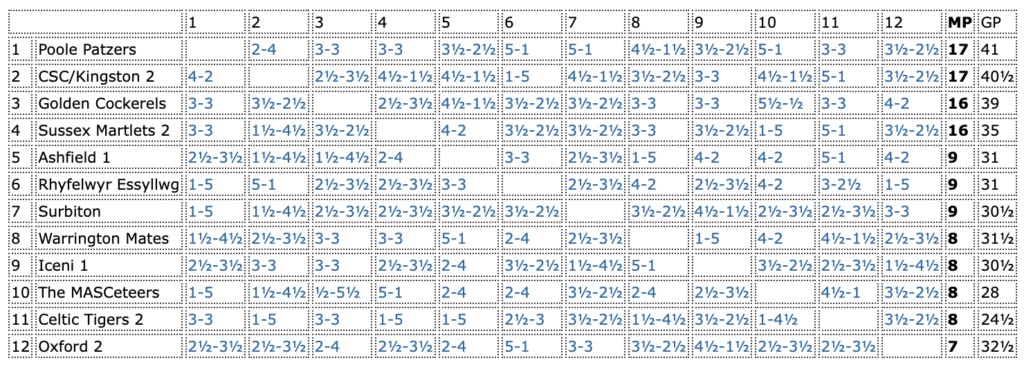
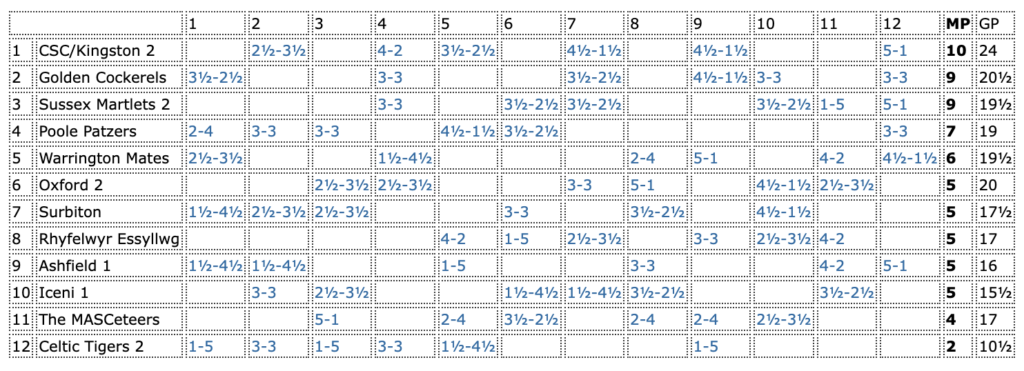
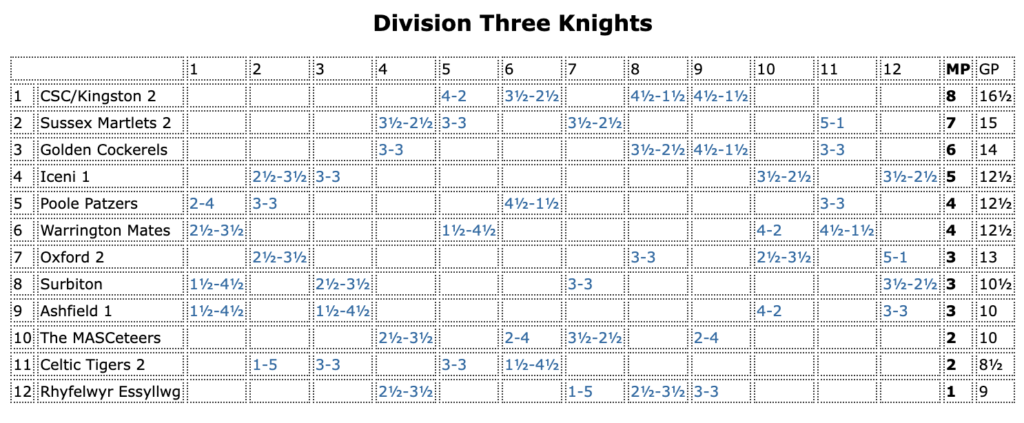
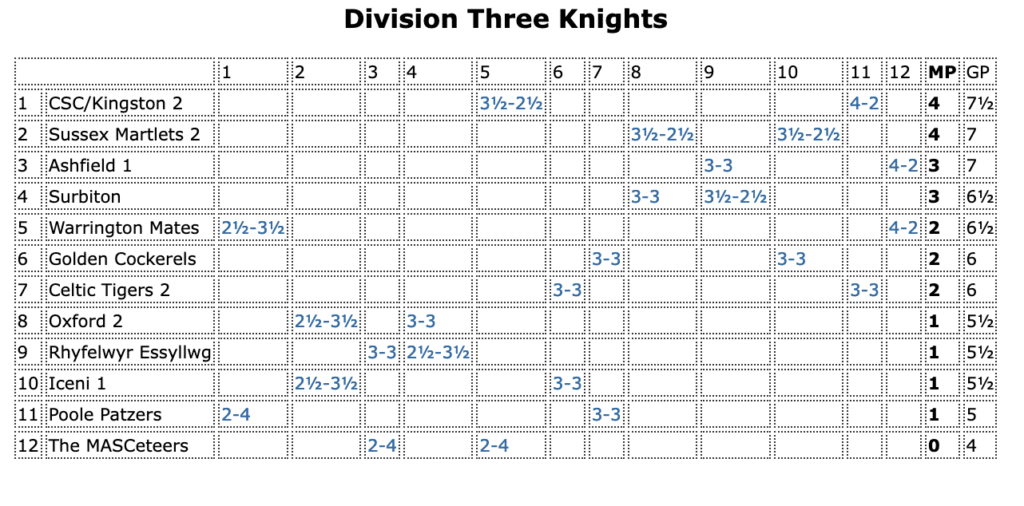
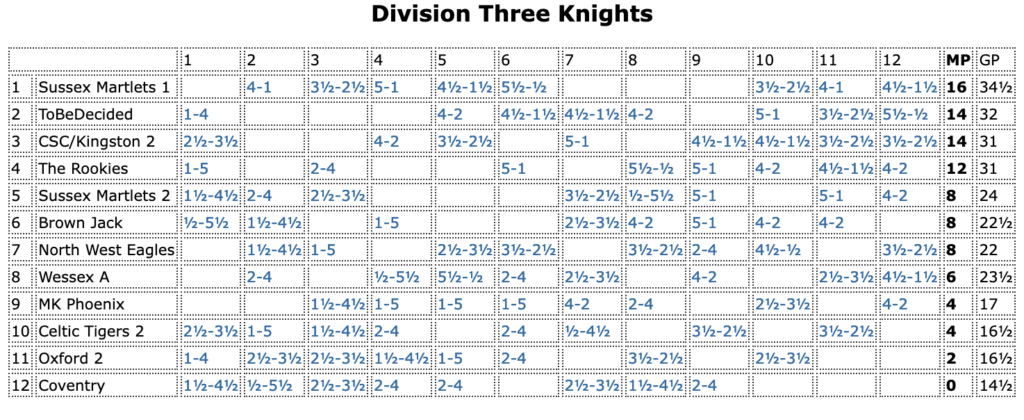
Iceni slightly outrated the CSC/Kingston 2 team, so a draw in the match was a good result. But would it be enough? At one point it looked as if the highly rated Golden Cockerels would pip us at the post, but in the end they could only draw their match with Warrington Mates, and Peter Finn’s draw against Iceni on board 1 was enough to get us over the line. Indeed, we were in the end only pipped to the Division 3 (Knights) title by Poole Patzers by half a game point. Two teams go up from this division 3 pool, and that was always the principal objective. We will now have both the first and second teams at the same venue next season, which we hope will make team planning and transport arrangements simpler.

Final Division 3 (Knights) table

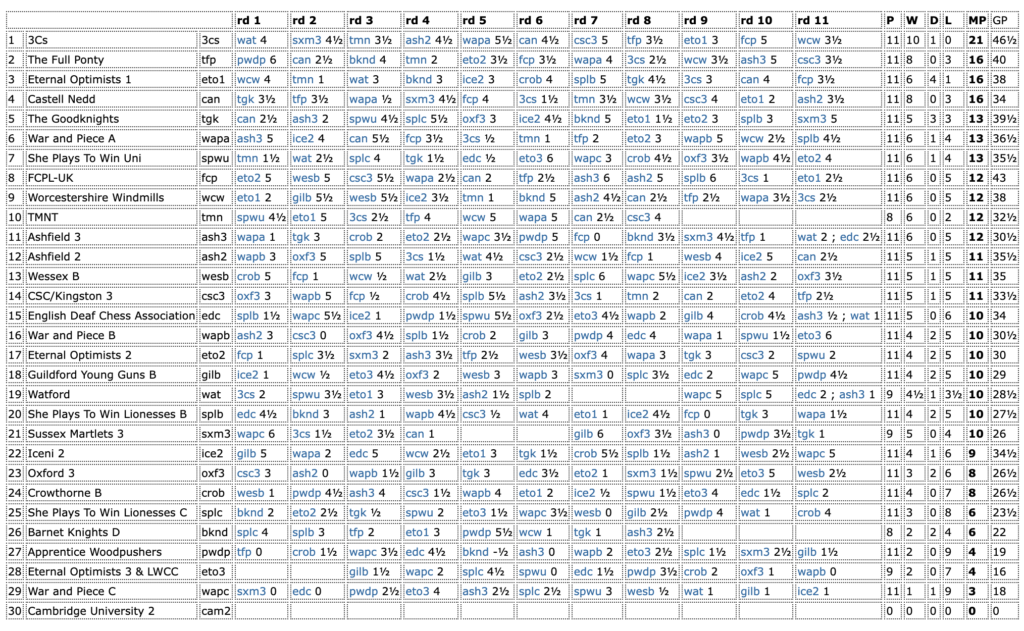
The third team contains players with a wide spread of strengths and promotion was never likely against some strong outfits in a competition which operates as a 30-team Swiss. The Swiss system means that a win one day tends to pit you against a strong team the next, and vice versa.

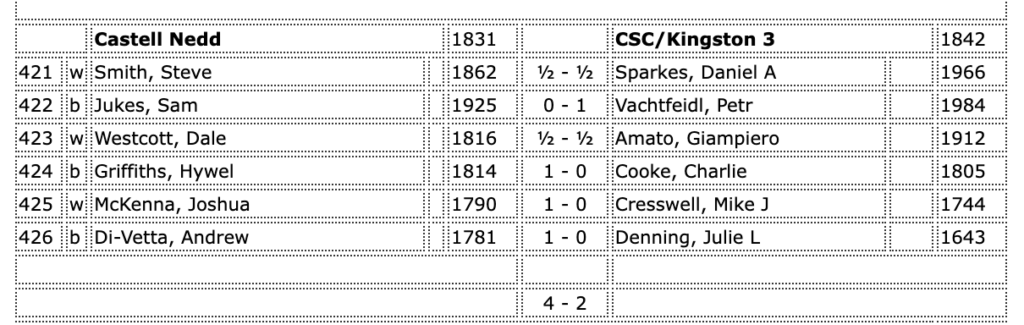
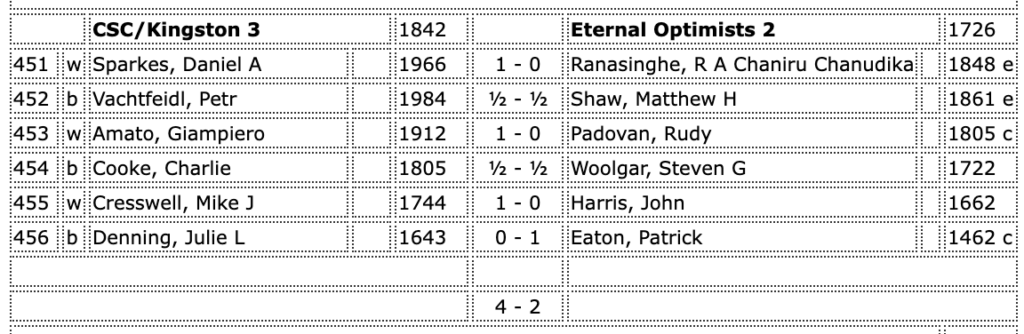
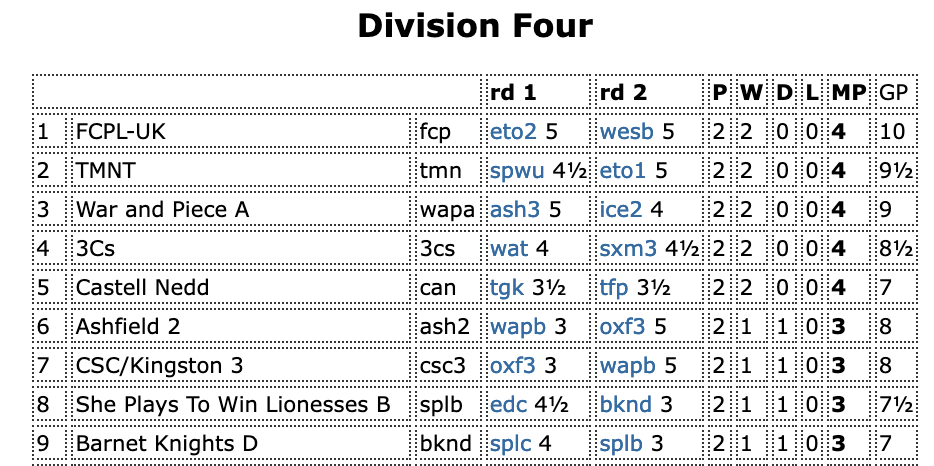
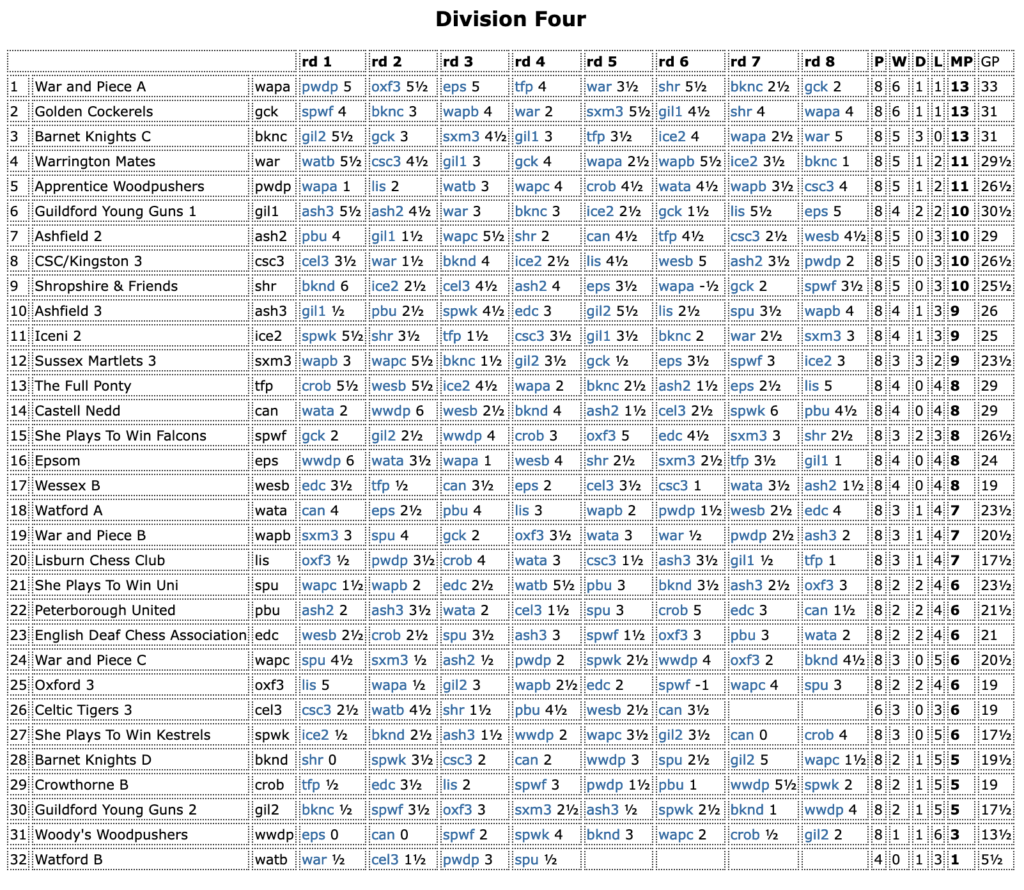
All three of CSC/Kingston 3’s matches went according to rating: a 4-2 loss on Saturday against the strong Castell Nedd, one of the four teams ultimately promoted from the division, was followed by a win on Sunday by the same score against the outrated (and perhaps aptly named) Eternal Optimists.

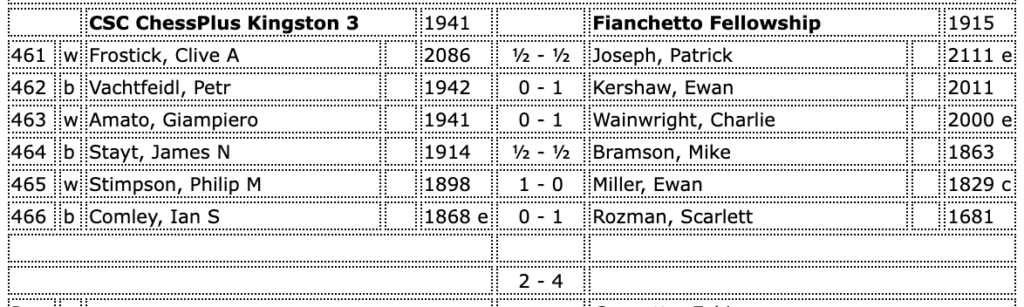
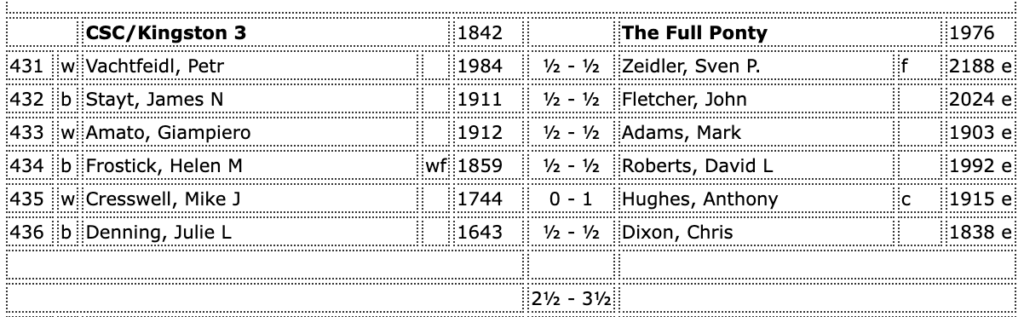
Monday saw a match-up with The Full Ponty, who ended up in second place in the division and were also promoted. CSC/Kingston 3 fought admirably and five of the games were drawn (special mention to Petr Vachtfeidl for holding the highly rated Sven Zeidler on board 1), but Tony Hughes got the better of Mike Cresswell on board 5 after a tough struggle and The Full Ponty (excellent name for this Welsh side!) were home. Congratulations to them. That left CSC/Kingston 3 in mid-table after a season in which they won five matches, lost five matches and drew one – a very satisfactory all-round performance.

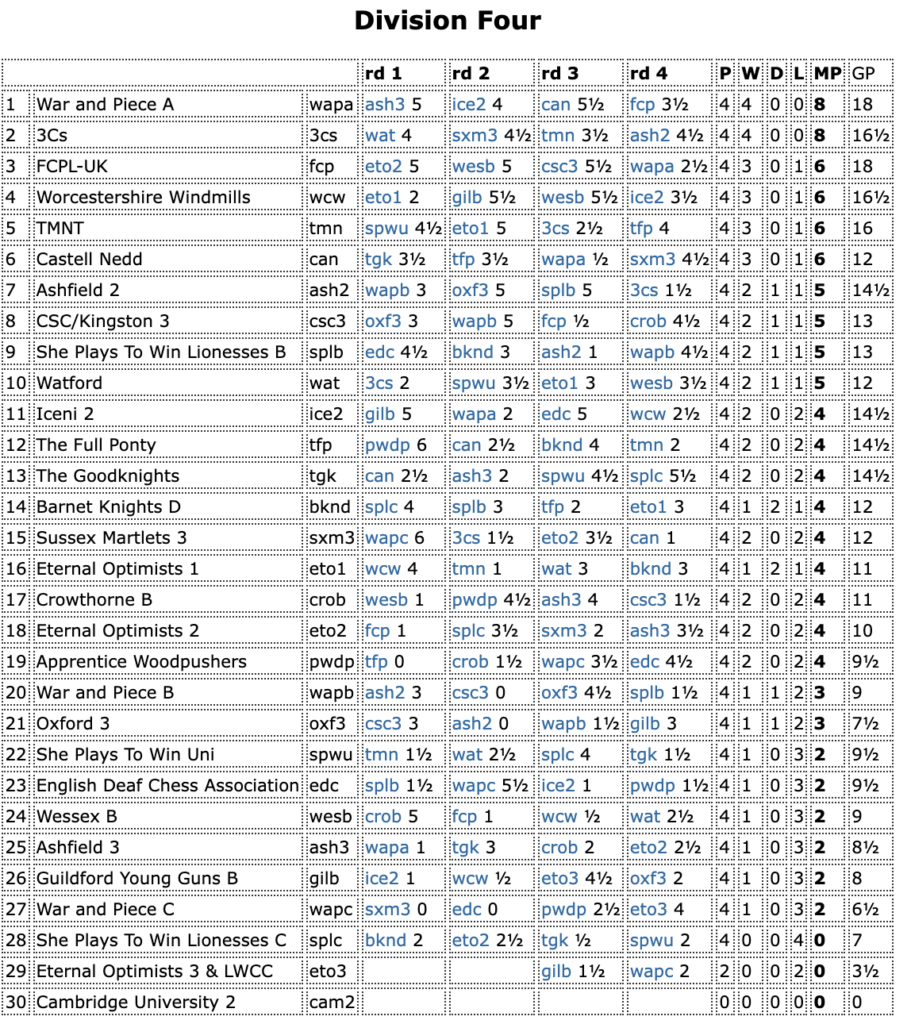
Final Division 4 table

Ameet Ghasi (left) and Liwia Jarocka play Saturday-night blitz in the bar – always important for team bonding at 4NCL

Shortly after the final 4NCL weekend, we received the welcome news that IM Harry Grieve, a mainstay of CSC/Kingston 1 this season, had achieved his final IM norm at a tournament in Budapest and was now a grandmaster-elect. Hopefully next season, GM Grieve will be turning out for CSC/Kingston. Vladyslav Larkin also reached the magic 2500 rating mark in the June Fide list, and is now just one norm away from also becoming a grandmaster. This young team is truly coming of age.

We also had the less happy, but not entirely unexpected, news that Kate Cooke was stepping down from the captaincy of the CSC/Kingston squad after an immensely distinguished and hard-working 12 years in charge. We thank Kate and her husband Charlie for all their selfless dedication to the cause over the past decade and more. Kingston president John Foley, a very good player as well as being a leading chess educationist, has kindly agreed to take up the mantle and assume the captaincy of CSC/Kingston. Kate and Charlie will be a very hard act to follow, but we will press on in the hope of even better things to come.

Stephen Moss is Kingston club captain

CSC/Kingston 1 bitten by dangerous Sharks

The three CSC/Kingston teams experienced mixed fortunes in the fourth round of 4NCL matches, played in Coventry and Daventry on the weekend of 21/22 March

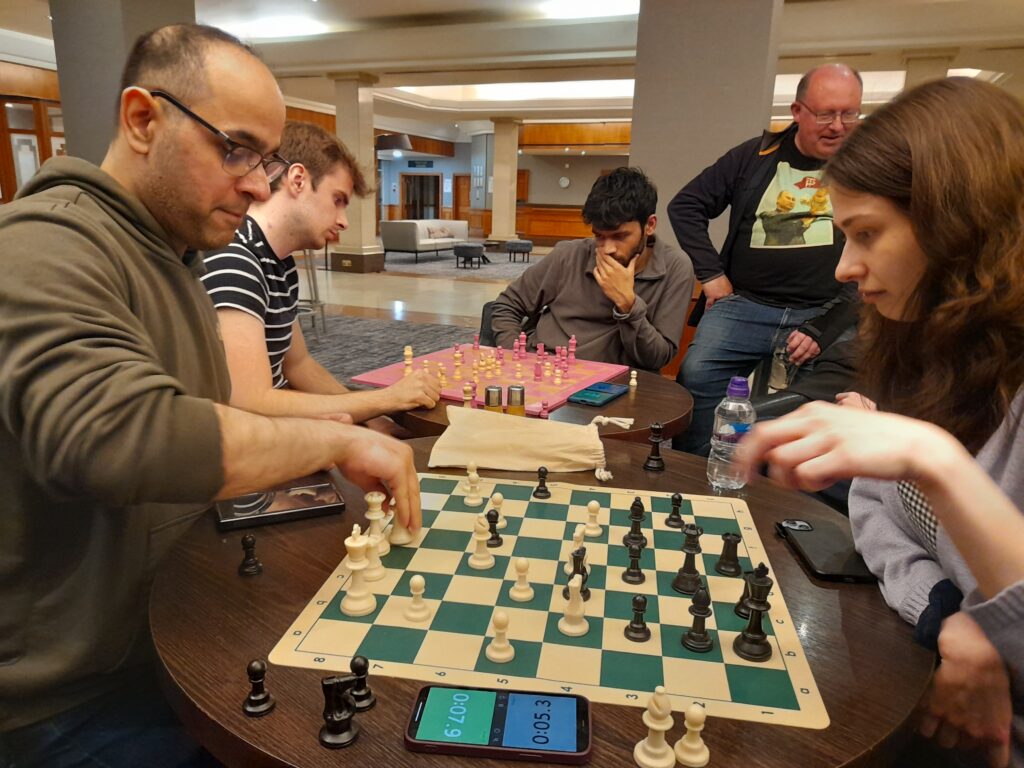
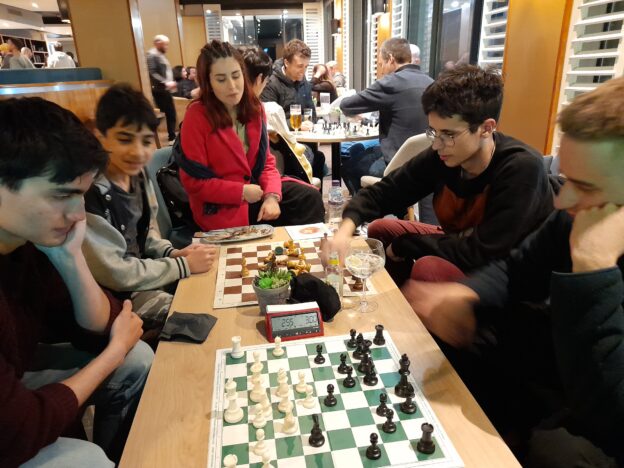
The photograph above shows members of CSC/Kingston 1 playing blitz on Saturday evening after the victory over Warwickshire Select. Jacob Templen Grave (left) and Vlad Larkin are in the foreground, with Luisa Bashylina watching on

Weekend 4 of 4NCL, played at two separate venues in Coventry and Daventry on 21/22 March, proved to be tough for CSC/Kingston’s three teams, all of which were flying high in their respective divisions. The teams are still well placed after the struggles of the weekend, but it was a salutary lesson in how challenging 4NCL can be.

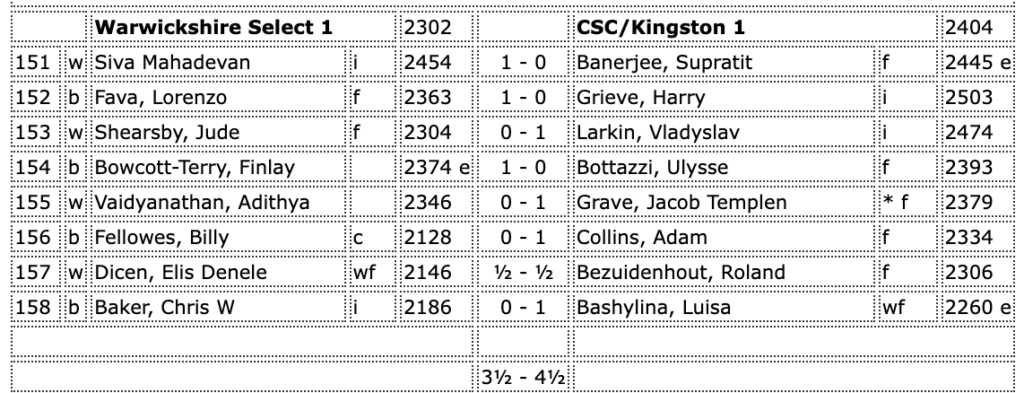
On Saturday, Kingston 1 squeezed past a very competitive and youthful Warwickshire Select team. Supratit Banerjee, playing on board 1 for CSC/Kingston to give him the strongest possible opponent, fought hard against Indian IM Siva Mahadevan, but Siva played what one observer described as a “gem of a game” and prevailed with a blistering attack.

Warwickshire’s Lorenzo Fava had a memorable win against IM (soon, we hope, to be GM) Harry Grieve with Black on board 2, and Finlay Terry-Bowcott did the same against FM Ulysse Bottazzi on board 4. But IM Vlad Larkin started the ball rolling for CSC/Kingston with a win on board 3, and our players proved almost irresistible on the lower boards. Wins for Jacob Templen Grave, Adam Collins and Luisa Bashylina, and a draw for Roland Bezuidenhout, took us over the line by 4.5-3.5. Warwickshire were outrated by 100 points a board, so should be congratulated on their performance.

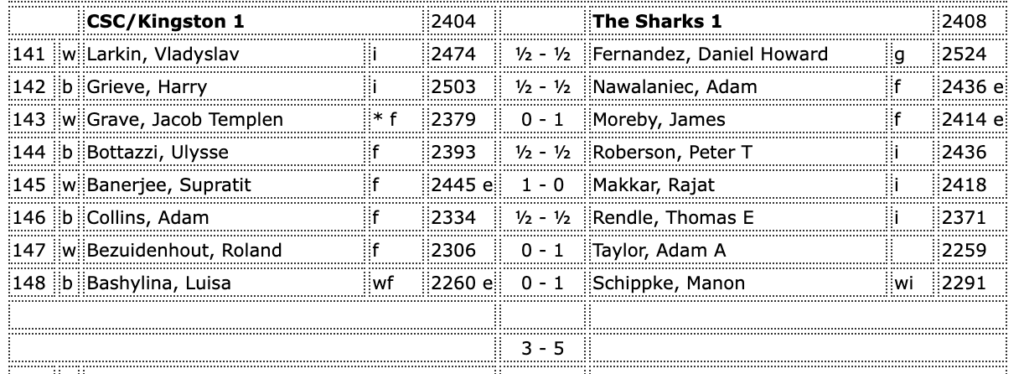
On Sunday, we were up against a highly motivated Sharks 1 team. They brought in GM Daniel Fernandez especially to play against us, and just had a touch too much firepower and nous, running out 5-3 winners. The high spot for CSC/Kingston was Supratit’s terrific victory over IM Rajat Makkar, but there were plenty of other strong performances, notably Ulysse’s draw with IM Peter Roberson and Adam’s draw against IM Tom Rendle – both the CSC/Kingston players had Black. Vlad Larkin drew with Dan Fernandez in a game in which both had chances of winning at different times before peace was declared.

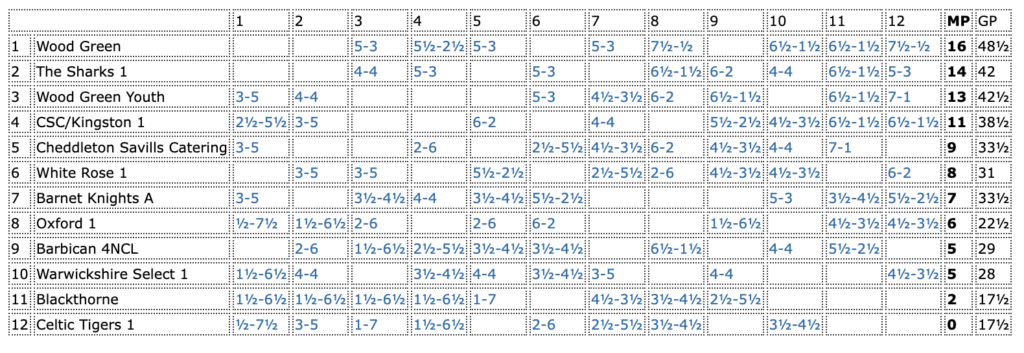
The win on Saturday and loss on Sunday left CSC/Kingston 1 fourth in the table – a very satisfactory position after last season’s early struggles and one we hope to maintain at the final three-round weekend on 2-4 May, when the first team will again be playing in Daventry.

Current Division 1 table

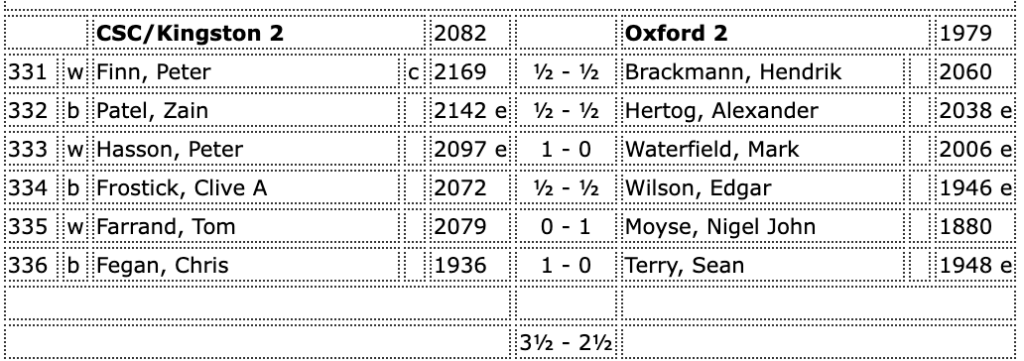
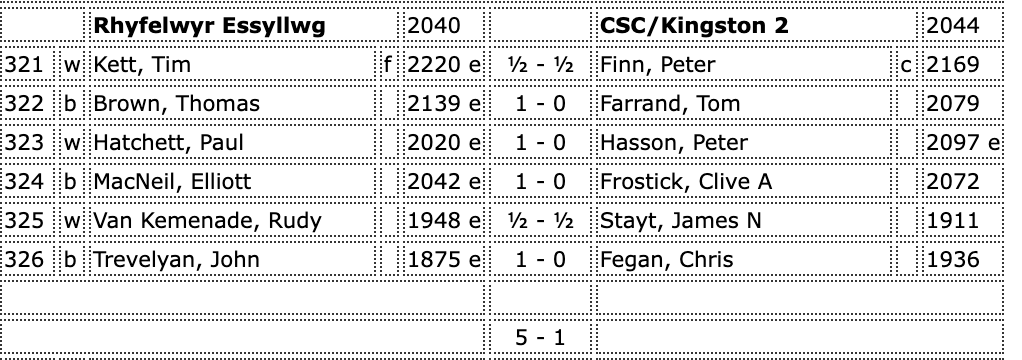
In the very competitive division 3 (knights), where CSC/Kingston 2 have high hopes of promotion, we had a narrow 3.5-2.5 victory over Oxford 2 on Saturday, with wins for Peter Hasson and Chris Fegan. But Sunday proved to be a disaster against Rhyfelwyr Essyllwg – yes they are Welsh and Rhyfelwyr means warriors. On paper the match was very close, but the events on the board proved anything but, and the Warriors ran out easy 5-1 winners, with draws from Peter Finn on board 1 and Jim Stayt on board 5 saving our blushes.

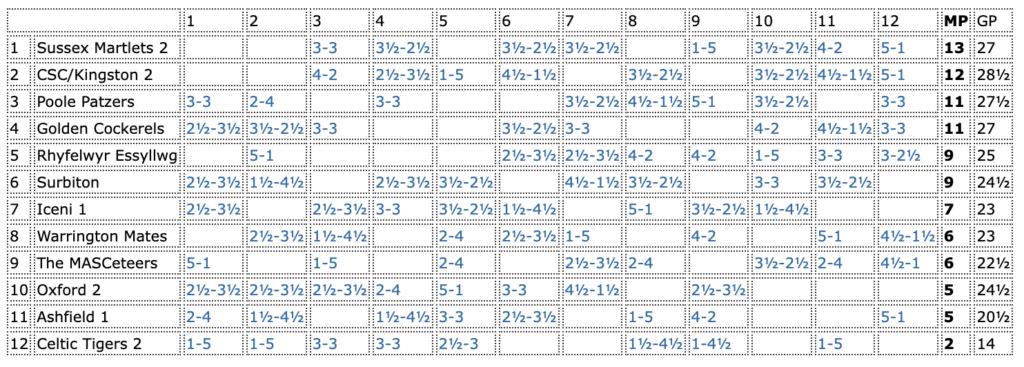
The loss makes the promotion fight harder for CSC/Kingston 2, but they are still clear second and in with a good chance going into the final weekend, with two teams from each Div 3 pool promoted to division 2.

Current Division 3 (Knights) table

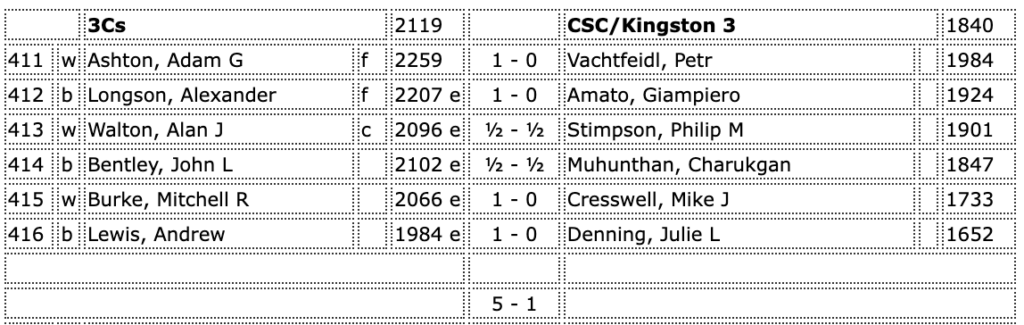
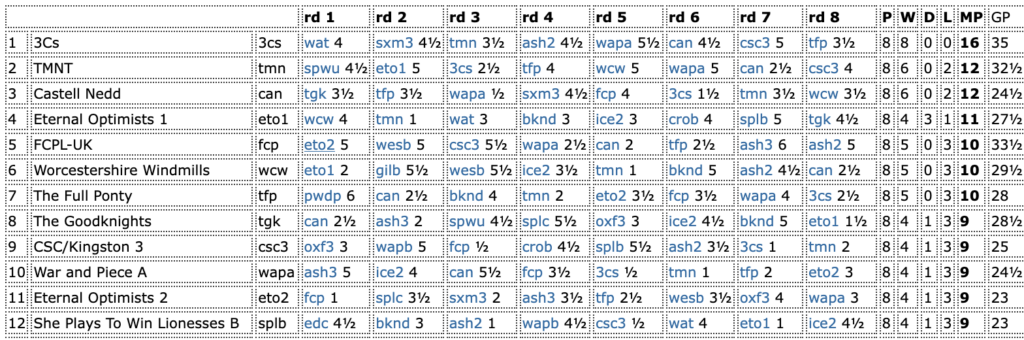
The third team had an even tougher weekend – the result of being close to the top of the 30-strong league and coming up against very highly rated sides. On Saturday, they faced 3Cs, whose average rating of 2119 would make them one of the strongest teams in division 3. They beat CSC/Kingston 5-1, but well done to Phil Stimpson and Charukgan Muhunthan on securing draws against much higher-rated opponents. It was especially commendable by Charukgan, who was making his 4NCL debut.

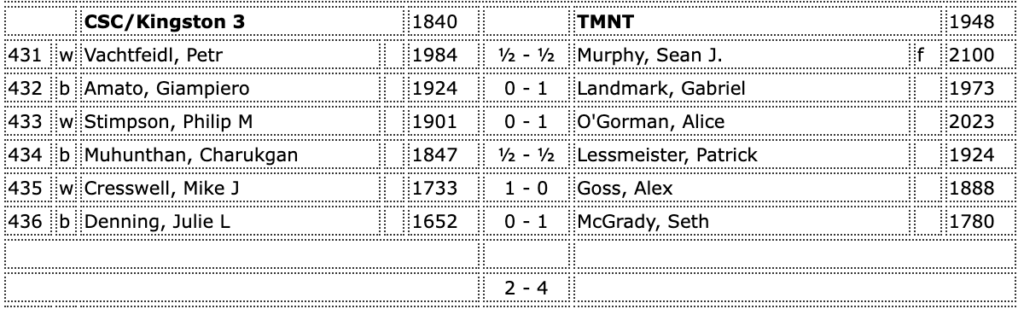
The unpoetically named TMNT, CSC/Kingston 3’s opponents on Sunday, were not quite as strong as 3Cs, but they still had an average rating advantage of almost 100 points a board and ran out 4-2 winners. CSC/Kingston’s hero was Mike Cresswell, who scored a tremendous win against a player who outrated him by more than 150 points. Despite the two defeats, CSC/Kingston 3 are still ninth from 30 in division 4, which is very respectable.

Current Division 4 table (top 12 teams of 30)

The final weekend takes place over three days from 2-4 May, culminating in the final round on bank holiday Monday. The first team will be in Daventry and the second and third teams in Coventry. The first team will be happy with a top four place and the third team with a top 10 position, so most eyes will be on the second team, who for the third year in a row are fighting for promotion to division 2. They have been denied twice over the past two seasons. Can they finally do it this year?

Stephen Moss is captain of Kingston Chess Club

CSC/Kingston enjoy a golden weekend

All three CSC/Kingston teams made good progress in the third round of 4NCL matches, played in Coventry and Daventry on the weekend of 7/8 February

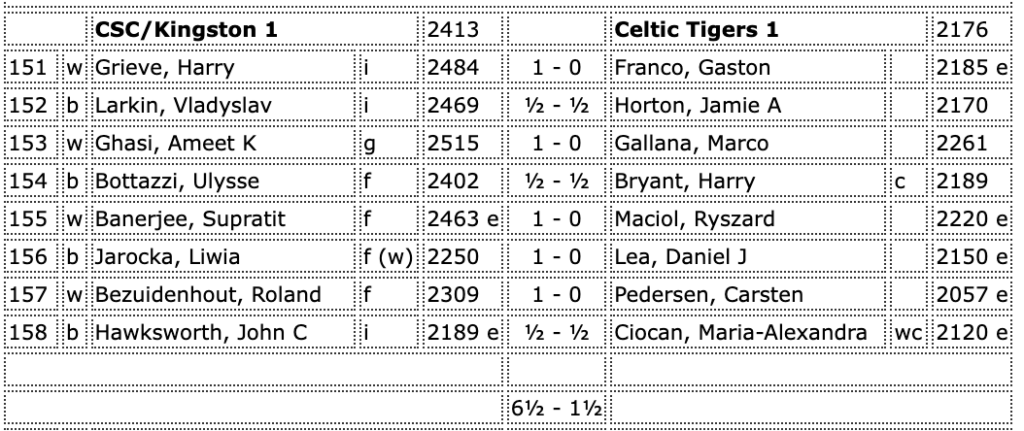
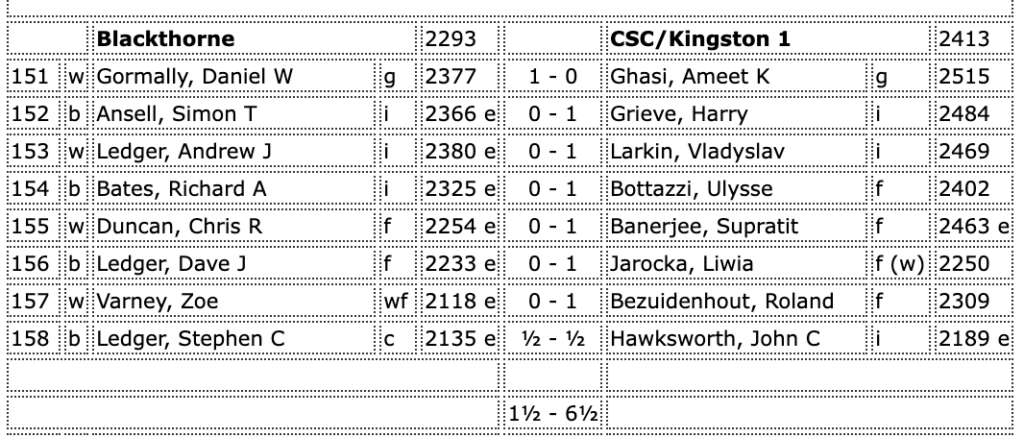
We have reached the halfway stage of the 4NCL season, and all three CSC/Kingston teams are feeling pretty chipper. The first team had a tremendous weekend, winning both their matches – against Blackthorne and Celtic Tigers 1 – by 6.5-1.5. IM Harry Grieve, FMs Supratit Benerjee (pictured above) and Roland Bezuidenhout, and WIM Liwia Jarocka all scored 2/2 across the weekend. The results leave CSC/Kingston 1 joint third in division 1 and looking to improve on last season’s seventh place.

Current Div 1 table


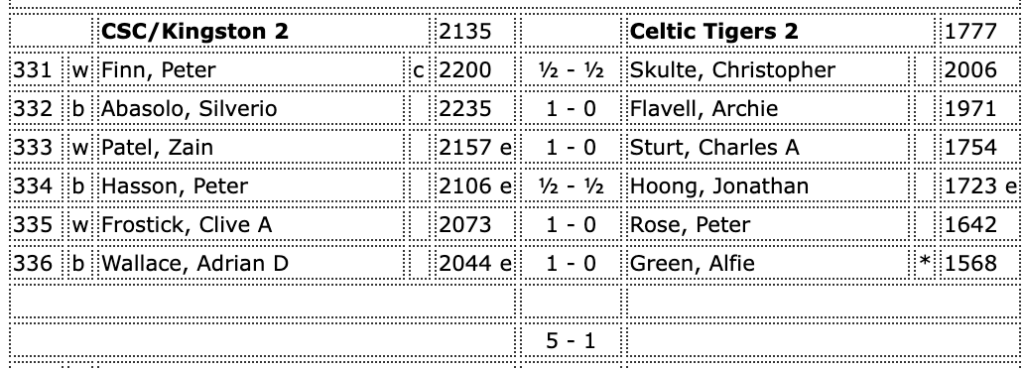
The second team, playing in division 3 (knights) and chasing promotion to division 2, suffered a reverse on Saturday, going down narrowly to promotion rivals Golden Cockerels. But an emphatic 5-1 win against Celtic Tigers 2 the following day means they still lead the division going into weekend 4 on 21/22 March. With Golden Cockerels and Sussex Martlets 2 just a point behind, the battle for the two promotion spots is sure to be intense. Silverio Abasolo had a memorable weekend, winning both his board 2 games against strong opponents.

Current Div 3 (Knights) table

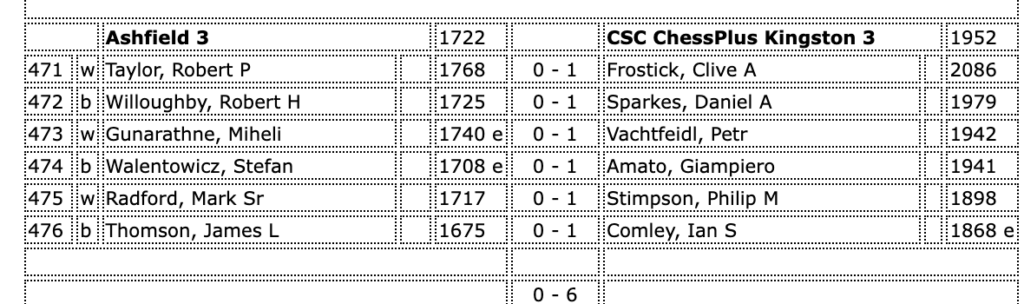
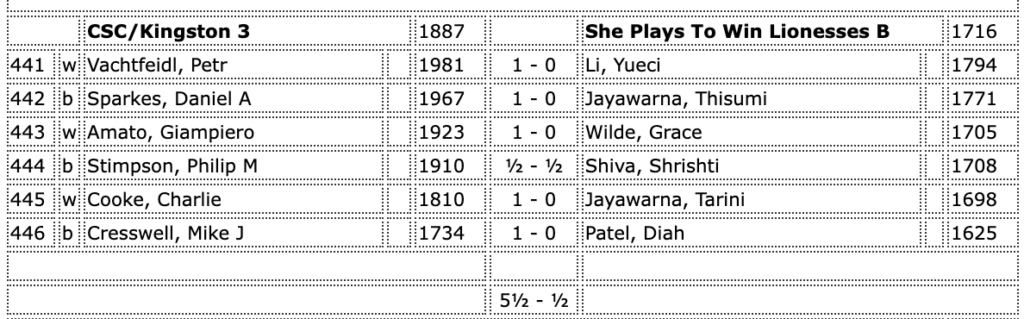
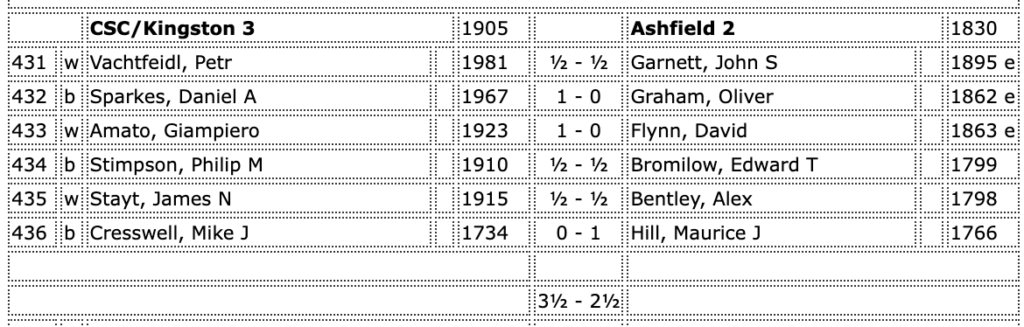
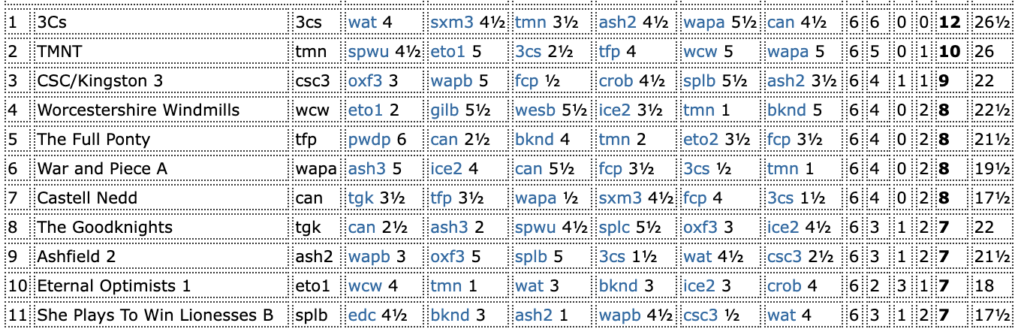
Determined not to be left out, CSC Kingston 3 – playing in division 4 in Daventry – also had an excellent weekend, hammering She Plays To Win Lionesses B 5.5-0.5 on Saturday and edging out Ashfield 2 3.5-2.5 on Sunday. Daniel Sparkes and Giampiero Amato both scored 2/2, but everyone contributed in two very solid team performances. That leaves CSC/KIngston 3 in third place in division 4 and suddenly starting to dream of promotion. Four go up to the two division 3 pools from this division.

Current top 11 teams (from 30) in division 4

Stephen Moss is Kingston club captain

CSC/Kingston 1 fall to might of Wood Green

The second round of 4NCL matches, spread across two weekends in January, saw mixed results for CSC/Kingston’s three teams, with a setback in division 1 but solid progress in division 3

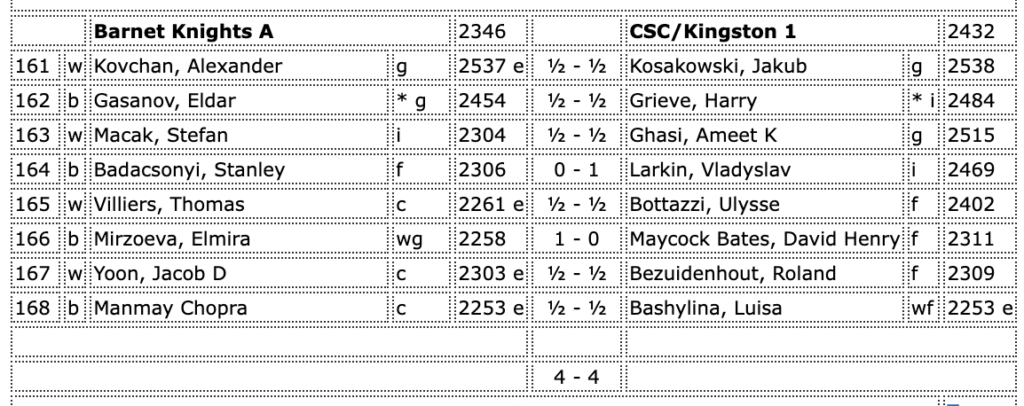
For a moment we dared to dream. After two victories on the opening weekend, including a remarkable 6-2 victory over GM-laden Cheddleton, we had started to believe our own publicity. Might we actually be able to win the competition? Unfortunately, the answer was a resounding no: on the Saturday of Weekend 2 (10 January) we drew with Barnet Knights and the following day we lost 5.5-2.5 to Wood Green, by some margin the strongest team at 4NCL. Oh well, it was fun while it lasted.

We had taken a very strong team to Coventry in the hope that we could spring a surprise: Polish grandmaster Jakub Kosakowski on board 1, former British champion Harry Grieve on 3, GM Ameet Ghasi on 3, youthful Ukrainian IM Vlad Larkin on 4 – but our opponents had strengthened too.

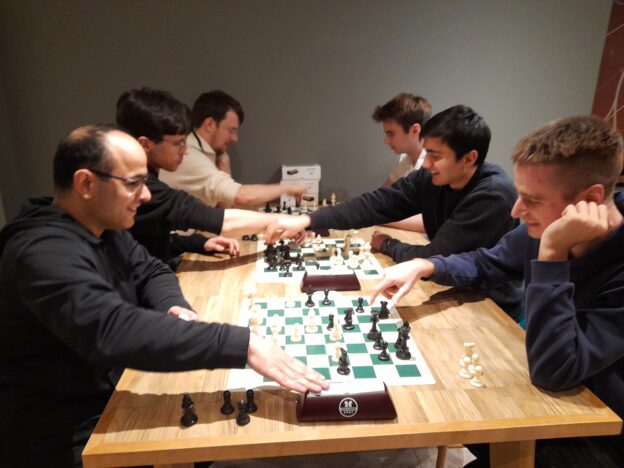
The match on Saturday against Barnet Knights ended in a thrilling 4-4 draw, with Grieve pressing hard for a win against GM Eldar Gasanov on his debut for CSC/Kingston. On Sunday, we were outgunned on the lower boards – every Wood Green player was 2400-plus – though the result could have been closer. Ulysse Bottazzi was on top against IM Jonah Willow until time trouble undermined him. A good learning experience for all of us – this league is tough! The players remained in good spirits and, as the photograph above shows, happily played blitz and bughouse late into the night on Saturday. Good for team bonding, if not for early-morning prep on Sunday.

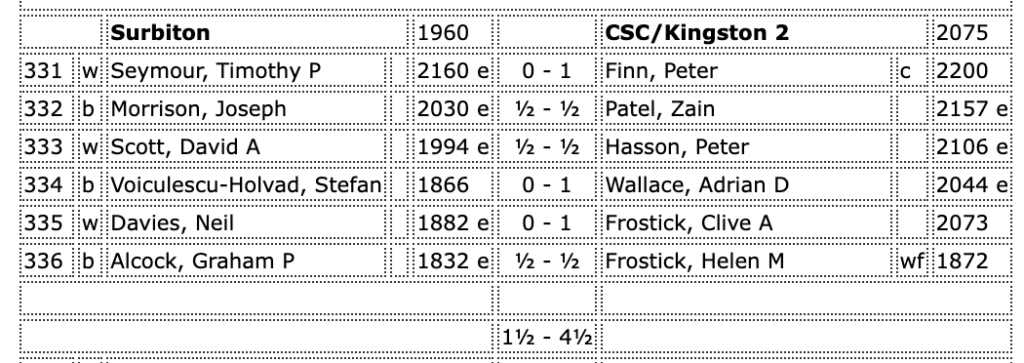
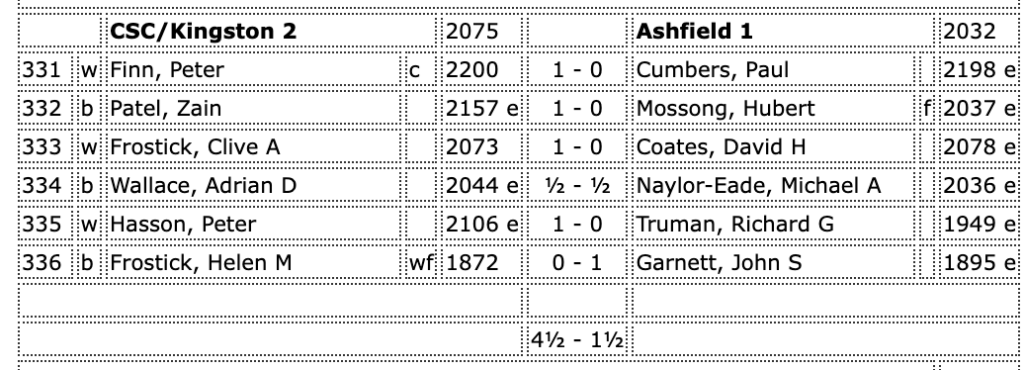
CSC/Kingston 2, playing on the same weekend and at the same venue – a Holiday Inn somewhere on the M6 – had a more successful weekend in their quest to win promotion from division 3 (knights). They beat south-west London neighbours Surbiton 4.5-1.5 on Saturday, and followed it up with victory by the same margin over Ashfield on Sunday. Peter Finn and Clive Frostick both scored 2/2, and everyone contributed in what has become a tightly knit and very effective unit. The team is now 4/4 after two weekends and sit proudly atop the division (see tables at foot of report).

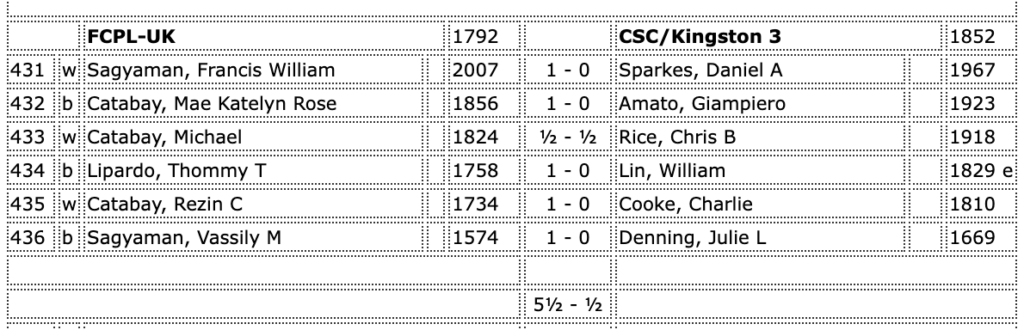
CSC/Kingston 3 played in division 4 a week later (17/18 January) in Dudley and suffered a 5.5-0.5 hammering by the evocatively (sic) named FCPL-UK on Saturday. FCPL-UK were outrated, so one can only assume they have some seriously underrated players. Or perhaps we just had a bad day at the office. Anyway, well done to Chris Rice for securing the half-point which avoided the dreaded “bagelling” (ie 6-0, as in a very one-sided set in tennis).

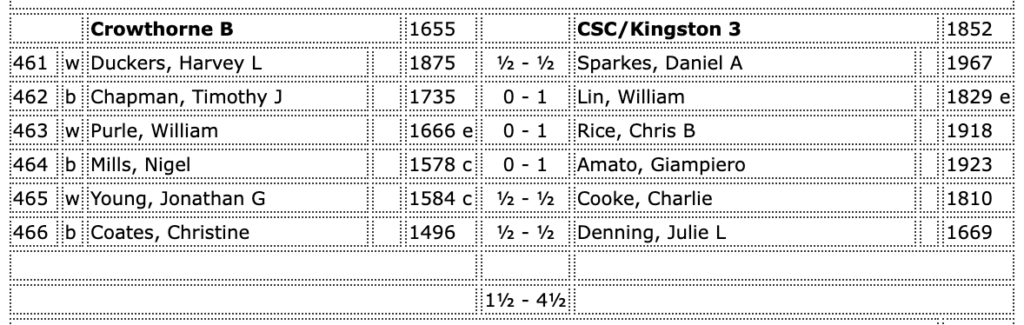
Sunday was a much better day, and CSC/Kingston 3 bounced back with a convincing 4.5-1.5 victory over Crowthorne B to leave the team eighth of 30 teams in the table (division 4 is a Swiss, unlike the other divisions which are all-play-alls). Chris Rice and Giampiero Amato won, as did Kingston junior (and British under-10 champion) William Lin on his debut weekend at 4NCL.

A great result for William and, despite the Wood Green setback, a generally encouraging set of results for the 44-strong CSC/Kingston squad. Thanks as ever to squad matriarch Kate Cooke for looking after the players, booking the hotels and making the logistics work. Weekend 3, when all three teams play on the same days (7/8 February) in Coventry and Daventry, promises to be even more complicated.

The tables after Weekend 2

Stephen Moss is Kingston club captain

4NCL weekend 3

Measuring how individuals contribute to a team

A case study based on the performance of the CSC/Kingston first team in the 4NCL in the 2024/25 season, by John Foley

Our first team, having been promoted in 2023/24 to the first division of the Four Nations Chess League (4NCL), managed to stay up and achieved a creditable mid-table seventh place in 2024/25. The season comprises 11 rounds over five weekends of exciting and exhausting chess. The start of the 2024/25 season was ominous as we lost our first three matches. In mid-season, with two wins from six matches, the team management even contemplated the unthinkable – making this our last campaign – but our players rallied and, in a final glorious weekend, we drew one match and won two matches against our rivals to secure our survival.

Ten years ago, I was team manager when (under a different team name) we were last promoted. I kept the players together as a reward for their efforts – allowing them to play the cream of the chess world. Whilst my intentions were noble and regarded as fair by the team members, this was not the mindset to achieve glory. There is no room for complacency at the top; one needs a ruthless attitude. During the course of the 2024/25 season, we strengthened the composition of the team as it became clear that obtaining promotion from division 2 is one thing, but staying up in division 1 is something else completely.

The team managers deserved tremendous credit for keeping the show on the road. Each weekend requires considerable planning in terms of team selection, logistics and accommodation. Complications are multiplied because we also have a second and third team, and not all the teams play on the same weekend nor at the same venue. The first team is eight boards and the lower teams are six boards. Nightmare! We did not default a single game out of the 220 played during the season. The person at the centre of the operation is Kate Cooke, who should receive a medal from the 4NCL organisers. 

We have one of the youngest teams in the first division, with an average age of around 21. They liked playing for us and a good team spirit developed both over the dinner table and through watching and analysing the games. The matches were written up by Stephen Moss, who doubled as the shadow team captain and guardian angel, always solving problems in the background and ensuring that we had the right resources to deploy competitive teams.

Four measures

The team’s success depends upon the contribution by its members. We use four measures to analyse different aspects of individual performance: 

  • Commitment
  • Competitiveness
  • Combativity
  • Decisiveness

1. Commitment

Commitment can be measured by the number of games played in the campaign. Playing a game implies that one was available and selected. Three players participated in all 11 matches: Vladyslav Larkin, David Maycock and Supratit Banerjee. Vladyslav, a young man from Ukraine, made a considerable effort to come to the Midlands hotels in which 4NCL matches are played. Supratit was only 10 years old, so his parents also had to make a significant commitment. David Maycock not only played in the 4NCL, but is a vital member of the Kingston first team which won eight trophies. Liwia Jarocka and Roland Bezuidenhout each played nine games, for which they also deserve recognition.

Vladyslav Larkin: The Ukrainian IM played in all 11 matches, showing huge commitment. Photograph: John Saunders

2. Competitiveness

The traditional measure used to recognise performance is the percentage score. To be eligible, a minimum number of games must be played to be fair to other players who may have turned up more often, even if they have not been so successful. Turning up on two weekends out of five seems a reasonable cut-off point – equivalent to four games out of 11. There were two players who played at least five games and obtained a positive percentage score: Supratit Banerjee had 6.5/11 (59.1%) and Liwia Jarocka 5/9 (55.6%). Zain Patel and Ulysse Bottazzi both scored 50% from six games.

Supratit Banerjee: The most competitive player based on his percentage score. Photograph: John Saunders

3. Combativity

The Tour de France has a special prize for the most combative cyclist – the participant who animates the race by their aggression, attacking flair and will to win. The equivalent in chess is to find the players who perform well beyond their rating. This can be measured as the ratio between their actual performance and their expected performance. The expected performance is derived from the difference in the elo ratings of the players. A 100-point gap confers a two-thirds winning chance for the stronger player; a 200 points gap confers a three-quarters winning chance for the stronger player, and so on. 

The most combative player was Supratit Banerjee, whose combativity score was 1.34. One way of looking at this is that the average return on a bet across all the games on Supratit would have returned 34%. This was a tremendous performance from a seriously talented junior. Supratit’s best result was in round 3 against the higher-rated Tomasz Sygnowski, in a match in which Kingston were trounced 6.5-1.5 by Wood Green Youth. 

Evening blitz: (players from left) David Maycock, Zain Patel, Ulysse Bottazzi, Vladyslav Larkin.
Ulysse was one of the team’s most combative players

Competitiveness and combativity are correlated and Supratit is the most competitive player, so, to share the honours, we can look to the next highest combative player, Ulysse Bottazzi (then rated 2320) achieved a combativity score of 1.18 from six games. Ulysse had a formidable run in rounds 6, 7 and 8, where he beat IM Stefan Macak (2305) and took draws from IM Rajat Makkar (2413), and GM Daniel Alsina Leal (2490).

Eray Kilic: Most combative player over three games

If we want to recognise more players who contributed to the final team standing, or to recognise outstanding performance, we can widen the net to those who played just three games. On this criterion, the most combative player was Turkish IM Eray Kilic, who scored 2.5/3 (83%) on the final weekend to gain a combativity score of 1.42. This was largely on account of having beaten GM Keith Arkell in round 9 in the match which we drew against Cheddleton, one of the stronger teams in the competition (Cheddleton were fifth in the final table).  

4. Decisiveness

The measure of decisiveness recognises that some games are more important than others. In a tight match, an individual result can make the crucial difference: converting a lost into a drawn match or a drawn match into a won match. Using an idea by the Nobel prize-winning game theorist Lloyd Shapley, we can identify the player who has made the greatest difference to the team result by winning or drawing in critical matches. 

Think of the sort of person who holds their nerve when under a lot of pressure. They pay attention to the balance of games in each match and try to get the right outcome, eg taking a draw to win the match or trying to get a positive result from a hopeless position. With a minimum of four ranking games, we can rank the players who made the most decisive impact:

David Maycock               21.0%
Vladyslav Larkin             20.7%
Liwia Jarocka                  20.6%
Supratit Banerjee          19.9%
Roland Bezuidenhout 17.9%

David Maycock: Most decisive player based on performances in matches where CSC/Kingston either won or drew

David Maycock made an impact when the team won or drew. He scored four points in these six matches, perhaps most valuably in round 10 when there was a small margin between the teams. Liwia was also in the running and might have pipped David, but she participated for one fewer weekend. In the game below, David converts a lost ending to a decisive victory.

To summarise, we have navigated through the team result numbers to identify the valuable contributions made by individual players. We identified the most committed player, the most competitive player, the most combative player and the most decisive player. Putting these together, the player who made the overall greatest impact on the team’s performance – the most valuable player – was Supratit Banerjee.

I am grateful for computational support from Dr Lawrence Liao in preparing this article.

CSC/Kingston make impressive start to 4NCL campaign

The opening two rounds of the new 4NCL season, spread across two weekends in mid-October and early November, saw CSC/Kingston’s three teams make bold starts

As well as falling leaves, autumn sees the start of treks to Midlands hotels to play the opening rounds of the 4NCL season. CSC/Kingston 1 began with matches against Barbican and Cheddleton, played at the Copthorne Hotel in Dudley on 1/2 November. CSC/Kingston’s second and third teams had been in action a fortnight earlier at the same venue, which was being used by the league for the first time. All three teams performed superbly and, as we see below, are well placed after the first two rounds of the 11-round season.

CSC/Kingston 1 came a creditable seventh in division 1 last year and hope to do at least as well this season. There is a great deal of jeopardy in this very tough division – three of the 12 teams get relegated, a 25% churn. This is one too many in the view of this writer – two down would be fairer – but there is no question that it adds drama to the season.

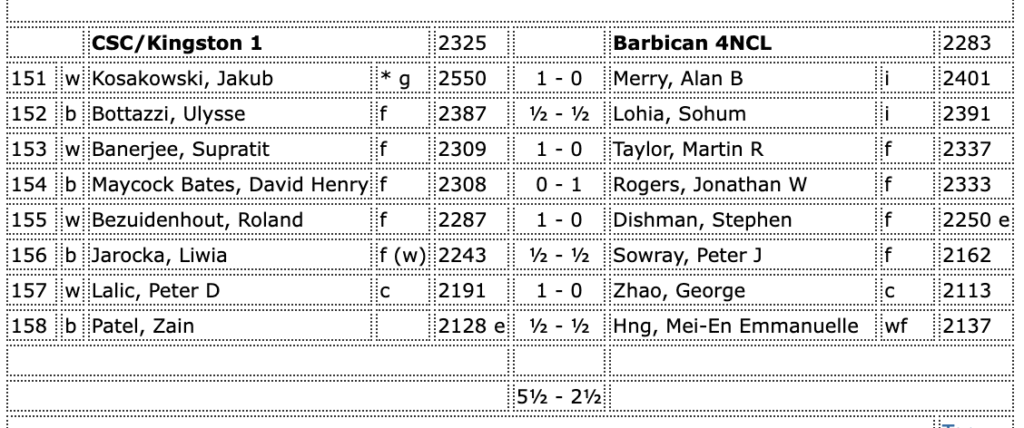
The first team faced Barbican on Saturday. CSC/Kingston had a slight ratings edge but it promised to be very close, and the match seemed likely to set the tone for the rest of the season. The young Polish grandmaster Jakub Kosakowski, runner-up in last year’s Polish national championship, was making his debut for CSC/Kingston, supported by many of the regulars from last year’s successful campaign. Jakub had White against IM Alan Merry and, as the time control approached, the game became a comedy of errors and missed opportunities.

Barbican’s second IM, Sohum Lohia, came straight to Dudley from a very strong tournament in Coventry, where he had shared first prize with GM Vojtech Plat and IM Hao Wang. Clearly he was a player to be feared. But the CSC/Kingston board 2, FM Ulysse Bottazzi, playing Black, was able to neutralise the threat without undue alarms, and a draw was agreed after 36 moves.

CSC/Kingston’s board 3, Supratit Banerjee (pictured above), had White against FM Martin Taylor on board 3, and boldly gambited a pawn in the opening to get an initiative. For a long time the engine favoured Black, but in this position he erred and Supratit gradually got a stranglehold on the game:

David Maycock, with Black against Jonathan Rogers on board 4, had the advantage early on, but Rogers skilfully fought back and had the upper hand when David blundered a rook in time trouble. At that stage the match looked as if it could go either way, and seemed certain to be very close. But it was about to take a decisive turn.

Roland Bezuidenhout played a superb game in a complicated tactical struggle to win with White on board 5 against Stephen Dishman. Black’s key error comes in this position where he allows an exchange which gives White a powerful pawn centre.

An important win for CSC/Kingston and now we could breathe a little easier. But the result which completely changed the complexion of the match was on board 7, where young George Zhao with Black had a much better position against CSC/Kingston’s Peter Lalić when he inexplicably failed to make his 40th move to reach the time control. He thus lost on time, a tragedy for the promising Barbican junior and an unexpected bonus for CSC/KIngston, who were now winning the match with ease.

Liwia Jarocka, with Black, secured an important draw with Peter Sowray on board 6, and Zain Patel battled magnificently with Black against Emma Hng to hold a rook and pawn endgame two pawns down which for a long time he looked destined to lose. That gave CSC/Kingston the match 5.5-2.5 and made the Saturday-evening dinner a very pleasant affair, but it was hard not to feel sympathy for George Zhao, who had played very well to secure a potentially winning advantage against Peter Lalić before his brain fade.

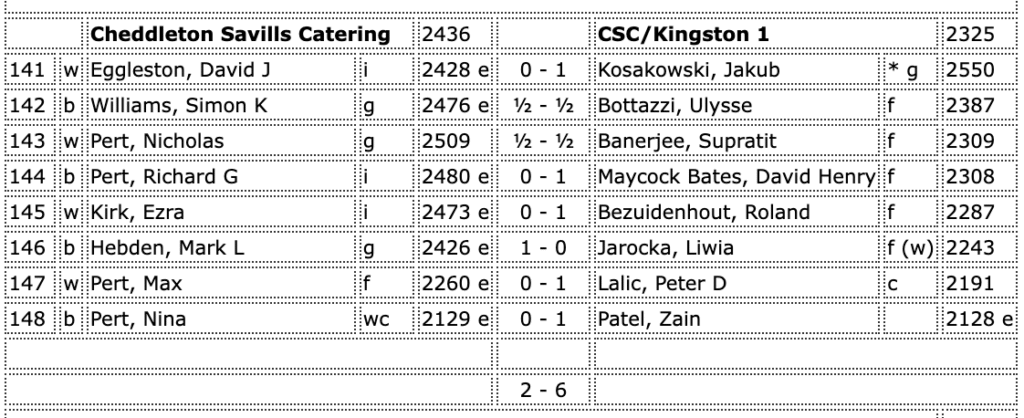
On Sunday, CSC/Kingston 1 faced Cheddleton, with their three GMs and three IMs. We were outrated by an average of 100 points a board. I did not expect us to win the match and thought 5-3 was a likely score. I would happily have settled for 4-4, which one spectator predicted after the match had been under way for a couple of hours. To win it by 6-2 was simply extraordinary, and I couldn’t help reminding people on the Kingston WhatsApp group that the average age of our team was 21. A group of very talented and highly motivated youngsters had walloped some of the cream of British chess.

Jakub Kosakowski was always pressing against David Eggleston on board 1 and duly converted. Cheddleton’s Mark Hebden equalised with a nice attacking game against Liwia Jarocka. Ulysse Bottazzi once again played solidly to draw with GM Simon Williams on board 2, and Supratit Banerjee defended superbly to hold a rook endgame against GM Nick Pert when two pawns down. Supratit’s was the last game to finish, and it is worth studying the endgame and marvelling at the 11-year-old’s mature and resourceful defence.

The other four games were all won: Zain Patel beat Nina Pert with a powerful attack with White on board 8; Peter Lalić performed one of his characteristic escape acts to convert a losing endgame into a winning one with Black on board 7; and on the critical middle boards David Maycock beat Richard Pert with White on board 4 in a rollercoaster game and Roland Bezuidenhout recorded his second victory of the weekend by beating IM Ezra Kirk, who played an ambitious knight sacrifice which proved to be unsound.

David’s game was a dizzying one which left both him and his rival exhausted. He had a winning plus as the 40-move time control approached, but then made a mistake which gave Black a potentially decisive advantage. To have blundered away his second game of the weekend would have been crushing, but he showed remarkable resilience to fight back and turn the game around. This is the position in which David went wrong:

David’s win and Supratit’s draw ensured a convincing 6-2 win for CSC/Kingston, a remarkable result given Cheddleton’s strength and experience.

These two wins left CSC/Kingston 1 sitting proudly on top of division 1 (see table below), jointly with Wood Green, who on paper are the strongest team in the division. We face Wood Green in round 4 on the weekend of 10/11 January, and happily the match will not be played on paper but on eight chess boards.

CSC/Kingston 2 also had a fantastic opening weekend in division 3 (knights) and also ended up on top of the table (see below), half a game point ahead of Sussex Martlets and Ashfield 1. It is very pleasing to see our neighbours Surbiton also going well.

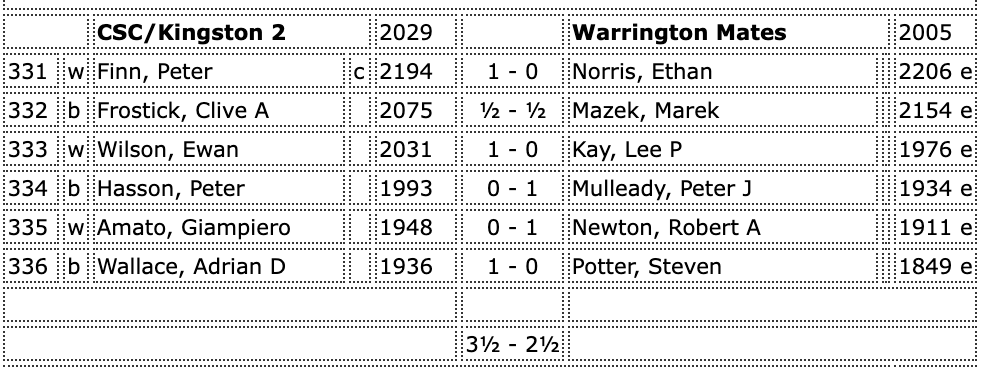
Matches in divisions 3 and 4 comprise six boards, compared with eight in the top two divisions. CSC/Kingston 2 beat Warrington Mates 3.5-2.5 in a tight struggle on Saturday, with wins by the ever reliable Peter Finn on board 1, Ewan Wilson on board 4 and Adrian Wallace on board 6, and a crucial draw by Clive Frostick with Black on board 2.

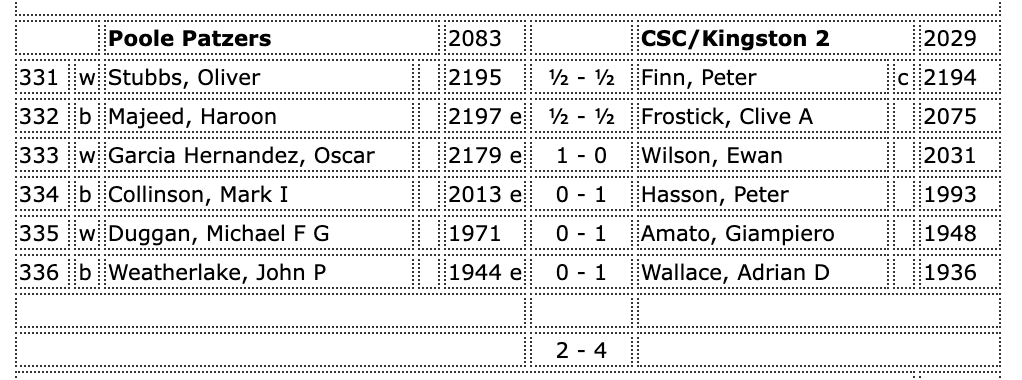
Sunday’s victory against the self-deprecatingly named Poole Patzers was slightly more emphatic at 4-2, but could still have gone either way. There will be no easy matches in this highly competitive division and winning promotion to division 2 – two teams go up from each 12-team division 3 pool – will be far from simple. The success on Sunday came courtesy of wins by Peter Hasson, Giampiero Amato and Adrian Wallace, who had an excellent weekend with two victories, and top-board draws against two highly rated players by Peter Finn and Clive Frostick.

It was a tremendous team performance across the weekend, with every player contributing. Peter Hasson, who was White on board 4 against Mark Collinson, has kindly supplied a detailed analysis of his fascinating king and pawn endgame.

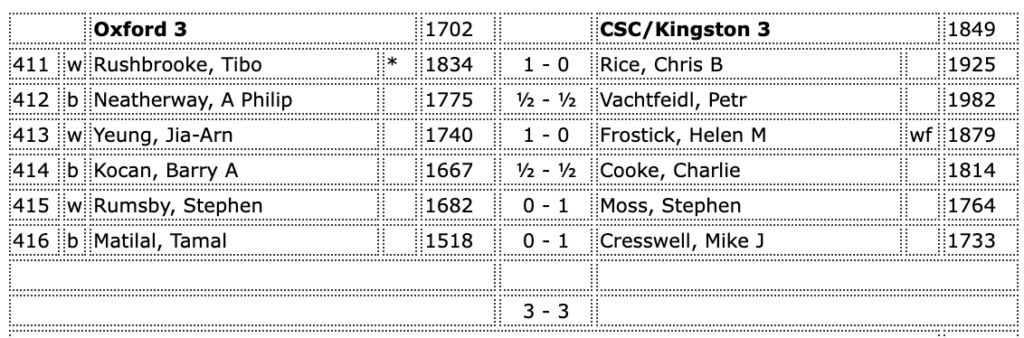
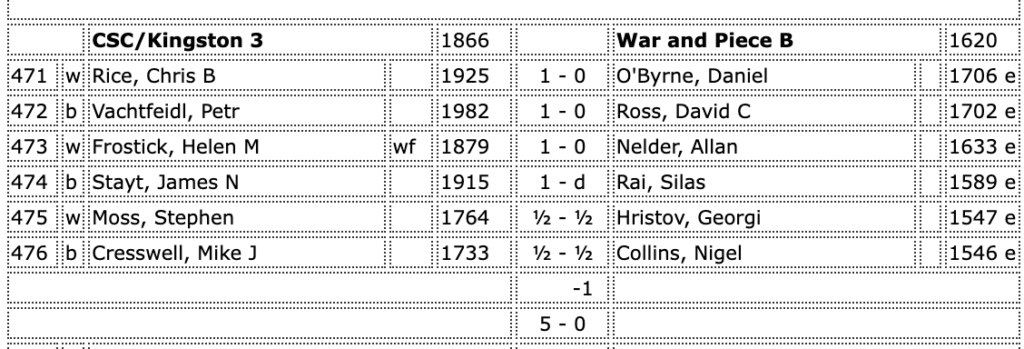
CSC/Kingston 3 played in Dudley on the same weekend as the second team, 18/19 October, and also had a successful start to the season. We drew 3-3 against Oxford 3 on Saturday, with wins for Mike Cresswell and your correspondent, and then won 5-0 on Sunday against War and Piece B, one of whose players failed to show, leading to the deduction of a point.

These results left us joint seventh in the 29-team division 4, which is played as a Swiss tournament . The current table, showing the leading nine teams, is below.

Four teams are promoted from division 4, but there are some very strong outfits among the leading contenders and it is safe to assume that we will not be one of them. But this was nevertheless a pleasing beginning.

Well done to all three teams on their excellent starts; thanks to all the players who made the Great Trek to Dudley in north-west Birmingham; and thank you as ever to team captain Kate Cooke, who keeps the whole show on the road. We now have 43 CSC/Kingston squad members, and juggling that number of potential players and getting them to the various Midlands hotels we will play in during a long season is a complicated logistical undertaking.

Stephen Moss

Kingston are London champions

4th SCCU/London Club Championship held at St Luke’s Church, Hampstead on Sunday 21 June 2025

Photograph: John Foley (captain), John Bussmann, Vladimir Li, Supratit Banerjee and Peter Lalić

Kingston capped, or should that be cherried, an extraordinary season by winning the London Team Championships organised by the Southern Counties Chess Union. This unique event brings together teams from London and the Home Counties which normally compete in different leagues. Kingston played in the top section of three, which was limited to an average rating of less than 2200 ECF. It was the hottest day of the year with temperatures over 30C, which affected some players more than others.

Each team comprised four players with an optional reserve. In our case, the team was 1) Supratit Banerjee 2) Peter Lalić 3) Vladimir Li 4) John Bussmann with me as captain/reserve. The line-up conformed with the average rating provided that John Bussmann played in each round, which meant there was a lot of pressure on John.

The tournament was supposed to be a Swiss format. However, one of the teams dropped out late and the organisers modified the format so that no player would miss a game. Although well-intentioned, the practical consequences of a triangular format embedded into the Swiss format left us wondering if it is worth avoiding byes. Under this arrangement, three teams play each other wherein each round boards 1 and 2 play different opponents from boards 3 and 4. The players were confused as to whom they would play, and online followers were confused about the match results. There was a delay after each round to sort out pairings. The tournament director David Gilbert reassured everyone that matters were under control as the laptop master Michael Flatt grappled with the pairings.

Michael Flatt on keyboards

In round 1, Supratit won, as did Vladimir, against Ian Snape (see start of game below).

Kingston won in the first four rounds but could only draw against Pimlico in round 5. Vladimir’s game in that match is shown in the Games section. In a fitting finale, Kingston faced Richmond & Twickenham in the final round. R&T are formidable opponents well known to Kingston. They had won the event on each of the previous three occasions it was held. On top board, Supratit drew with occasional Kingstonian Michael Healey. Peter accepted a draw offer from Gavin Wall in what was shown afterwards to be a winning position.Vladimir beat Maks Gajowniczek.

Final Round: Peter Lalić v Gavin Wall, Mike Healey v Supratit Banerjee on Board 1

In the final game to finish, John Bussmann decided to play aggressively against Martin Benjamin as the best way to obtain a draw. He sacrificed a piece and was rewarded with perpetual check. The game was a draw, the match was won, the London Team Championship was won and so was the historic octuple of victories.

Maks Gajowniczek v Vladimir Li on Board 3, John Bussmann v Benjamin Martin

Supratit had a tremendous result undefeated on board one with 5/6. The prize for the best performance at the event went to Vladimir Li who scored 6/6. These two were the engine room of the team.

In the final ranking, the Dummy entries are there on account of the triangular match. We are unable to provide any explanation of their purpose.

Vladimir Li receiving a prize for the best performance from David Flewellen, deputy president of SCCU
Supratit Banerjee receiving an individual trophy of the SCCU London team prize

We celebrated by repairing the famous Old Bull and Bush in Hampstead for a liquid refreshment.

Old Bull and Bush

John Foley, Kingston Chess Club president

CSC/Kingston 1 feast on Sharks in historic win

CSC/KIngston’s first team record a remarkable victory over the formidable Sharks 1 and the second team win both their matches to give themselves a shot at promotion on a riveting fourth weekend at 4NCL

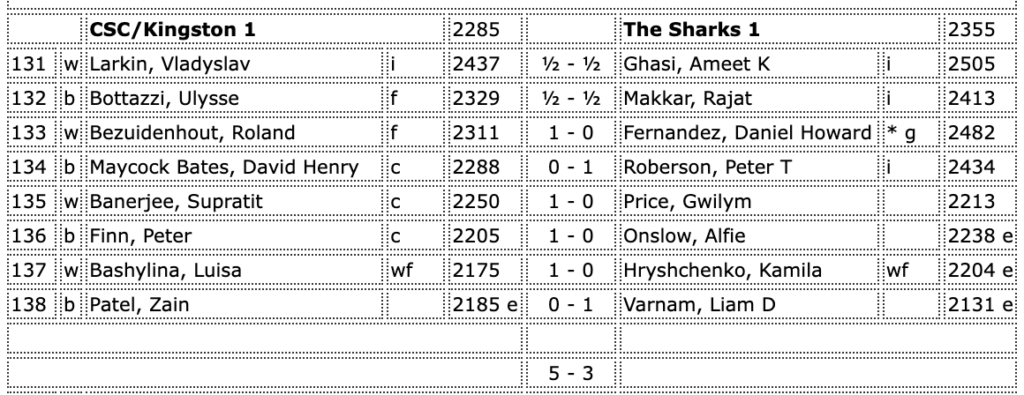
In the late afternoon on Saturday 5 April, something remarkable happened: CSC/Kingston 1, new to division 1 this season and among the favourites to be relegated, beat Sharks 1, who for the past few seasons have been vying to win the 4NCL title. It was a remarkable victory and a mighty tribute to captain Kate Cooke and her vibrant and youthful team (members of which are seen in the photograph above playing late-night blitz after their triumph). This is the scorecard of the success:

Vlad Larkin and Ulysse Bottazzi overcame significant rating disadvantages to draw on the top two boards; David Maycock (who spurned a draw offer) and Zain Patel lost with Black on boards 4 and 8; but we were carried over the line by wins from Roland Bezuidenhout (against grandmaster Daniel Fernandez!), Supratit Banerjee, Peter Finn and German WFM Luisa Bashylina, who enjoyed a fantastic debut weekend for the team winning both her games.

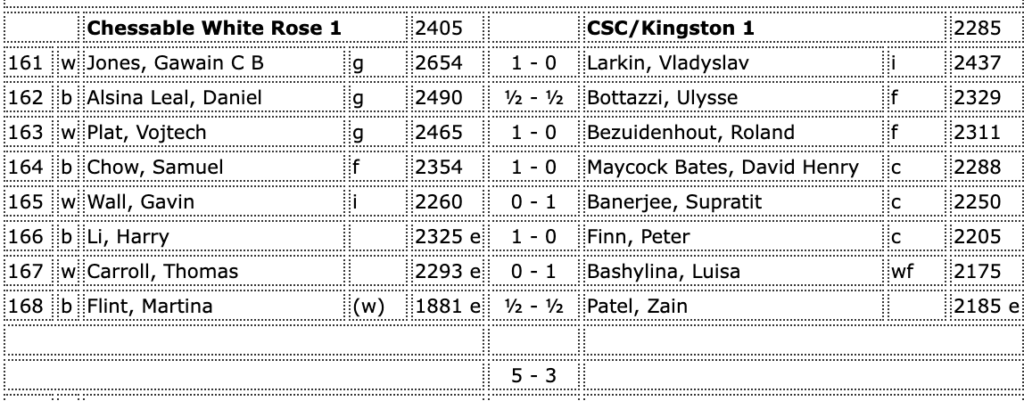
On the following day, the first team lost 5-3 (nothing to do with the late-night blitz, honestly) to a strong Chessable White Rose 1 team (see scorecard below), but even that was a close-run thing. Vlad Larkin felt he had a winning chance against top GM Gawain Jones, but it came close to the first time control when he had only seconds to calculate. Peter Finn also had excellent drawing chances against Harry Li, but blundered in the endgame.

There was, however, no crying over opportunities lost. Overall, this was a great weekend which gives CSC/Kingston 1 a good chance of surviving in the division 1 sharkpool. The final weekend, in Daventry on 3/4/5 May, promises to be fascinating one, with make-or-break matches against Cheddleton, Barbican and Sharks 2.

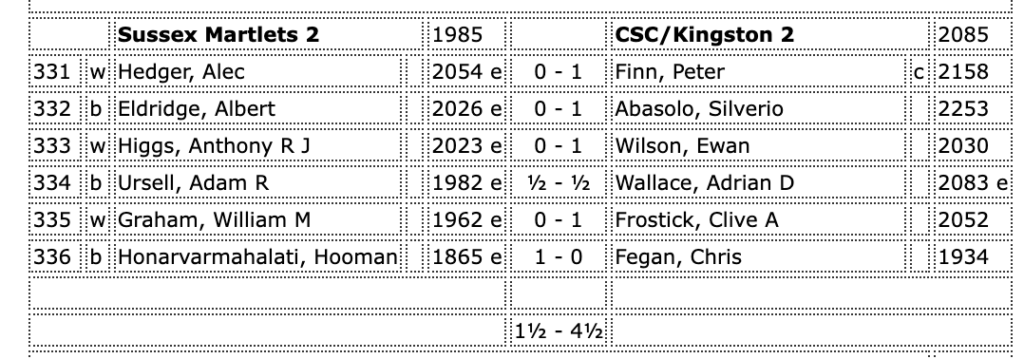
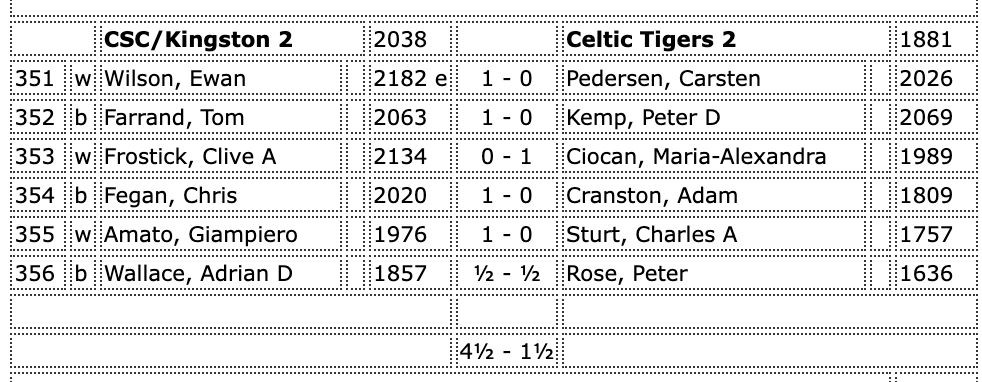
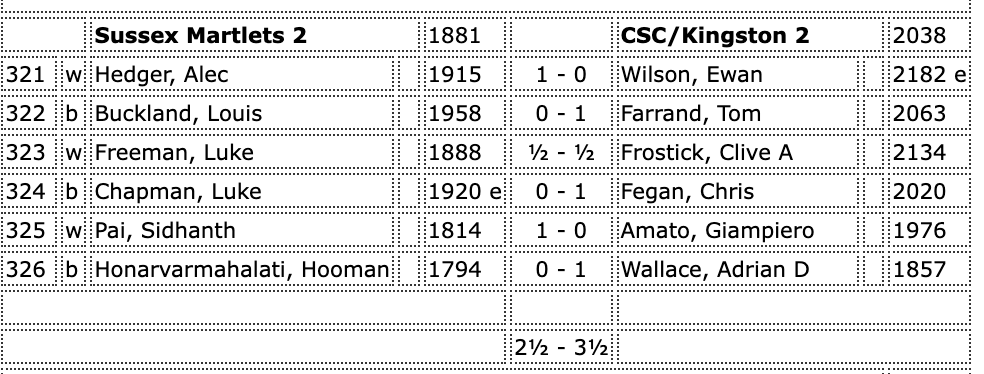
The weekend after CSC/Kingston 1’s great achievement, it was CSC/Kingston 2’s turn to trek to Peterborough for rounds 7 and 8 of division 3 (knights). The team won convincingly by 4.5-1.5 against Celtic Tigers 2 on Saturday (see scorecard below), but had a scare against Sussex Martlets 2 on Sunday, coming back from 2-1 down to win a nailbiter. Clive Frostick, who had been unwell coming into the weekend, heroically secured a crucial draw in the final game to finish to take the team to victory. Props also to Tom Ferrand and Chris Fegan for winning both their games over the weekend.

CSC/Kingston 2 now have a chance of winning promotion to division 2 on the concluding three-match weekend in Daventry on 3/4/5 May (when division 1 and division 3 knights will be played at the same venue, allowing the first and second teams to play alongside each other). The round 11 match against promotion rivals To Be Decided on the last day of the competition is likely to be decisive (as the name of our rivals, currently ahead of us in the table by a single game point, handily suggests).

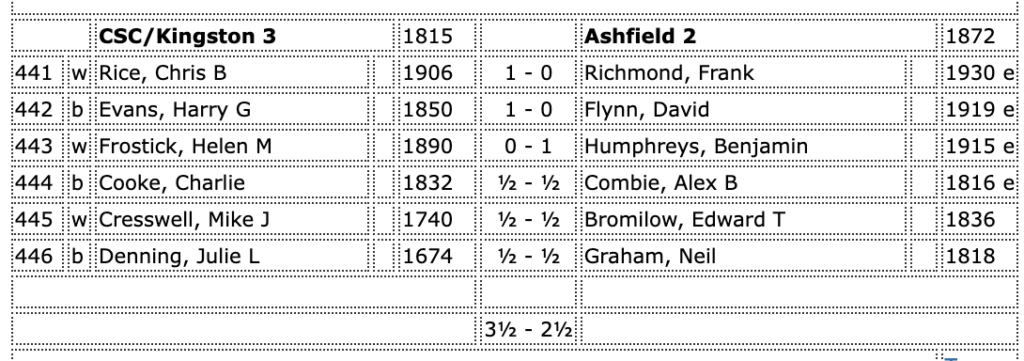
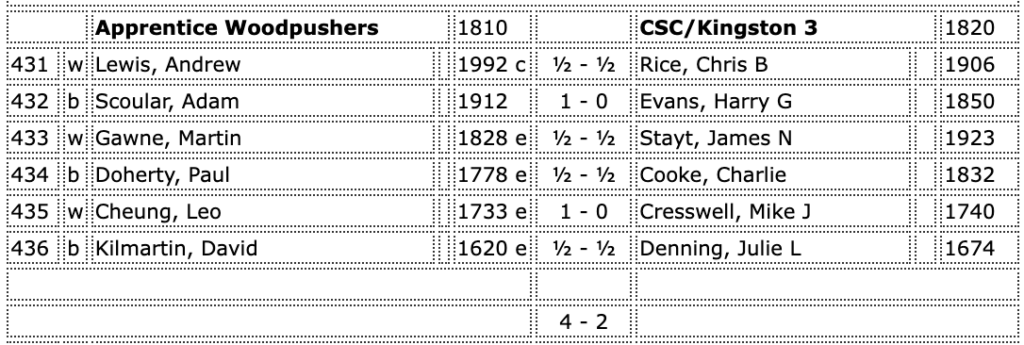
CSC/Kingston 3, who head to Coventry for the final weekend on 3/4/5 May, also had a productive weekend, beating Ashfield 2 on Saturday before losing a hard-fought match to Apprentice Woodpushers on Sunday to leave them eighth in the table. Promotion is still possible, but they would have to win all three of their matches on the final weekend and others results would also have to go their way.

Here are the tables as they currently stand for the divisions in which the three CSC/Kingston teams play:

Stephen Moss, Kingston club captain

4NCL weekend 3

Kingston’s 4NCL teams are serious contenders

The first and second teams played at the Holiday Inn, Coventry. The third team played in Peterborough on the third 4NCL weekend 15/16 February 2025

From left: front: Nia Videnova, David Maycock, Ash Stewart; back: Viviana Galvan Cipriani, Ulysse Bottazzi, Peter Finn, Liwia Jarocka, Vladyslav Larkin (Photograph: John Foley)

The 4NCL is the national chess league which is played one game per day over five weekends at hotels in central England. Divisions 1 and 2 comprise 12 teams – eight players in division 1, six in division 2. Division 3 is split into two groups of 12 teams, with six players in each. Division 4 has 32 many teams of six players. Kingston has teams in Divisions 1, 3 and 4. The team is called CSC/Kingston to reflect the aspiration that we provide a pipeline for those learning under the Chess in Schools and Communities project.

This was the third weekend and marks the halfway point of the season. It was make or break this weekend, and we proved ourselves up to the challenge. We were short-handed because some of our players were on international duty for England at the World Senior Team championships in Prague. Peter Large is in the 65+ first team, Clive Frostick is in the 50+ second team, and his wife Helen is in the women’s team. We were also missing players from our second team – Chris Fegan for England and Alan Scrimgour for Scotland. Nonetheless, we have a strong squad and others were drafted in.

The Kingston team is newly promoted and battling to survive at the top flight of British chess. During the first two weekends, we had won just one out of four matches. However, most of these opponents were from the “elite” group of first-division teams. We won against Alba which, although the top Scottish team, was not quite at the elite level. So we had not given up hope of survival.

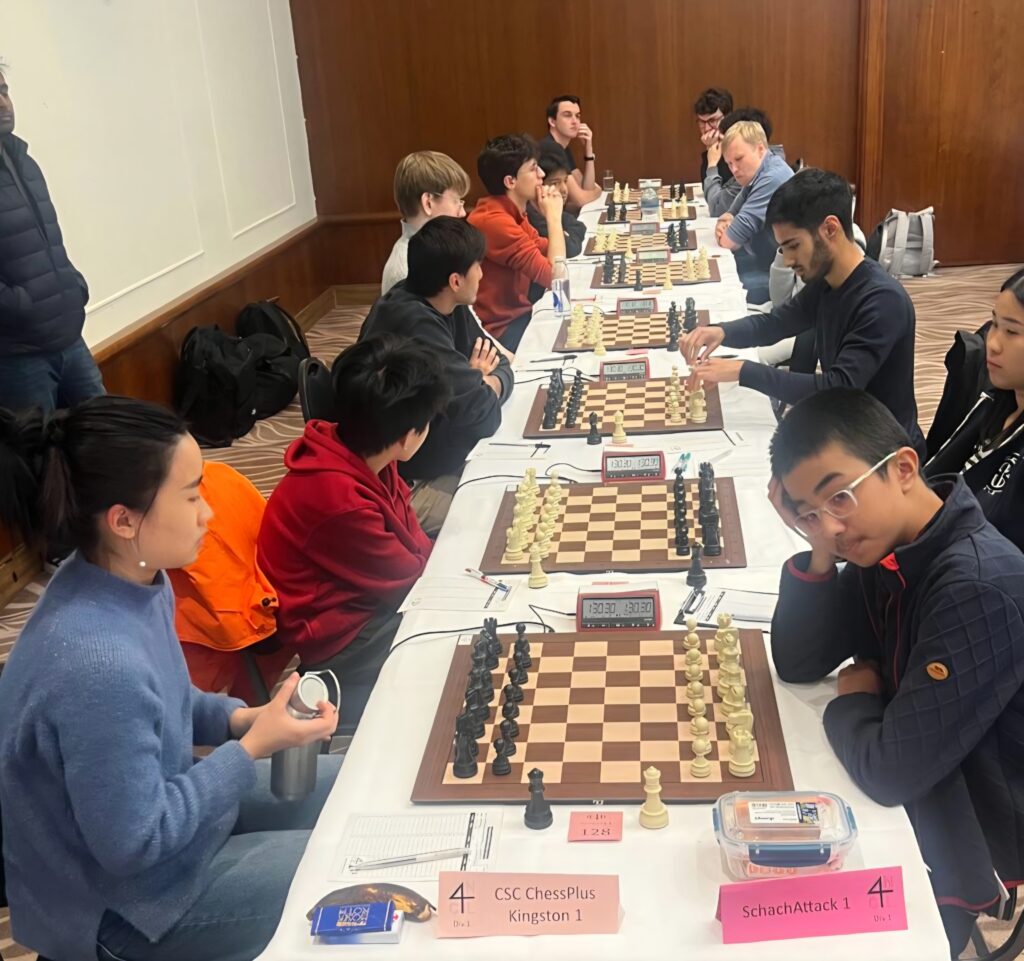
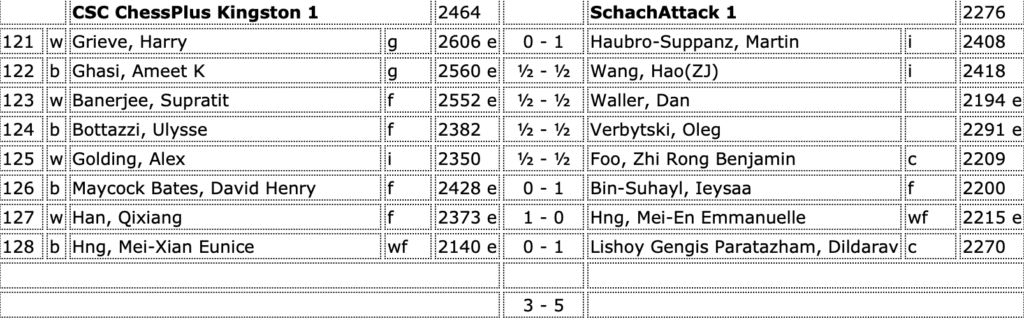
Division 1 Round 5

The first match this third weekend was against the formidable Wood Green, a sponsored team which has won the title on many occasions. They outrated us on every board and the final defeat by 3-5 was within our expectations. Six of the games were drawn and we lost only two. This proved that we were able to slug it out with the elite.

One factor in our favour for the longer term is that the average age of our team is only 19 years old. We are much younger than the soi-disant “Wood Green Youth” team, whose teeth are getting long. Past players for our CSC/Kingston team (the fluctuating history of the team will be told one day) were the then teenagers Matthew Wadsworth and Harry Grieve, both of whom have now graduated to bigger teams.

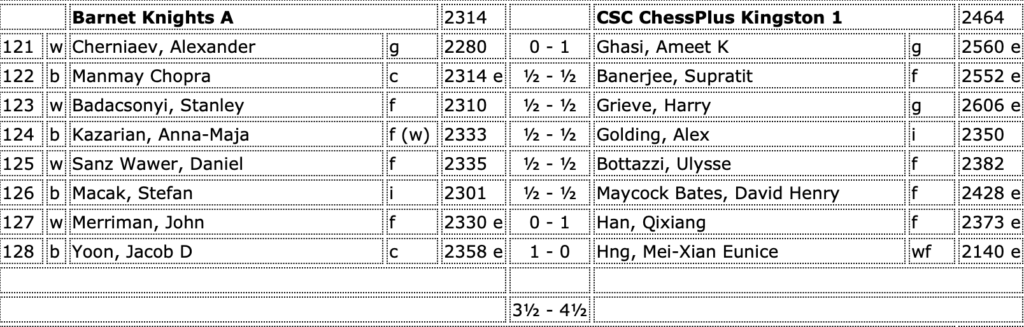
Division 1 Round 6

After the loss, the team repaired to the Hungry Horse to lift our spirits. This had the desired effect because the next morning the team arrived fresh and creative to face the strong Barnet Knights A team. Barnet Knights have been a mainstay of junior coaching in north London and their talented protégés were participating, including the Badacsonyi brothers. We were delighted to see Stanley, who was a joint winner of the Kingston Invitational last summer.

This result marked the “coming of age” of the Kingston team according to an exultant tweet from Kingston club captain Stephen Moss, who had decamped to Florida. He loyally left aside the attractions of sun, sea and beach and hung on the live results feed from 4NCL. We were a shade outrated but by less than in the previous round. The first game to finish was from Ulysse Bottazzi, who made short work of his international master opponent as if in compensation for his quick loss the previous day. Peter Finn had two extra pawns against Ethan Pang, but both sides had two rooks which made progress very slow but he got there in the end.

Finn v Pang
Peter Finn (right) v Ethan Pang

The league table shows we are now fourth from the bottom, which crucially is just above the cut-off point for demotion back down to the second division. A decade ago, I captained a team which had just been promoted to the first division, and my policy was to reward the players who had won promotion for their loyalty and devotion by retaining them in the team. They had the pleasure of playing some of the best players in the country, if not Europe. Whilst this policy had ethical merits, it led to our immediate demotion. The competitive reality is that to survive after promotion it is necessary to strengthen the team, which is what we have done this season.

Division 3 Round 5

Turning now to our second team, which was on 3/4 after two weekends, our only loss being to Sussex Martlets 1, which is the strongest team in the division and top of the table. As mentioned, we were shorthanded as some of our players were on international duties. To make matters worse, at the very last minute, after the pairings against The Rookies, one of our players pulled out due to illness. Defaulting a game is a serious matter in the 4NCL, losing not just the game, but also suffering a penalty point and possibly a financial penalty. Fortunately, Gerhard Bezuidenhout, the father of one of our first-team players, stepped into the breach and, although he lost quickly, he saved the penalties.

This was an excellent victory 4-2 against a slightly higher-rated team. I wondered if they were members of the Stephen Moss fan club named eponymously for The Rookie, his book ruminating on the chess world. Alas, he could not be present to give a speech. After the match, the team tracked to the Hungry Horse for dinner with the first team. The social aspects of team morale cannot be underestimated.

Division 3 Round 6

The morning train from London to Coventry brought our Sunday substitute, Giampiero Amato, who eschewed the offer of a lift to take the No 9 bus from the station. One has to admire his faith in public transport, but it doesn’t do much for the captain’s blood pressure. We swapped the bottom board from the first team and the top board of our second team partly to keep our opponents MK Phoenix guessing.

The team cruised to another victory. Giampiero won a piece in the early middle game and could get the next train back. Ewan Wilson notched up his second point of the weekend. Zain Patel obtained a draw on board 1, as did Viviana Galvan Cipriani on board 2. Tom Farrand was under attack for most of the game, but when the smoke cleared he was the exchange up in the endgame and won.

The games have yet to be published on the 4NCL website at the time of writing so I will mention mine. I had overreached, losing a pawn. I was on the wrong side of a R+P v R ending. It looked ominous, but the game ended curiously. I had been continually checking my opponent’s king from the rear, not allowing any time for the pawn to be promoted. I offered a draw and, to my surprise, my opponent accepted, which was quite a relief. The scoresheets were signed. Our team-mates on both sides subsequently queried whether the position was really drawn. They were right of course – the position was lost.

The second team’s hopes of promotion were greatly increased this weekend with two victories. We are third in the table. Our match against second-placed ToBeDecided will be critical.

Division 4

The third team were playing a Peterborough, which meant that I was unable to learn much more than the match results. The vibe was very positive, with match wins on both days. Chris Rice and Harry Evans both scored a brace.

Division 4 Round 5

Division 4 Round 6

It was an excellent weekend, with five match victories out ofsix. Kingston are definitely contenders for promotion from Divisions 3 and 4 and to avoid demotion from Division 1. Most of the credit should be given to Kate Cooke, who organises the entire squad and was there for all the crucial moments such as dropouts and replacements, logistics and transfers. It really is a team effort.
John Foley