Inspired by David Maycock’s theory that spending too much time looking at the board is inhibiting, we spent an evening playing chess in our heads … and our imaginations
John Foley
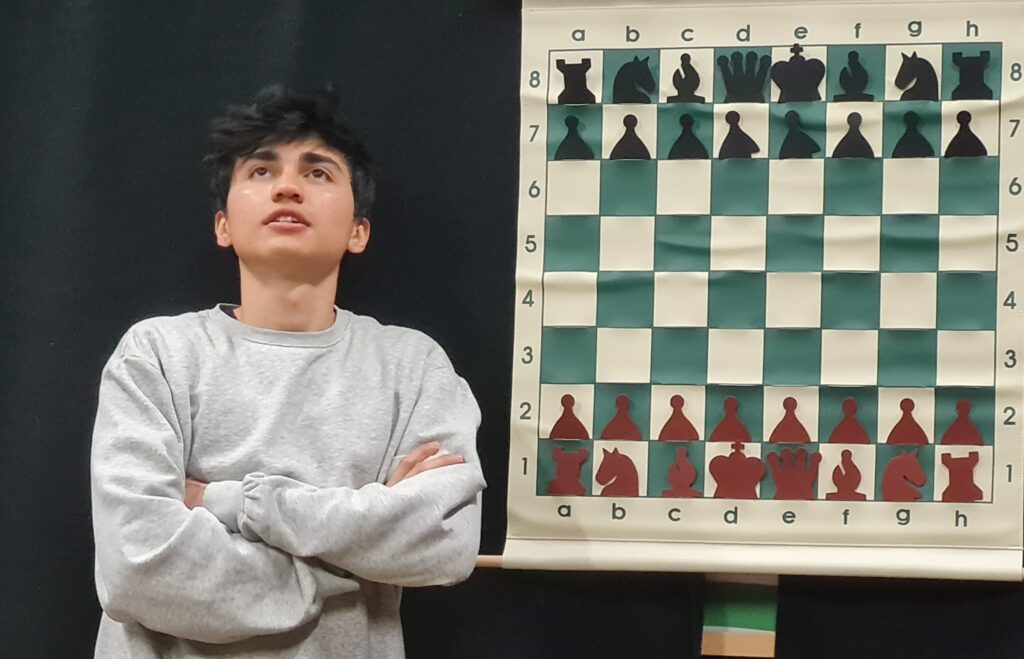
At our club night on Monday 28 March, we explored the theme of playing chess without looking at the board. The evening started with a talk from David Maycock on how he has been developing this technique over recent months. His argument is that if you can visualise the board, then calculating variations becomes much easier. As a simple example, when you are staring at the board and start to analyse a variation you might move a piece in your head but when that piece still remains in vision it interferes with the thought process and you falsely place it on its physical square rather than the square it moved to in your head.
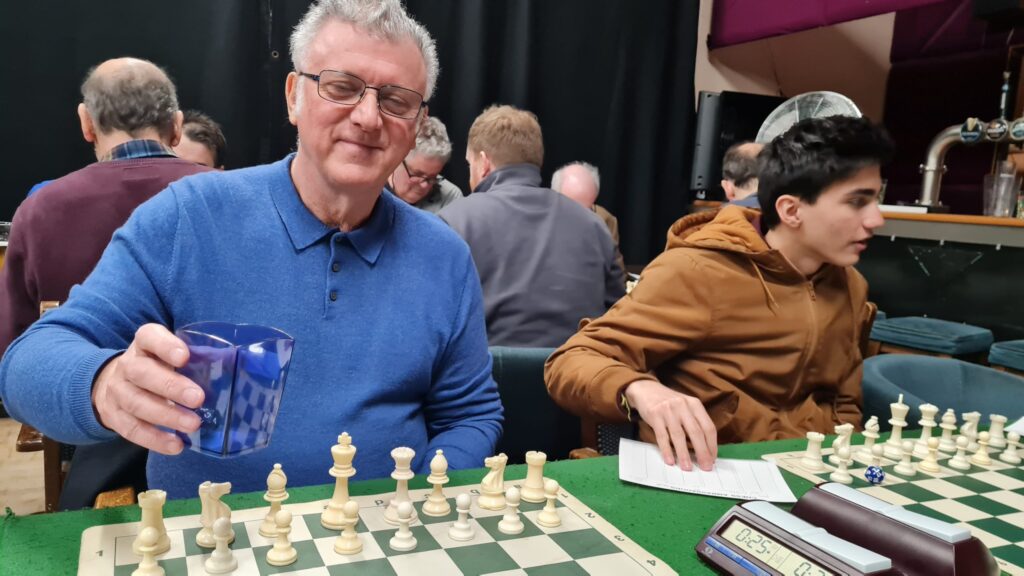
David Maycock not looking at the deliberate mistake on the board
The argument for blindfold chess would be convincing but for the reluctance of many people to give it a try. Hence, we prepared to overcome this reluctance by means of some simple exercises devised by Peter Lalić, who is also a becoming a proponent of the “no looking” approach to playing chess. Peter prepared exercises in which players were paired with each other to play blindfold a simple pawn game on a 3×3 board. This was then followed up by a pawn game on a 4×4 board. Of course, there were no boards – all the physical equipment was removed before the exercises.
It should also be pointed out that “blindfold” does not mean that the players were wearing a mask around their eyes but simply that they were not looking at a physical board. When Magnus Carlsen was featured playing a simultaneous display against players from corporate America, he wore a substantial blindfold. However, this was more to suit the cameras than out of necessity. It looks impressive, but the blindfold is not necessary.
Some of our leading club members suffer from aphantasia – the inability to form any mental images. Stephen Moss readily accepted that he suffers from a mild form of this affliction but did manage to get through the 3×3 game stage, although the 4×4 game was going too far and he lost comprehensively, choosing the wrong one of two possible pawn moves and seeing (or rather not seeing) his opponent clean up.
We had an interesting discussion about why many of the world’s top players get up from the board and wander about. Clearly they are still thinking about the game. Sometimes they return to the board only to make their move. Our inference is that the ability to visualise the game is an important indicator of chess strength. At some point in every game, a critical position is reached. It is necessary to carry out some serious analysis. In these circumstances, it must be a huge advantage to have a clear mental vision of the board in order to construct a variation tree. Strong players are invariably good at blitz chess – perhaps this quickness of vision is also related to their visualisation ability.
Vladimir Li recalled a point made by Jacob Aagaard, the Danish grandmaster and former British champion, in one of his books: that to be an efficient mental analyst you should not keep reverting to the current position. Instead, you should analyse ahead to the critical position and thereafter use that as the staging post for subsequent analysis of variations. It would be a significant advantage for a player to be looking ahead several moves not from the current position but from a future position derivable, perhaps through forced moves, from the current position.
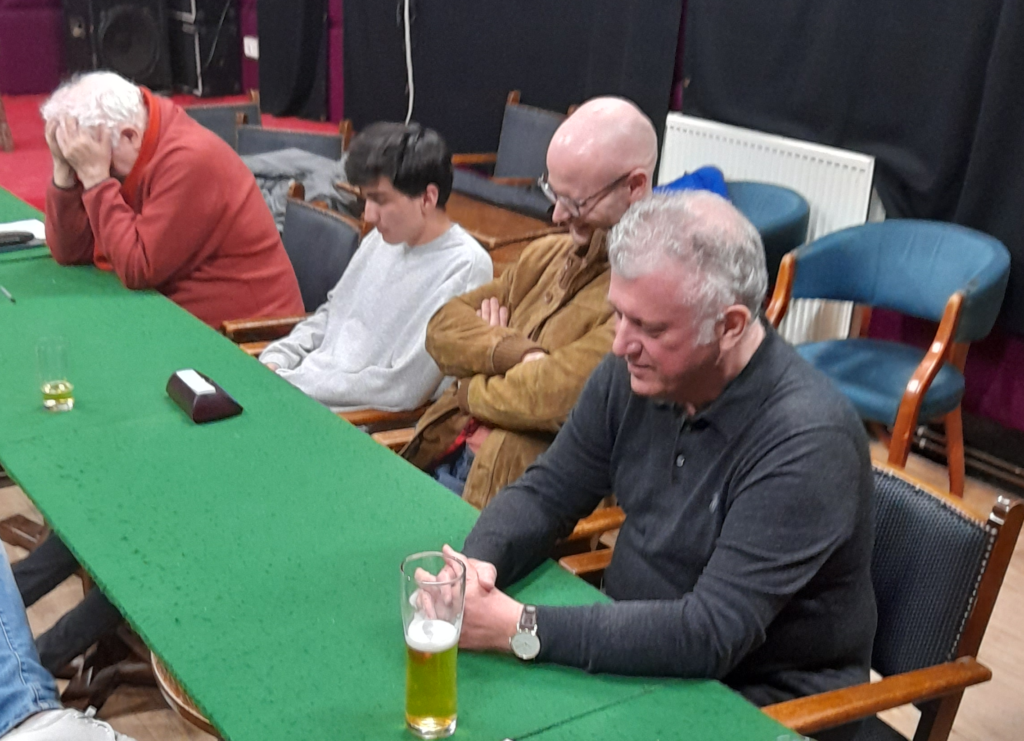
The evening ended with a grand final of blindfold non-consulting pairs. This paired John Foley and David Maycock against Peter Lalić and Alan Scrimgour. The pairs were not permitted to talk to each other – only to give meaningful glances which could be misinterpreted. I have never played blindfold chess previously, so did not fancy our chances, but surprisingly managed to find some moves which were not terrible.
Squeezing their brains playing blindfold chess
The four players sat alongside each other in a state of mental distress, with the display board behind us being operated by David Shalom and Vladimir Li. As we called out our moves, the assembled audience veered from fascination to amusement and finally admiration regarding the match. The game would not merit being featured on the Games section of the Kingston website but is a droll divertissement for the blog.
Legendary IM Michael Basman gave a presentation on the games and legacy of H.E. Bird
Michael Basman treated us last night, the evening of St Valentine’s, to a lecture – more of a love note – to Henry Bird, one of the historic figures of English chess. Although primarily known as an openings innovator and chess instructor, notable for having founded the UK Chess Challenge, Basman has a keen interest in chess history, as befits a chess player who studied history at university.
The topic of the talk was unknown in advance to the assembled Kingstonian cognoscenti. We half expected a detailed analysis of some games in which Basman had narrowly failed to beat the Soviet legends Tal and Botvinnik back in the late 1960s/early 70s when Basman played for England. Perhaps we could have been treated to a discourse on the Fried Liver Attack which Basman had popularised in his early instructional pamphlets, having translated the term from the somewhat more stylish word Fegatello, an Italian dish. Instead, we were given a thoughtful and masterly account of the evolution of international chess in the Victorian period.
Basman devises his lectures as he devises his openings – with an element of surprise. We never know what we are going to get until it happens. There are, however, some constants. First of all, Basman is an excellent verbal communicator. He speaks fluently and authoritatively with an irrepressible wit. Given the subject matter, avian puns were unavoidable, in this case mainly from the audience sadly. Secondly, pure thought must be unadorned by technology. So the presentation notes were handwritten on loose sheets of A4 paper. The absence of staples meant that at one point the sheets inevitably got mixed up. Suddenly we had a vision of a hapless prime minister making a disjointed speech to the Confederation of British Industry. Fortunately, our speaker retrieved the situation without having to resort to ruminations on Peppa Pig.
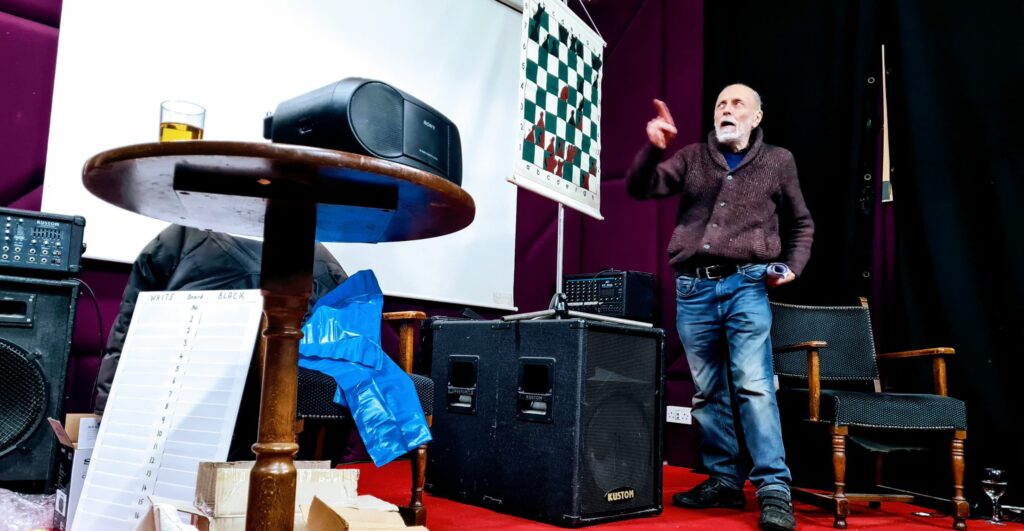
Michael Basman delivers a thrillingly eccentric lecture about the great English player Henry Bird
I recall a presentation Basman gave at the London Chess Conference in 2016. The topic was “A survival guide to teaching chess”. I had expected stories of teaching chess in the classroom or of setting up a national schools chess tournament or even an academic account of chess didactics. Instead, we were given a financial survival guide based on Basman’s well-publicised dispute with Her Majesty’s Revenue and Customs regarding the application of VAT. Suffice to say that a pedagogue representing himself was no match for Queen’s Counsel, resulting eventually in the loss of the case and a financial disaster. Instead of Powerpoint slides, the presentation used large colourful posters held aloft by an attractive assistant. This episode was surreal to say the least. The attendees said later that they had no idea about tax law but that it had been very amusing.
Henry Edward Bird was born in Portsmouth in 1830 (or 1829 according to other sources) in a period when chess in England was in its infancy. Bird was to prove crucial in popularising chess and played a vital part in the development of the game during the 19th century. He was a railways accountant and wrote a book on the subject. The coming of the railways was fundamental to social and cultural change. Indeed, we can trace the emergence of chess in English towns to the arrival of the railways. So in his profession, Bird literally carried chess to the population (see also the Kingston railway connection).
According to Basman, Bird should be much better known. He attributes Bird’s relative obscurity to losing out to Howard Staunton (b. 1810) in what we would today call the information war. When chess history comes to be rewritten, Bird will earn his rightful place in the pantheon of masters.
One cannot help but surmise that the reason for the choice of topic is that there are biographical parallels between the lives of Basman and Bird. Both are notable chess players who arguably did not get the recognition they deserved. They are both openings innovators. Bird lends his name to Bird’s Opening (1. f4) and the Bird’s Defence in the Ruy Lopez. Basman has popularised offbeat openings (Grob, St George Defence) and his name is attached to various other openings (eg Basman-Williams attack against the King’s Indian). Bird and Basman were also both popularisers of the game. Bird had a vision of the newly emerged industrial working classes adopting chess and wrote several chess books, as has Basman.
We learned that Bird did not particularly favour the Bird’s opening. This leads us to the main takeaway from the evening: our openings repertoire is too narrow. Bird liked to try many different openings, including 1. g4 and 1. h4. His contemporaries were unsettled by this unpredictability, which was his main purpose. Eventually, 30 years after he started playing it more regularly, the Bird’s opening was credited to him in 1885.
Bird was of the romantic school of chess and relished sacrifices and attacking play. He played all the greats, including Horwitz, Anderssen, Falkbeer, Boden, Blackburne, Gossip, Mason, Macdonnell and Winawer. He played Morphy on the latter’s trip to England in 1858. Bird witnessed the rise of Steinitz and the scientific “accumulation of small advantages” school which went on to dominate chess strategy.
Bird had clear opinions on his chess contemporaries and the chess scene. He was playing before the invention of chess clocks and analysed the prospective introduction of chess time controls. He categorised players according to the time control at which they best performed. The comparison was measured in moves per hour. He warned against slow time controls as this would take chess out of the reach of the casual chess player and the working man. He recommended that around two hours was a suitable length for a game. This was a prescient observation given the rise of rapid and blitz chess in modern times. His views are completely in line with leading players of the present day. When I discussed this topic with Alexei Shirov, he told me that he wants two hours tops for a game, if only to minimise the chance of cheating.
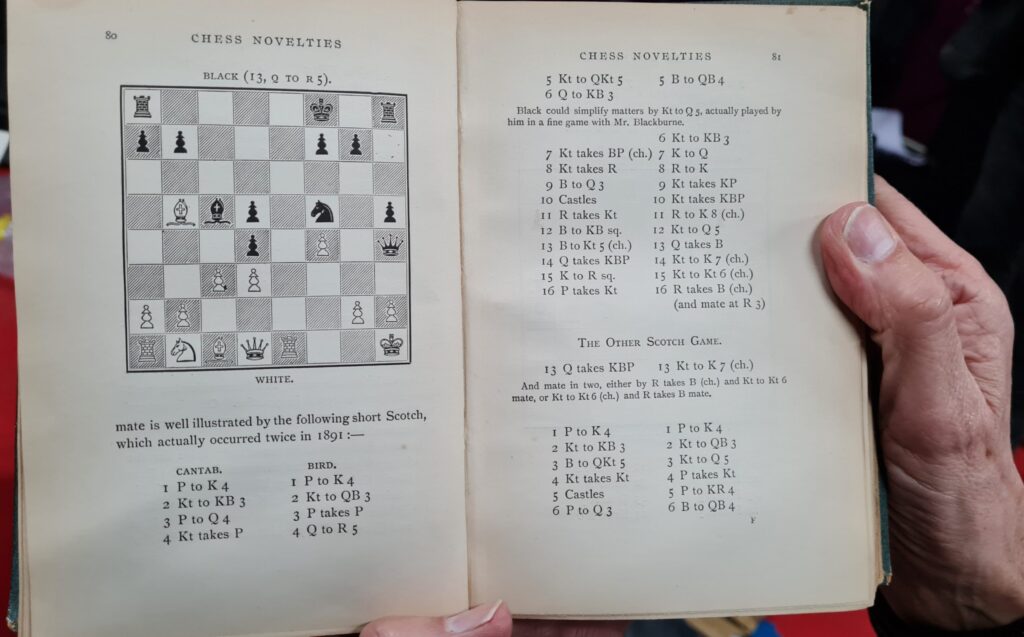
Basman went on to look at some of Bird’s games from his book Chess Novelties and Their Latest Developments published in 1895. He handed out for inspection a first edition of this book, which had previously been in the possession of G.H. Diggle (1902-93), the eminent historian of chess in the 19th century.
Cantab v Bird 1891 from Chess Novelties
One of the games we looked at was Cantab v Bird 1891, a casual game played against somebody presumably associated with Cambridge University. It illustrates Bird’s aggressive style of all-out attack. The text uses an older form of descriptive notation which is still a pleasure to read due to its spaciousness and verbally guided placement of the pieces.
Following the talk, Basman organised a unique rapidplay Bird tournament. It comprised a one-round Swiss complete with pairing cards. The uniqueness lay in the selection of opening moves. In the spirit of Bird, and fellow traveller Basman, the players were bound to play a wider variety of openings. Basman noted that there are 20 moves available on the first move for each player. He therefore obligingly brought along isocahedral (ie 20-sided) dice, which each player rolled to randomise their first moves.
That’s not a glass of beer, it is a dice shaker. Alan Scrimgour (in blue) and beside him David Maycock
The idea of randomising the opening moves stems from the feeling that chess has been extensively analysed and that some changes are required to bring creativity back into the game. An alternative method, Neoclassical Chess, developed by Gabriel F. Bobadilla from Spain, involves randomising the first three full moves. Randomising the opening moves may make some people uncomfortable, but the main alternative approach is Fischer Random, which has the downside that the starting position is different.
Having rolled the die, we consulted the table of moves, inevitably called a Bird Table, corresponding to the number on the die. The Bird Tournament passed off in good spirit. Basman’s win on top board against Peter Lalić was offset by Pat Armstrong’s win for the opposing team on bottom board against Mehran Moini, who hasn’t touched a pawn in 40 years. “I thought we were playing for the same side?” said a bemused Basman to Armstrong when the results were totted up. All were happy at the end of the evening. Thereafter, it was down to the bar to play blitz.
John Foley
Stephen Moss writes: Michael Basman died just nine months after giving this memorable talk and devising a wonderful evening of Basmaniacal chess. He must already have been ill with the cancer that was to kill him, and this will have been one of his last public events, though he also presided over an evening of highly competitive blitz at Chessington Chess Club to celebrate the club’s first birthday a few months later when he was visibly declining but still full of humour and love for chess. He produced a short book on Bird based on his talk and on the games played at Kingston that night – his last chess book.
Club starts regular internal event in an attempt to give more purpose to social chess
As a club, Kingston has not in recent years been good at using its non-match evenings profitably. This is something we hope to change, and on Monday 7 February we held an internal blitz tournament that aimed to combine the fun of social chess with a steely edge of competition. Ten Kingstonians attended, spread across a large ratings range, and there were five rounds at a time control of 10 minutes and five seconds – as John Bussmann remarked, not quite blitz and not quite rapidplay but something in between. We plan more of these events as we develop a structure for social chess, and will experiment with different controls.
David Maycock, the highest-rated player in attendance, was in imperious form and disposed of your correspondent in round two without having to use any brainpower at all. But he faced a tough struggle in round three against the 2000-rated player Peter Andrews, who joined the club just two weeks ago. Maycock had a small edge throughout, but Andrews defended adroitly and the king and pawn endgame was drawn.
Neither player encountered much turbulence in the final two rounds and both ended up on 4.5 points from 5. With time pressing, FM Julian Way, who had masterminded the tournament and done the pairings – at some cost to his own performance in the tournament – had the bright idea of awarding the trophy to new member Andrews rather than forcing the two players into anything so crude as an Armageddon play-off. Maycock already has quite enough trophies and took the runners-up prize, a box of caramel chocolates, which most of those present seemed to think preferable to the little mock-silver cup. A successful experiment and one the club intends to make a regular part of the calendar.
FM Julian Way spearheads start of a monthly online club that aims to complement the weekly in-person meet-ups
Sunday 16 January saw the start of what we are grandiosely calling Kingston Chess Club Online. It does what it says on the tin: it’s the club meeting in online form, initially once a month, to back up our weekly in-person meetings. FM Julian Way, a pillar of the Kingston club for 30 years, is the driving force behind the initiative, and gave the opening talk, based on a game former world champion Mikhail Tal played against the East German international master Reinhart Fuchs in 1964.
The game was not one of Tal’s attacking gems, but a relatively quiet positional game where he won a pawn early on and proceeded to win very simply and smoothly. A textbook example of how to exploit a space advantage, judge an endgame plus, and make a bishop count against a increasingly desperate knight. An instructive game by a great master.
The idea is that we will use the monthly online meet-ups to study games, work on openings, look at endgame studies and commission talks, while holding online club tournaments and simuls by visiting expert-level players on some other Sundays in the month. The club wishes to thank Julian for facilitating the online club, which meets by Zoom, and for offering to help run it in the future. It promises to be a hugely important addition to Kingston as it seeks to emerge from the pandemic and develop as an organisation that wants to cater for both experienced league and tournament chess players and the new generation of chess wannabes that got interested in the game during lockdown.
Kingston Chess Club online will now settle into a monthly pattern – meeting on the last Sunday of each month. Michael Healey will lead the next discussion, looking at the life and games of Russian grandmaster and former Soviet champion Yuri Averbakh, who will be 100 years old on 8 February.
The club is now taking a break until the scheduled resumption of the season on 10 January. Meeting that schedule will of course depend on whether there is a further tightening of government restrictions on socialising in the next three weeks, and on what attitude the leagues in which Kingston plays take to the spread of the Omicron variant. Although the club is not holding any events, there is at present nothing to stop members from visiting the Willoughby Arms to play casual chess. The club will continue to monitor the Covid situation and will update the events calendar and issue further bulletins here as required. Happy Christmas and best wishes for a more buoyant New Year than we have enjoyed over the past 22 months.
Peter Lalić won the Blitz Tournament at the London Chess Classic on Sunday 5 December with an impressive 9.5/11, half a point ahead of Harry Grieve and two points ahead of grandmaster Keith Arkell, who was the top-rated entrant (2398). This was the third blitz in a series of four in the London Classic festival.
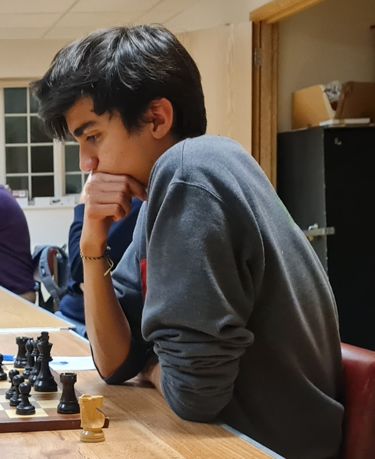
Peter Lalic, taken at Kingston’s recent Alexander Cup victory over Epsom
The Classic is an annual event that brings the cream of international chess masters to London. Due to Covid, the Classic was cancelled last year, and this year it has had to be scaled down. The World Chess Championship in Dubai has also diverted the chess world’s attention away from London. The associated London Chess Conference which I direct has also been postponed until a more propitious date in the New Year.
The blitz tournaments are the only London Classic events which are open to all – the other events are invitation only. The entry fee is £15 and the time control is the nowadays unusual “all moves in five minutes”. This gives rise to some fraught disputes mainly about not placing the pieces in the centre of the square, which unfortunately was also the case during this event. The games were FIDE blitz rated. The first prize of £250 was the first prize money Peter, who took a sabbatical from competitive chess before making a welcome return in the summer, has won in seven years. With a performance rating of 2337, he will not have to wait very long until his next prize.
Peter’s path to victory was as difficult as it gets because he played against all of the top contenders. In round 3, he beat FM Tarun Kanyamarala, the young prodigy from Dublin, who won the 1st EJCOA Forest Hall Invitational event in Newcastle in October with a performance rating of 2508. In round 4, he beat FM Harry Grieve, a mathematics undergraduate at Cambridge who plays for the well-funded Guildford Young Guns 4NCL team and has been tipped by leading English trainer IM Andrew Martin as a future grandmaster. In round 5, he drew with the Canadian FM Tanraj Sohal, a pan-American blitz chess champion, who won the second blitz in the London Classic series 9/11 after drawing with Peter in the final round on the previous evening. In round 6, Peter lost to Keith Arkell, the ubiquitous chess weekender. This is the second time that Keith has beaten a Kingston player recently and plans are afoot to spring an anti-Arkell trap next time. In round 8, Peter defeated IM Ezra Kirk (2308), and in round 10 swept aside the young prodigy FM Shreyas Royal. By the time he reached the last round, there were no comparable players left to pair, and Peter faced Heinrich Basson from South Africa, who had scored 2.5 points fewer. Basson did not present any obstacle.
Peter has a remarkable memory for chess and was able to reconstruct all 11 of the games he played in winning the event. He also performed well in the second of the four London Classic blitz tournaments, and here is his victory in the penultimate round against Harry Grieve.
Healey runner-up at Golders Green
In a double success for Kingston players at the weekend, Mike Healey obtained second place behind Alexander Cherniaev at the Golders Green RapidPlay on Saturday 4 December, scoring 5/6. Mike lost to perennial winner Cherniaev at their encounter in the penultimate round.
David Maycock came third in the strong 4NCL Hull Open held over the weekend 22-24 October 2021. Sharing first place were GM Peter Wells and Steven A Jones on 4.5/5. David shared 3rd place with GMs Mark Hebden and Keith Arkell and Marco Gallana from Italy who all scored 4/5. David, who moved to Kingston from Mexico a few months ago, has been working to improve his over the board chess after a period of enforced abstinence during Covid. His performance rating for the event was Elo 2402.
David rode his luck especially in the final game against the strong amateur John G Cooper. David was unfortunately paired with fellow Kingstonian Peter Lalić in the fourth round. This was the only game which Peter lost, ending on 50% overall.
After over a decade we have decided to switch the site to WordPress which we hope be easier for some of our members to use. We have decided not to transfer our historical articles at this stage. Perhaps we will publish some of the more interesting ones from time to time in the future. The club actually won Club Website of the Year a few years back on the strength of these articles, which were written in the early days of chess club websites. We are grateful to Michael Bennett for having hosted us with TextPattern since the beginning.
The plan is to start afresh with members’ games and match reports. It seems we are at the start of a new era, and we are wiping the slate clean. The pandemic has changed the way we do chess. We have met together online. We play in “beach huts” in the pub garden. There are several new members and some older, more vulnerable, members have been staying away.
It is extraordinary to think that the club was founded in 1875 (though we accept the evidence for its launch in that year is a little sketchy), and is still going after many transformations. We look forward to reaching our sesquicentennial year in 2025 and have begun to make plans. Our ideas include writing a brief history of Kingston Chess Club and running a chess festival in the market square in Kingston. One can never start planning too early.
The club has thrived and survived due to the diligence of a large number of people over the years. We have not taken advantage of social media as much as we could have. Traditionally, chess players moving to Kingston would seek out their local club, but those simple days have passed. Nowadays a chess club must be active on Twitter and other outlets, even if many of the members reject such platforms for themselves.
People join the club to play chess over the board. Playing online does not have the social element. Come along to the club and you will meet other people with a shared interest. Some members are very serious about improving their chess; others prefer to engage in conversations starting with chess but never limited to chess. If you want to drop by on a Monday evening you are always welcome.