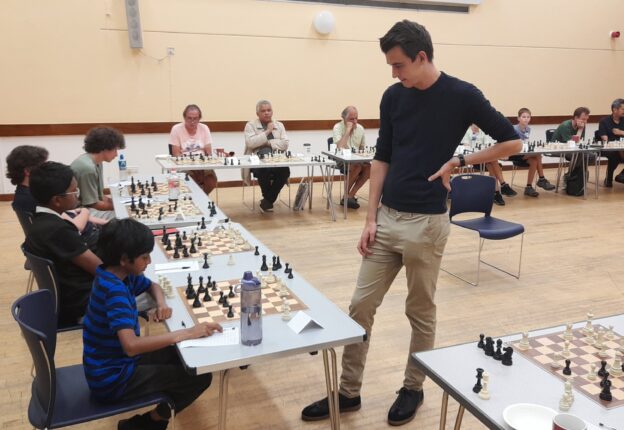
Former British champion Harry Grieve, who recently gained the title of grandmaster, took on 26 of Kingston’s finest in a simultaneous display. It proved a tough night for the GM
A few days before he played in the British championship, where he performed strongly and finished joint fourth, grandmaster Harry Grieve (who won the British as an FM in 2022) played against 26 members and friends of the Kingston club in a simultaneous display at the United Reformed Church in central Kingston, the club’s home. It turned out to be a memorable evening.
Harry won 13 games, drew eight and lost five. The Kingston victors on the night were Peter Andrews, David Rowson, Martyn Jones, Jasper Tambini and Tom Mayers, and we look at their games below. Harry, who played from 7pm until well after 11pm and missed his last train home, was a great sport throughout and philosophical about the reverses.
One of his conquerors suggested it had been a mistake for Harry to have opted for aggressive openings – Harry had White on all boards – and complicated games. Why not keep it simple and technical? “It’s definitely true about the complications,” Harry said afterwards, “and many of the games I lost were as a result of losing control of those. On the other hand, several games I drew were from more dry positions where my opponents played solidly, and having more long endgame-type games also doesn’t seem ideal for the strategy. So maybe the aggressive style would have been more successful if I’d finished off a few boards more quickly. I think it took until 9.30 to get the first result!”
Kingston chair Peter Andrews was cock-a-hoop about his victory over Harry, and we start with his game. The annotations are by Peter.
Another Kingston stalwart to win was David Rowson, who afterwards said: “I was very pleased with my game, though Stockfish finds fault with the moves of course. I felt sorry for Harry. He probably didn’t expect quite such a tough evening. The psychology of playing a GM in a simul is interesting. I at first assumed that he had a deep insight into every position, but after a while I realised that he didn’t have the time or focus (playing 26 games at once) for this and was generally relying on his intuition, which was bound to let him down sometimes as every position has its own special features, which can only be discovered through pretty deep analysis.” Here is David’s game, with his comments:
Another Kingston winner on the night was Martyn Jones, who has a terrific debut season for the club last year and followed it up with a clear-eyed win here. (He recently became a father, but the sleepless nights do not seem to have dulled his tactical skills or positional awareness.) Martyn’s game is below, with some brief comments by him.
Jasper Tambini always plays aggressively and is a challenge for strong players in one-on-one chess, let alone in a simul. In his early 20s, playing in the 2013 British championship, Jasper downed grandmaster and former British champion Chris Ward in a thrilling game. Here Jasper claims another GM scalp, though afterwards Harry said he thought his resignation had been premature (it had ben a long night!).
The fifth player to win against Harry was young Tom Mayers – a superb result for him and a great boost so early in his chess career. Tom has provided extensive notes on the game below, and his annotations capture the unique pressures of playing in a simul and having to play at the simul-giver’s pace.
In retrospect, I realise that pitting Harry against 26 players, quite a few of them rated 2000-plus, was a bit unfair. He was clearly keen to spend more time thinking about complicated middlegame positions, but the clock was ticking and we didn’t want to finish at 2am. If this had been a Sunday-afternoon simul, spread over six or seven hoyrs, Harry would almost certainly have done better. As it was, as the night wore on, Harry had to speed up, errors were made and good players were able to exploit them.
The collective strength of the opposition also told. Harry couldn’t knock out the weaker players fast enough to put time pressure (though ever quicker visits) on the players who were doing well. In that sense a simul is a real team effort. Finally, many of the strongest players were seated together in one row, and they seemed to draw strength from the resistance each was putting up. They could see Harry had problems on a neighbouring board and that emboldened them further. Giving simuls against a large group of strong, motivated players is not easy.
Various prizes were awarded to players who had beaten Harry or achieved a draw, but counterintuitively Harry awarded the main prize, a copy of Stefan Zweig’s Chess Novel (also often called The Royal Game) to Richmond chair Alastair Armstrong. “I was really impressed by some of the creative resources Alastair found to complicate the game from a lost position.” Harry explained. We end by showing the prize-winning game, with a description of the rollercoaster by Alastair. It’s good to end on a game Harry won, because his play throughout was dynamic, and win, lose or draw he remained phlegmatic and boundlessly engaging.
The great thing was that Harry’s tough evening did not affect his play at the British, where he was in contention for the title until losing to tournament winner, 17-year-old GM Shreyas Royal, with Black in the final round. Maybe we can even claim some credit for sharpening him up for the tournament. Maybe…
Stephen Moss is Kingston Chess Club captain