Monthly Archives: December 2025

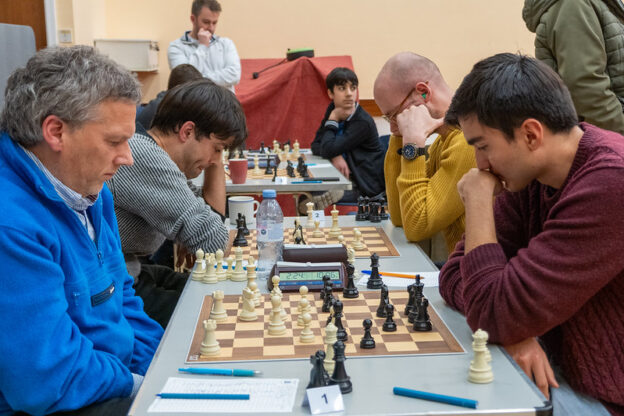
4NCL weekend 3

Measuring how individuals contribute to a team

A case study based on the performance of the CSC/Kingston first team in the 4NCL in the 2024/25 season, by John Foley

Our first team, having been promoted in 2023/24 to the first division of the Four Nations Chess League (4NCL), managed to stay up and achieved a creditable mid-table seventh place in 2024/25. The season comprises 11 rounds over five weekends of exciting and exhausting chess. The start of the 2024/25 season was ominous as we lost our first three matches. In mid-season, with two wins from six matches, the team management even contemplated the unthinkable – making this our last campaign – but our players rallied and, in a final glorious weekend, we drew one match and won two matches against our rivals to secure our survival.

Ten years ago, I was team manager when (under a different team name) we were last promoted. I kept the players together as a reward for their efforts – allowing them to play the cream of the chess world. Whilst my intentions were noble and regarded as fair by the team members, this was not the mindset to achieve glory. There is no room for complacency at the top; one needs a ruthless attitude. During the course of the 2024/25 season, we strengthened the composition of the team as it became clear that obtaining promotion from division 2 is one thing, but staying up in division 1 is something else completely.

The team managers deserved tremendous credit for keeping the show on the road. Each weekend requires considerable planning in terms of team selection, logistics and accommodation. Complications are multiplied because we also have a second and third team, and not all the teams play on the same weekend nor at the same venue. The first team is eight boards and the lower teams are six boards. Nightmare! We did not default a single game out of the 220 played during the season. The person at the centre of the operation is Kate Cooke, who should receive a medal from the 4NCL organisers. 

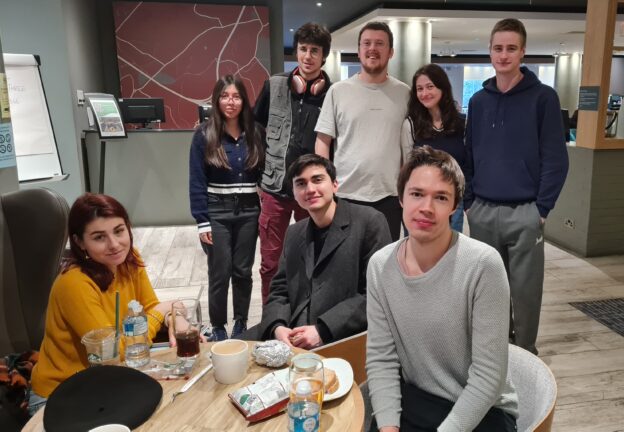
We have one of the youngest teams in the first division, with an average age of around 21. They liked playing for us and a good team spirit developed both over the dinner table and through watching and analysing the games. The matches were written up by Stephen Moss, who doubled as the shadow team captain and guardian angel, always solving problems in the background and ensuring that we had the right resources to deploy competitive teams.

Four measures

The team’s success depends upon the contribution by its members. We use four measures to analyse different aspects of individual performance: 

  • Commitment
  • Competitiveness
  • Combativity
  • Decisiveness

1. Commitment

Commitment can be measured by the number of games played in the campaign. Playing a game implies that one was available and selected. Three players participated in all 11 matches: Vladyslav Larkin, David Maycock and Supratit Banerjee. Vladyslav, a young man from Ukraine, made a considerable effort to come to the Midlands hotels in which 4NCL matches are played. Supratit was only 10 years old, so his parents also had to make a significant commitment. David Maycock not only played in the 4NCL, but is a vital member of the Kingston first team which won eight trophies. Liwia Jarocka and Roland Bezuidenhout each played nine games, for which they also deserve recognition.
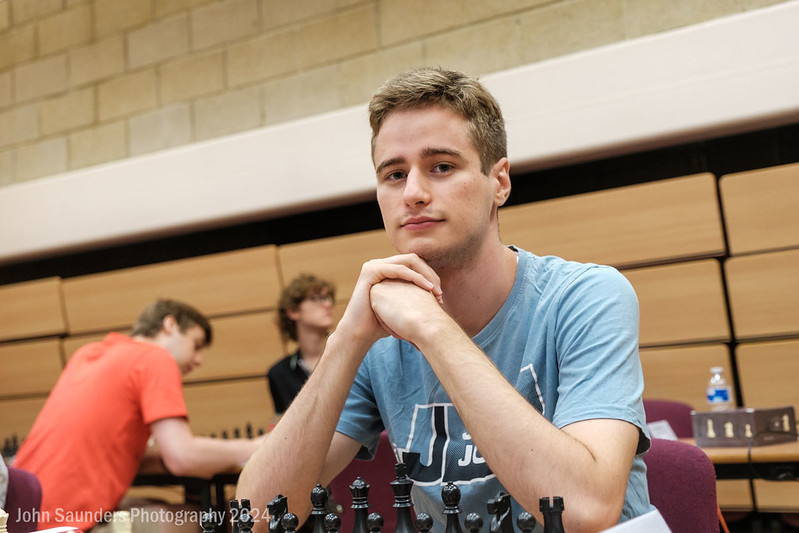
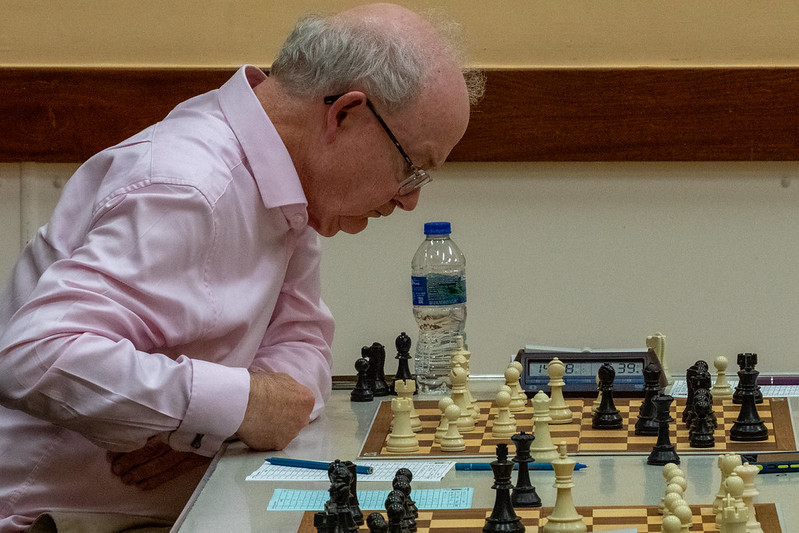
Vladyslav Larkin: The Ukrainian IM played in all 11 matches, showing huge commitment. Photograph: John Saunders

2. Competitiveness

The traditional measure used to recognise performance is the percentage score. To be eligible, a minimum number of games must be played to be fair to other players who may have turned up more often, even if they have not been so successful. Turning up on two weekends out of five seems a reasonable cut-off point – equivalent to four games out of 11. There were two players who played at least five games and obtained a positive percentage score: Supratit Banerjee had 6.5/11 (59.1%) and Liwia Jarocka 5/9 (55.6%). Zain Patel and Ulysse Bottazzi both scored 50% from six games.
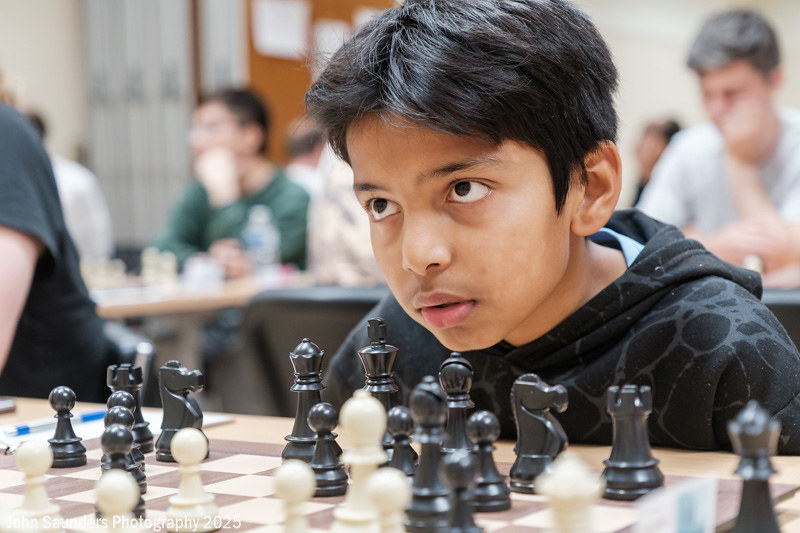
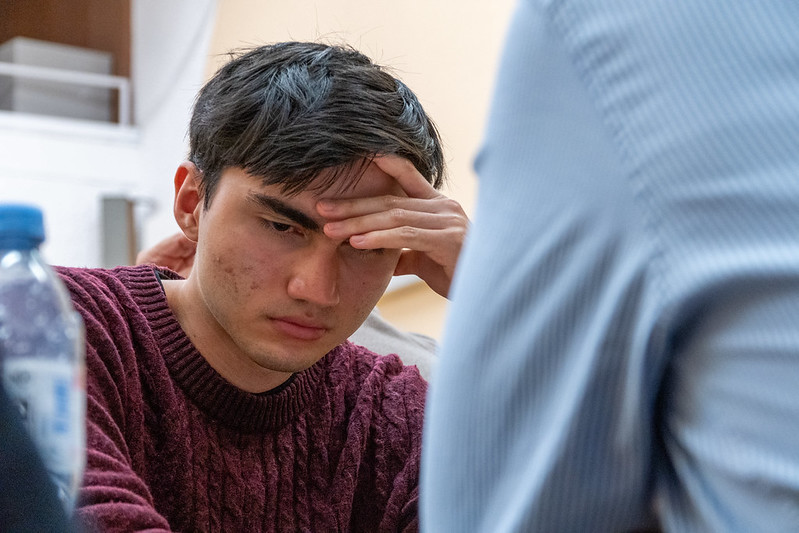
Supratit Banerjee: The most competitive player based on his percentage score. Photograph: John Saunders

3. Combativity

The Tour de France has a special prize for the most combative cyclist – the participant who animates the race by their aggression, attacking flair and will to win. The equivalent in chess is to find the players who perform well beyond their rating. This can be measured as the ratio between their actual performance and their expected performance. The expected performance is derived from the difference in the elo ratings of the players. A 100-point gap confers a two-thirds winning chance for the stronger player; a 200 points gap confers a three-quarters winning chance for the stronger player, and so on. 

The most combative player was Supratit Banerjee, whose combativity score was 1.34. One way of looking at this is that the average return on a bet across all the games on Supratit would have returned 34%. This was a tremendous performance from a seriously talented junior. Supratit’s best result was in round 3 against the higher-rated Tomasz Sygnowski, in a match in which Kingston were trounced 6.5-1.5 by Wood Green Youth. 
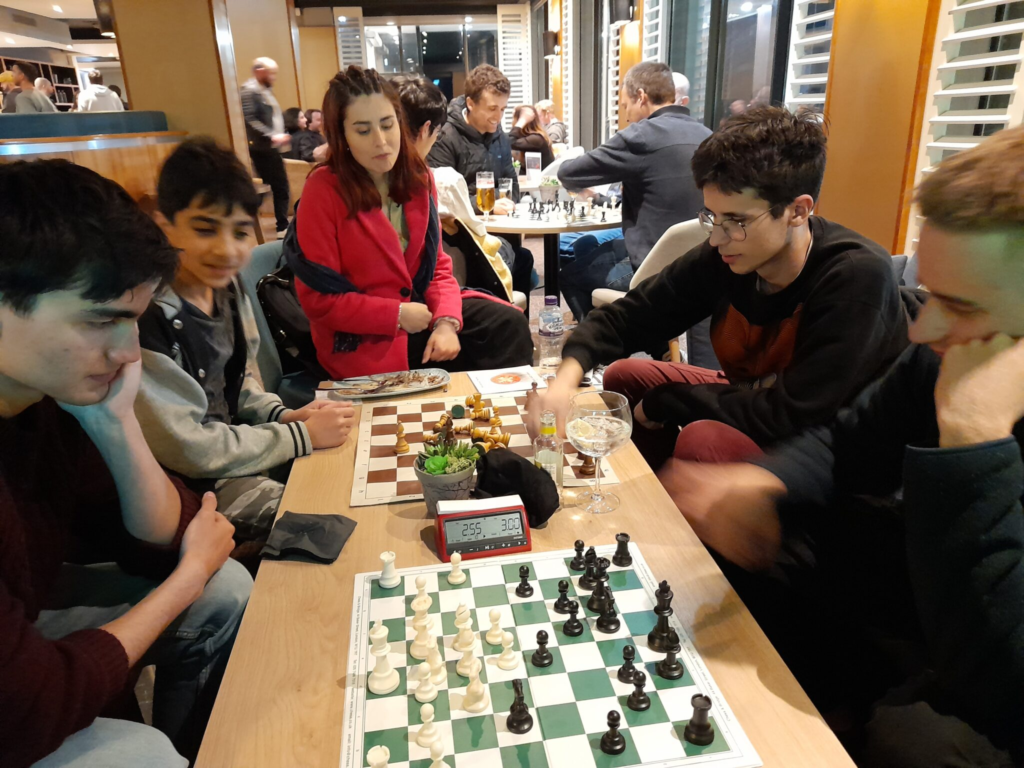
Evening blitz: (players from left) David Maycock, Zain Patel, Ulysse Bottazzi, Vladyslav Larkin.
Ulysse was one of the team’s most combative players

Competitiveness and combativity are correlated and Supratit is the most competitive player, so, to share the honours, we can look to the next highest combative player, Ulysse Bottazzi (then rated 2320) achieved a combativity score of 1.18 from six games. Ulysse had a formidable run in rounds 6, 7 and 8, where he beat IM Stefan Macak (2305) and took draws from IM Rajat Makkar (2413), and GM Daniel Alsina Leal (2490).
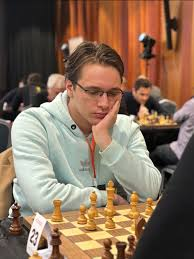
Eray Kilic: Most combative player over three games

If we want to recognise more players who contributed to the final team standing, or to recognise outstanding performance, we can widen the net to those who played just three games. On this criterion, the most combative player was Turkish IM Eray Kilic, who scored 2.5/3 (83%) on the final weekend to gain a combativity score of 1.42. This was largely on account of having beaten GM Keith Arkell in round 9 in the match which we drew against Cheddleton, one of the stronger teams in the competition (Cheddleton were fifth in the final table).  

4. Decisiveness

The measure of decisiveness recognises that some games are more important than others. In a tight match, an individual result can make the crucial difference: converting a lost into a drawn match or a drawn match into a won match. Using an idea by the Nobel prize-winning game theorist Lloyd Shapley, we can identify the player who has made the greatest difference to the team result by winning or drawing in critical matches. 

Think of the sort of person who holds their nerve when under a lot of pressure. They pay attention to the balance of games in each match and try to get the right outcome, eg taking a draw to win the match or trying to get a positive result from a hopeless position. With a minimum of four ranking games, we can rank the players who made the most decisive impact:

David Maycock               21.0%
Vladyslav Larkin             20.7%
Liwia Jarocka                  20.6%
Supratit Banerjee          19.9%
Roland Bezuidenhout 17.9%
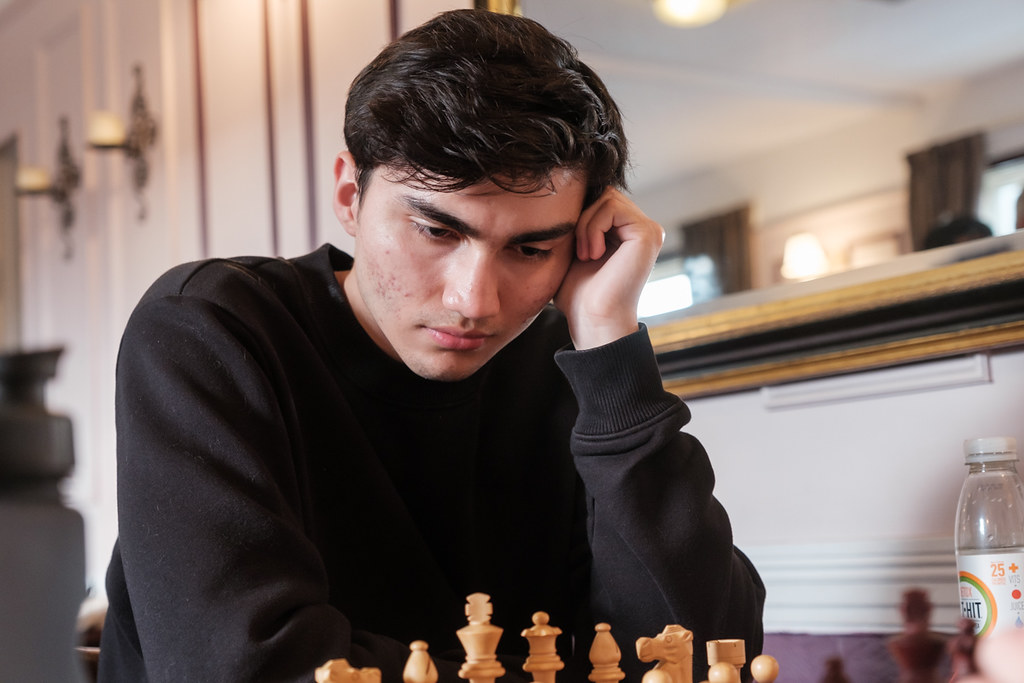
David Maycock: Most decisive player based on performances in matches where CSC/Kingston either won or drew

David Maycock made an impact when the team won or drew. He scored four points in these six matches, perhaps most valuably in round 10 when there was a small margin between the teams. Liwia was also in the running and might have pipped David, but she participated for one fewer weekend. In the game below, David converts a lost ending to a decisive victory.

To summarise, we have navigated through the team result numbers to identify the valuable contributions made by individual players. We identified the most committed player, the most competitive player, the most combative player and the most decisive player. Putting these together, the player who made the overall greatest impact on the team’s performance – the most valuable player – was Supratit Banerjee.

I am grateful for computational support from Dr Lawrence Liao in preparing this article.
Ruthless Kingston A whitewash Richmond A

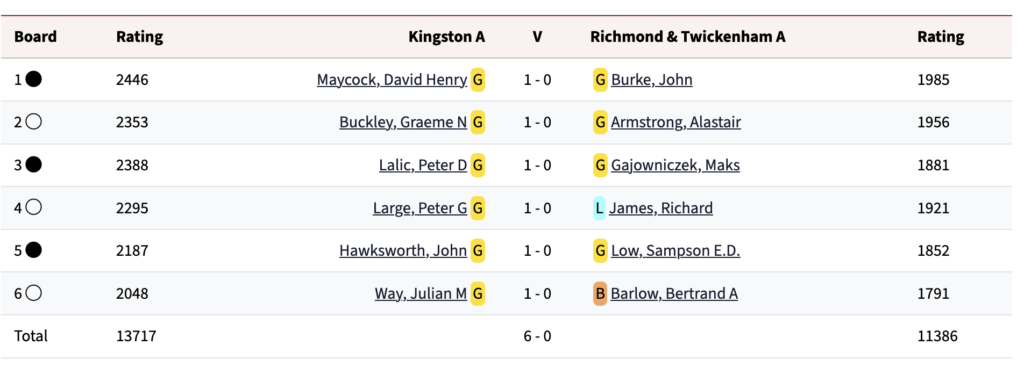
Kingston A v Richmond A, Thames Valley League division 1 match played at the Richard Mayo Centre, United Reformed Church, Kingston on 22 December 2025

This match was played three days before Christmas, but a very strong Kingston team were not in the mood to show any seasonal goodwill to the visitors from Richmond, and the latter were (to use tennis parlance) bagelled, losing 6-0 despite showing plenty of fight. The result meant that Kingston A would be top of the Thames Valley division 1 table over Christmas and New Year.

The Kingston team had three IMs, two FMs and what team captain Peter Large jokingly referred to as a “lowly CM”. The lowly CM, Peter Lalić, was actually playing board 3 and is FM strength – for various reasons, his Fide rating lags behind his true strength. It was a formidable team, and remarkable to think that three other titled Kingston players – GM Ameet Ghasi and FMs Supratit Banerjee and Vladimir Li – were not involved in the match. The club is surely stronger now than at any point in its history, even the fabled 1930s (the era of Blake and Michell) and 1970s (John Nunn) when it swept all before it.

The first game to end – a lot of moves were made but at great speed – was on board 6, where FM Julian Way with White got the better of Bertie Barlow in a bishop v knight endgame. Julian is a master of endgames and once again proved it here. The position below is level, but Bertie makes some tiny slips and Julian pounces on them.

On board 2, IM Graeme Buckley had White against Alastair Armstrong, a returner to chess who has rapidly re-established his 2000-plus credentials. Alastair played Alekhine’s Defence, resulting in the position below where White has several moves of roughly similar strength.

IM John Hawksworth soon made it 3-0 with a smooth win with Black over Sampson Low. John felt he was winning out of the opening, though it would probably take an IM to know that.

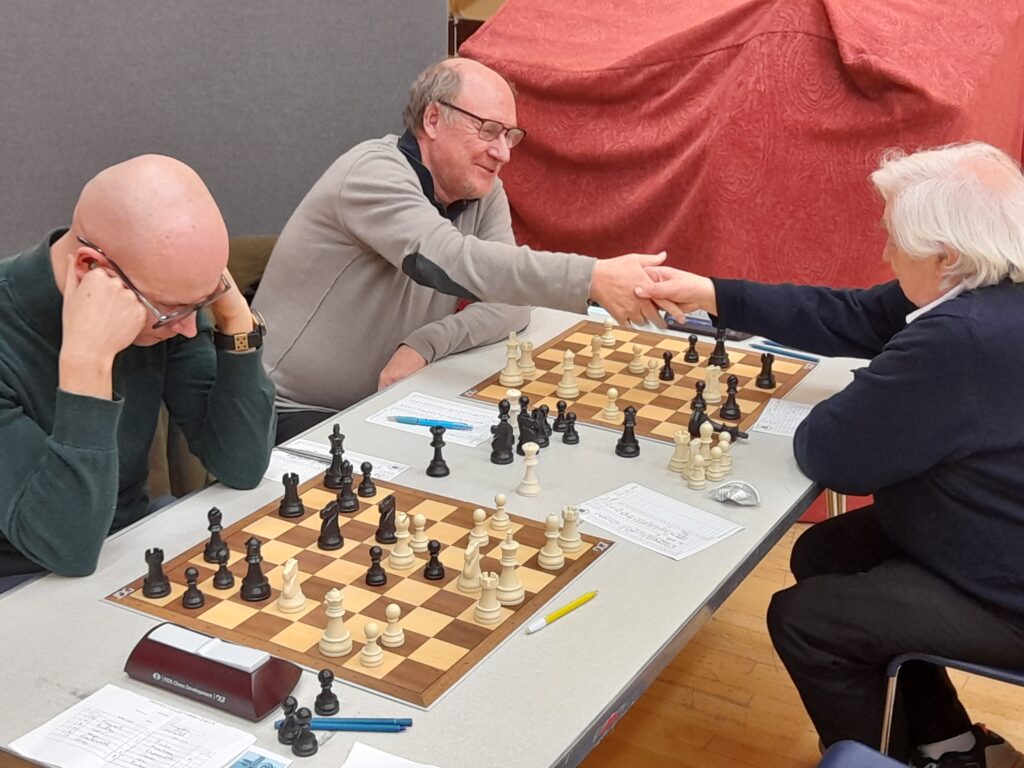
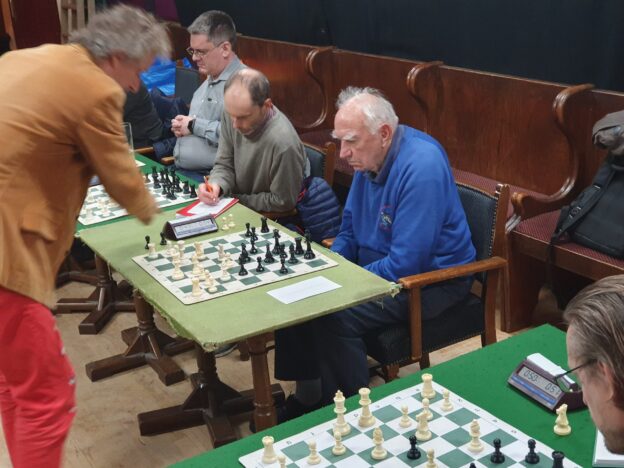
Kingston captain Peter Large was next to win, and that victory ensured the match would be Kingston’s. Peter had White against Richmond president Richard James – a meeting of two south-west London chess legends (pictured below as their game reaches its conclusion). Richard was kind enough after the match to post a report that sang the praises of what we are trying to build at Kingston. Coming from so distinguished a source, this made us feel we must be getting something right, though we know we have a very long way to go to secure a sustainable future for the club.

Clash of legends: Peter Large (top, left) shakes hands with Richard James as their game ends. Peter Lalić is impassive

Richard played the Modern Defence and Peter opted for all-out attack, signalling his intent with the move he played in the position below.

Kingston were 4-0 up, with the time-honoured duo of Maycock and Lalić still playing. Richmond captain Maks Gajowniczek played the English against Peter, but Black essayed an early f5, creating a pawn storm, achieving domination of the centre and neutering White’s dark-squared bishop. This was the discouraging position facing Maks by move 20.

Peter’s win left David Maycock and John Burke (pictured at the top of the report) throwing pieces (metaphorically speaking) at each other on board 1. I recall an exciting game these two played at Richmond a while back and they repeated the drama here, with John, who had the white pieces, giving as good as he got against David’s unflagging invention.

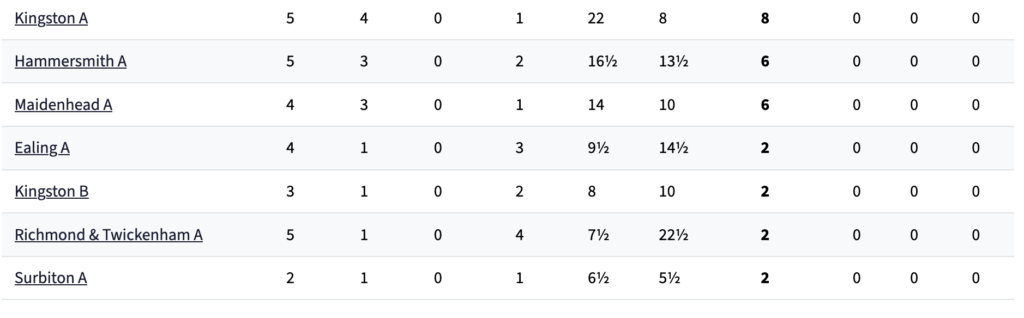
That completed the 6-0 win and gave us time to finish off Ed Mospan’s mince pies, happy in the knowledge that Kingston A would be top of the Thames Valley division 1 table at Christmas (see current table at foot of report). The defeat early in December against Hammersmith reminded us that our bid for a fourth successive Thames Valley title would not be a cakewalk, and the always difficult trip to Maidenhead beckons on 12 January, but for the moment we are riding high.

Stephen Moss is Kingston club captain

Thames Valley division 1 table at New Year

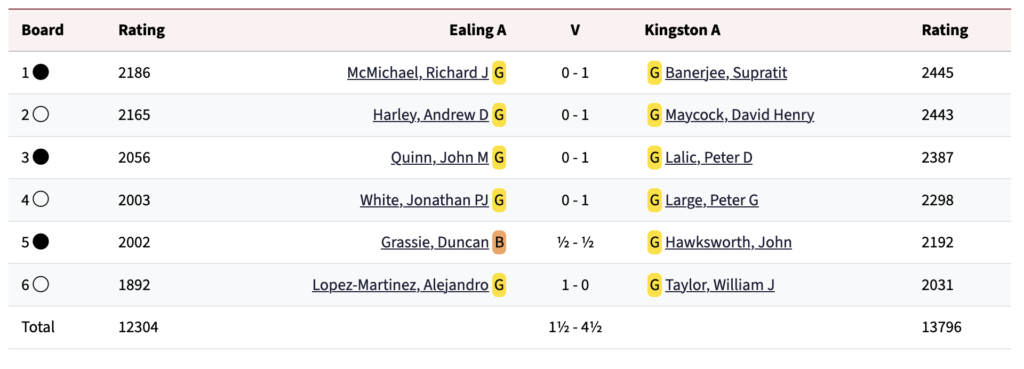
Kingston A get back on track with vital victory at Ealing

Ealing A v Kingston A, Thames Valley League division 1 match played at Actonians Sports Club, London W5 on 15 December 2025

Kingston A had a very pleasant time on our visit to Ealing. I was in a good mood before the match had even started. We arrived to find a table strewn with a cornucopia of old chess magazines and books, and we were told we could take any we wanted. With all the material there is online these days, perhaps people don’t value chess books as much as they used to. But I do. I picked up bound volumes of British Chess Magazine for 1994 and 1995, which I would happily have paid money for, and which I have been poring over ever since. Bliss.

In the match itself, our task was to get back on track after the humiliation at Hammersmith. The first game to finish was John Hawksworth v Duncan Grassie on board 5, in which John obtained a slight initiative in the opening, which quickly petered out into a drawn opposite-coloured bishops ending. Still, a draw is a satisfactory result in a team match (as John Nunn once pointed out to me in a rather withering tone after I had overpressed and lost while playing for the England 65+ team).

On board 6, Will Taylor played the Sveshnikov Sicilian and obtained an advantage after his opponent, Alejandro Lopez-Martinez, tried a dubious line with b4 and a4.

On board 2, with Black against Andrew Harley, David Maycock also played a somewhat non-standard opening. By the time we reached the position below, David had already set a number of problems for his opponent, offering a piece sacrifice which his opponent had wisely declined.

In my own game, it was my opponent Jonathan White, playing White obviously, who tried a non-standard opening (1. f4 e5 2. fxe5 d6 3. Nf3 dxe5 4. e4!? Bc5 5. c3 Bb6 6. Na3!?), but I found a little tactic to win the game.

The last game to finish, as usual, was Peter Lalić’s. Peter is the original and best exponent of the don’t-make-the-best-moves-make-the-moves-which-create-problems approach, and his game here with White against John Quinn was of course no exception. Opening with the ludicrous 1. d3 d5 2. e4?!, he subsequently obtained a good position, but unsoundly sacrificed the exchange to obtain a position which was objectively worse, but difficult for Black to play. Black immediately made several mistakes, which I suppose (and it pains me to say this) justified Peter’s play, and Peter won the ending.

So mission accomplished – we won 4.5-1.5 and Hammersmith has become just a bad memory.

Peter Large is captain of Kingston A in Thames Valley division 1

Stuart Fancy v Ken Inwood

Evening Standard 10th Islington Open, played at the Islington Green Youth Centre, Prebend Street, London N1 on 20 December 1974

We don’t have many games of our long-time top Kingston board Ken Inwood. This is a notable game where Ken succumbed to the dynamic Four Pawns Attack of Alekhine’s Defence. The game was originally published in Chess magazine in January 1975. It is sourced from John Saunders’ historic database resource for chess in Britain. The winner Stuart Fancy later moved to Papua New Guinea, where he became a member of their Olympiad team.

Source: CHESS, January 1975, p110

Staines B edge out Kingston C on big fundraiser evening

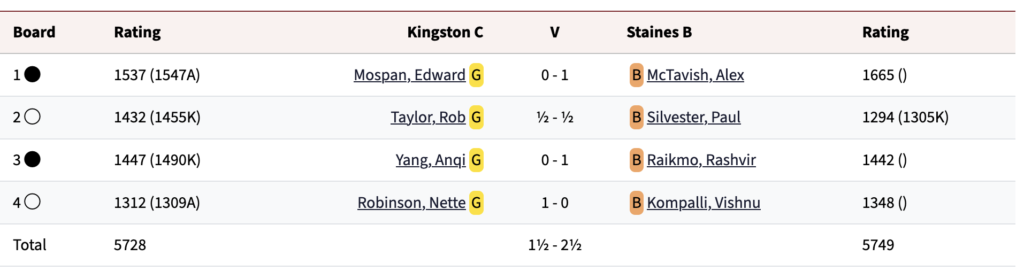
Kingston C v Staines B, Thames Valley League division X match played at the Richard Mayo Centre, United Reformed Church, Kingston on 15 December 2025

This was a well-contested encounter between two evenly matched teams. Ed Mospan, deputising for Jon Eckert, captained and played on board 1, losing with Black to Alex McTavish. Nette Robinson, with White on board 4, levelled the score; Rob Taylor drew on board 2 with Paul Silvester, and the issue was decided in Staines’ favour on board 3, Rashvir Raikmo (again with White) beating Anqi Yang to give the match to Staines by 2.5-1.5.

The evening doubled as a fundraiser by Kingston Chess Club on behalf of the Princess Alice Hospice in Esher. Organised primarily by the ubiquitous Ed Mospan, this initiative raised a fantastic £1,600 for the hospice, through a combination of donations (usually for the opportunity to play a rated game on the night), bids to be involved in a training session with grandmaster Daniel King, and cake sales.

Many thanks to Ed and Genc Tasbasi for running the fundraiser, Daniel King for offering his expertise for free to the highest bidders in the training auction, and to Anqi Yang and Heather Warren for bringing along their wonderful home-made cakes. A memorable evening and exactly the type of community involvement for which we strive at Kingston.

Stephen Moss

Epsom bring winter chill to Kingston

Kingston 1 v Epsom 1, Surrey League division 1 match played at the Richard Mayo Centre, United Reformed Church, Kingston on 8 December 2025

Epsom were worried enough about this match to use some disinformation tactics in advance – we had been led by our Epsom informant to believe that Graeme Buckley and Susan Lalić would not be in the line-up, but rather that they would feature an array of strong juniors. But it was only a minor surprise to find them entering the Richard Mayo Centre at about 7.20pm, and as it turned out it was not a failure to prepare for those two Masters which cost us the match, but rather a collapse on the lower boards.

Epsom had drafted in on board 2 Chris Russell, newish to Surrey but well established in leagues in central London, so no Lalić family clash. Susan Lalić had White on board 3 against fellow IM Peter Large, and that game was a fairly peaceful and quick draw. But the others all went the distance.

Peter Andrews got into early bother with White against talented Epsom junior Lev Razhnou. Photograph: Kyle Cajigas

My own game on board 8 against the fast-rising junior Lev Razhnou was an uphill struggle from early on which required my full attention, so the following account rests on the game scores rather than being able to report rising tension and depression through the evening.

The interest in my game lay in the evaluation of the position early and late on. Razhnou was tactically alert in the opening, and we soon reached the position in the diagram below in which I felt I was almost busted, affecting my mindset for the rest of the game.

I thought that I had done nobly to stay afloat as far as the position shown below after White’s 23rd move, and intermittent spectators felt the same.

Yet according to Stockfish, diagram 1 is only fractionally worse for White whereas soon after diagram 2 the roof fell in on the queenside. Black’s progress between the two diagrams came incrementally rather than in a stroke of brilliance on his part or incompetence on mine. Thereafter, I had some chance on the clock – he was down to three seconds at one point, and still thinking – but none on the board.

Wily veteran Robin Haldane. left. got the better of Peter Hasson with White on board 5. Photograph: Kyle Cajigas

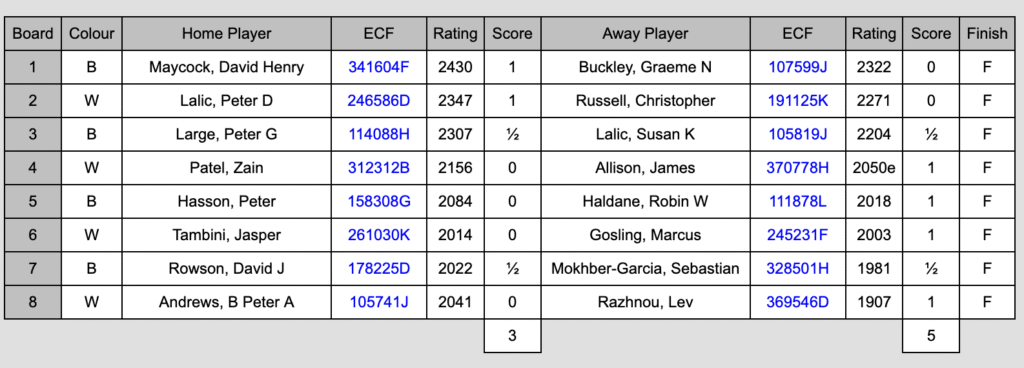
Boards 4 and 5, Zain Patel with White v Allison and Peter Hasson with Black v Robin Haldane, were similar in that the Kingston player outrated their opponent, outplayed them in the first half of the game, and then managed to lose, Zain perhaps through complacency, deferring castling for too long, and Peter through an endgame error which must have reflected time pressure. Around the same time, David Rowson on board 7 seems to have agreed a draw in a winning endgame:

The game was agreed drawn here. But the evaluation is -6, ie Black is winning. As we have seen on other occasions, it can be hard for the side trying to win to find exact moves when time is short, whereas the losing side can just react. The technique is to use the bishop to control the long diagonal to the last black square in front of the pawn, ie a1 to h8, while the black king can prevent the white bishop from settling at a3. Note that it is more difficult to win such an ending when the passed pawn is a centre pawn, because then the weaker side has enough squares on the shorter diagonal to escape the king.

David Maycock forsook his usual fireworks and played a positional game à la Peter Lalić. Photograph: Kyle Cajigas

Things were going better on the top boards. On board 1, David Maycock beat Graham Buckley with Black, not with the usual attacking cascade, but in [Peter] Lalić fashion, heading for a queenless middle game and exploiting several tactical slips to win material.

On board 2, the man himself won another game in which his masterful endgame skills are instructive:

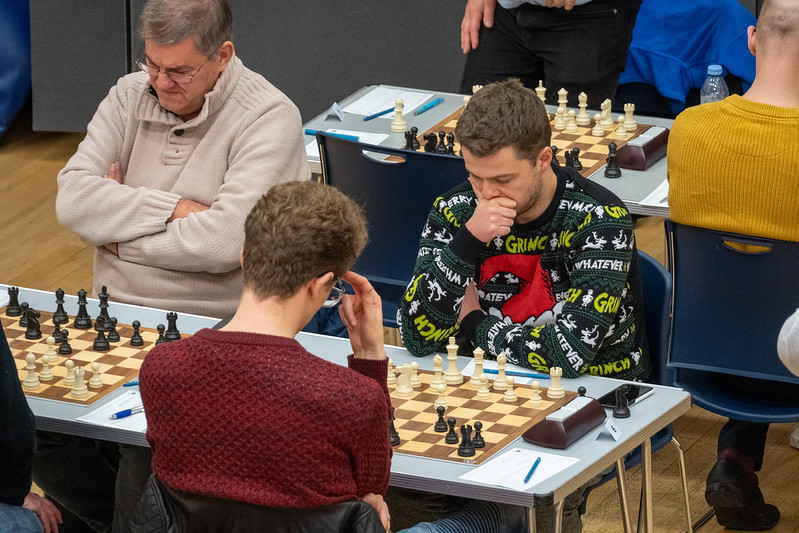
Jasper Tambini, in festive sweater, had a fleeting chance to win his game. Photograph: Kyle Cajigas

That win meant we had a chance to save a draw if Jasper Tambini, who had White, could beat Epsom president Marcus Gosling on board 6. He had one fleeting chance to do so, which both players had missed, and then lost by pressing too hard for the win in a drawn rook and pawn ending. This was the opportunity:

Epsom’s win throws the league wide open, with every team having lost at least one match, and we will need to be at full strength when we travel there on 30 March.  

Peter Andrews captains Kingston’s first and second teams in the Surrey League

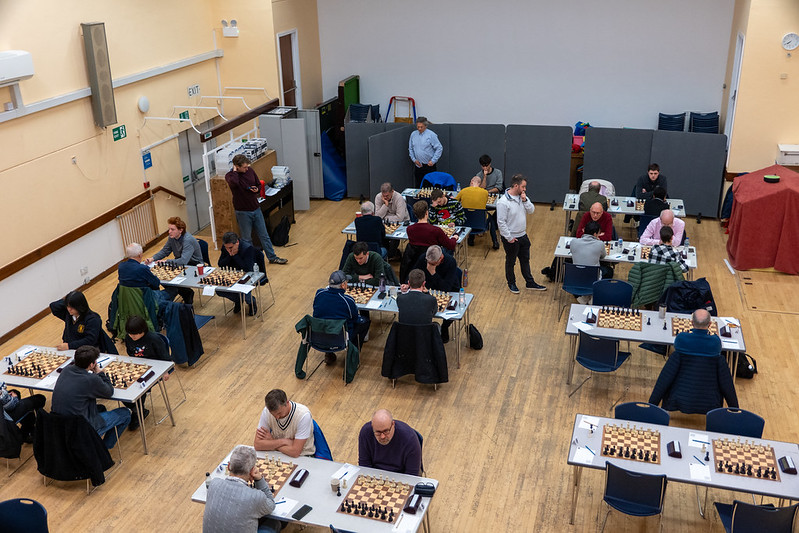
Two bonus pictures by Kyle Cajigas, who photographed the evening’s games for an art project on which he is working

Kingston 3 overcome strong Ashtead 2 side

Kingston 3 v Ashtead 2, Surrey League division 4 match played at the Richard Mayo Centre, United Reformed Church, Kingston on 8 December 2025

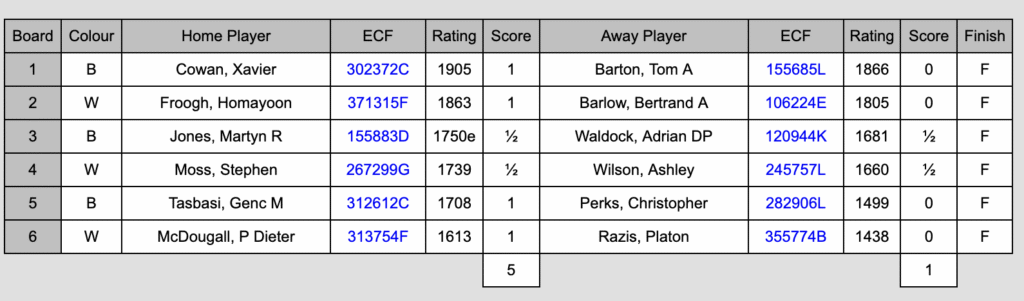
This meeting in the Centenary Trophy, division 4 of the Surrey League, saw two relatively strong teams pitted against each other, and the 5-1 victory for Ed Mospan’s Kingston 3 side was a considerable achievement. A very welcome one, too, on a night when Kingston 1 suffered an unexpected and painful defeat to Epsom 1, the latest in a string of reverses for the club’s higher-rated teams.

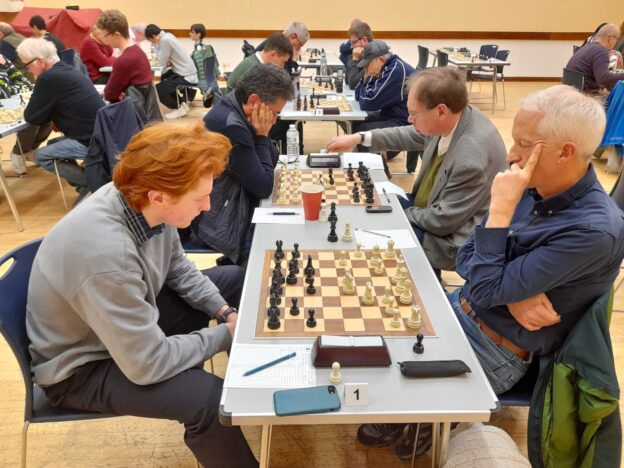
Recent recruit Xavier Cowan (pictured above, foreground left), who is already doing great things at Kingston, beat Ashtead’s very capable Tom Barton with Black on board 1. The opening was a very interesting line of the Sicilian and in this position White has a healthy advantage, but he goes for a tactic which doesn’t quite work.

Homayoon Froogh continued his tremendous winning run with victory over Ashtead captain Bertie Barlow on board 2. He grabbed a pawn in the opening and, once White had made a couple of ill-advised trades, never looked back.

Martyn Jones drew with Black against the very experienced Adrian Waldock on board 3 – like Homayoon, Martyn is having a terrific spell – and I drew with White against Ashley Wilson on board 4. In time-honoured fashion, I missed a likely win because I omitted an important intermezzo in the position below.

That made it 3-1 to Kingston, and Genc Tasbasi and Dieter McDougall completed an emphatic win with victories in well-contested games on boards 5 and 6. It’s still early days of course, but with a team of this strength and confidence Kingston 3 could have a shot at winning the Centenary Trophy this season. Promotion would be useful as we have a lot of players who would benefit from games in division 3.

Stephen Moss

Powerful Hammersmith down Kingston 1

Hammersmith v Kingston A, Thames Valley League division 1 match played at the Mindsports Centre, London W6 on 4 December 2025

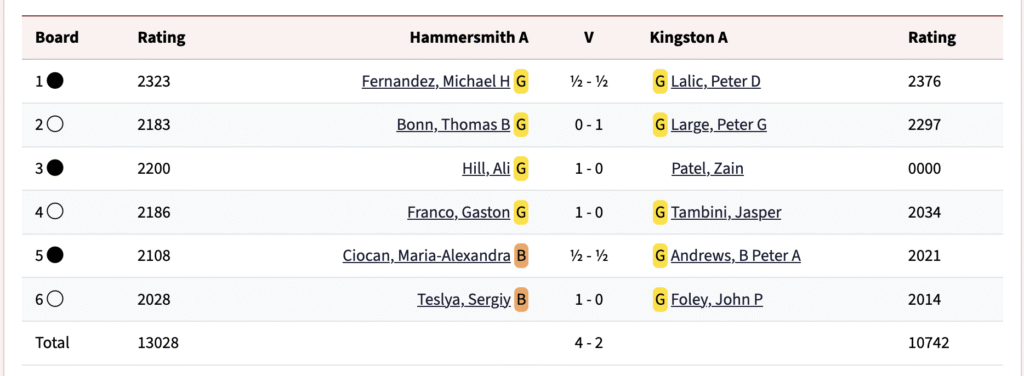
Hammersmith fielded their strongest team so far this season and we were without several key players, so a 4-2 defeat was not surprising. Kingston captain Peter Large, who quite rightly demands very high standards, said it was a hammering, but I felt it was less emphatic than that: a chastening defeat which suggests that winning a fourth successive Thames Valley title this season will be far from easy. Trappy away visits to Ealing and Maidenhead beckon in the next month, and we will need to be at our most resilient.

John Foley, with Black on board 6, was blown away by Sergiy Teslya, who we discovered afterwards had prepared a line against John’s usually trusty Caro-Kann. There was nothing subtle about his kingside blitz, but it was mightily effective, producing this horrible position (for Black) and a quick finish.

On board 2, Peter Lalić had a short but intriguing draw with White against Fide master Michael Fernandez. When I looked at Peter’s position (see diagram below), I thought he had good attacking possibilities. White’s pieces are well coordinated and castling looks dangerous, so what does Black do?

On board 5, Peter Andrews had White against Maria Alexandra-Ciocan. It was a tight struggle, but after establishing a healthy advantage in the middle game Peter missed a winning chance on move 30. The annotations below are Peter’s.

Boards 3 and 4 were going less well for Kingston. Zain Patel had White against the experienced Alistair Hill on board 3, but it always felt as if he was a little behind after the opening, though he sought counterplay throughout. He came very close to building a powerful kingside attack, but was hampered by time trouble and eventually Ali was able to exchange queens, defuse the threats and establish a material advantage that led to White’s resignation. That made it 3-1 to Hammersmith and meant they could not now lose.

Jasper Tambini has been under the cosh and short of moves with Black on board 4 against Gaston Franco for some time, and at no point did it look likely that we would win this game, so defeat in the match was a near inevitability with half an hour of the three-hour session still left to play. Franco played a highly positional game and didn’t allow Jasper, who prefers a more tactical struggle, any oxygen. White won a pawn in the middle game and just squeezed, establishing a winning endgame. A very professional performance by a strong player.

It was left to Kingston captain Peter Large to put a respectable gloss on the scoreline. With Black on board 2 against Thomas Bonn’s Ruy Lopez, Peter ceded a pawn for an initiative, and there followed a tactically complicated struggle which could have gone either way.

That made the final result 4-2 to Hammersmith, who go top of the Thames Valley division 1 table ahead of Maidenhead. We are currently third but have games in hand, and in any case the season is still in its early stages. It does, though, look as if the battle for the title will be extremely hard fought, with any team able to beat any other and home advantage potentially counting for a lot. It promises to be very exciting … and extremely stressful. But we will give it our best shot in an effort to retain our title.

Stephen Moss

Surbiton 1 claim revenge win over Kingston 2

Kingston 2 v Surbiton 1, Surrey League division 2 match played at the Richard Mayo Centre, United Reformed Church, Kingston on 1 December 2025

Having beaten Surbiton only 10 days earlier on their home ground, and with the likelihood that they would be weaker away from home, Kingston 2 approached this match with a degree of confidence. As we shall see, that confidence was justified on the ratings difference between the teams and on the run of play, but not in the final result.

For the fourth consecutive match, Kingston lost the toss in a seven-board Surrey Division 2 match, so having Black on four boards and White on three. Having an odd number of boards and a toss rather than predetermined colours which give a 50/50 split over the season does seem an anomaly. But we had overcome that disadvantage on the three previous occasions.

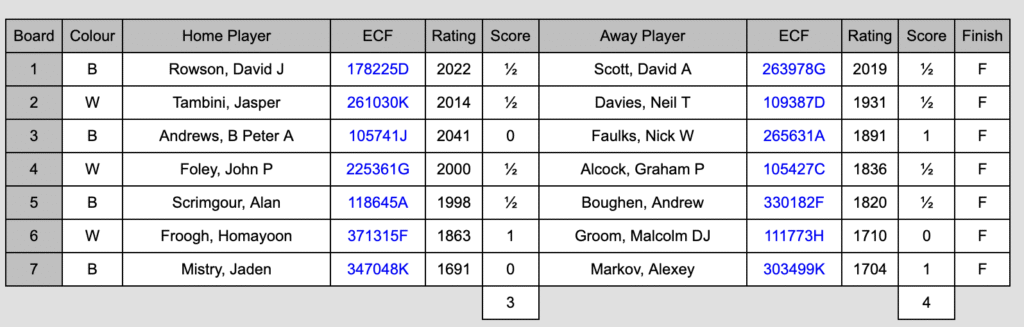
David Rowson quickly equalised with Black on board 1 against David Scott. Jaden Mistry, on board 7, reached what looked like a drawn rook and pawn ending in which his opponent Alexey Markov had a passed a-pawn but Jaden had a four to three majority on the kingside. Jaden pushed his majority and penetrated with his king, but perhaps pushed too hard for the win and went down to defeat. However, Homayoon Froogh soon netted the equaliser with a win on board 6 against Malcolm Groom. Having built up a strong and lasting kingside attack, he missed the chance of a spectacular sacrificial win here.

Instead, Homayoon took no chances and kept the pressure on, and was eventually rewarded when Black cracked and blundered a piece. 1-0

But there followed a series of disappointments in which, as football statisticians might say, expected goals failed to turn into the real thing. On board 5, Alan Scrimgour found a nice tactic to win a queen against Andrew Boughen.

With the white pieces on board 4, John Foley had found another of his trademark exchange sacrifices against Graham Alcock to reach a winning endgame. But a single mistake in the endgame cost the win.

My game with Black on board 3 against Nick Faulks was even worse. I have a substantial plus score against Nick, having a couple of times got away with murder, so he might regard this as evening up, but it was nevertheless galling with the match on the line.

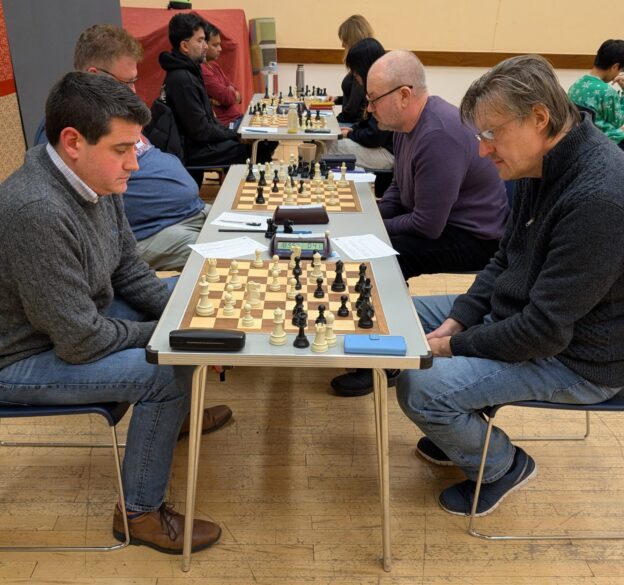
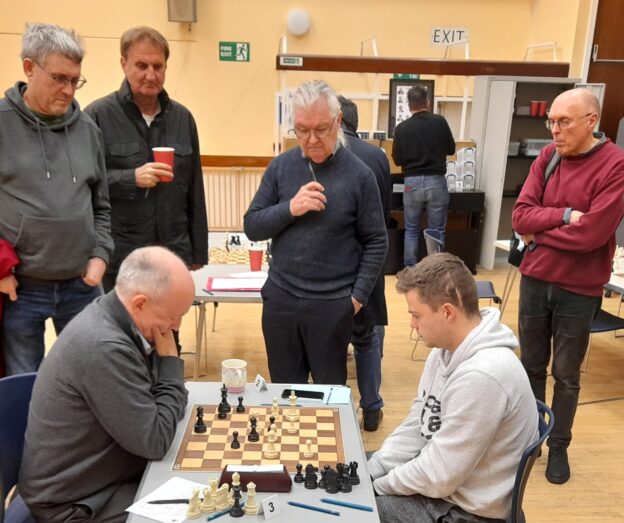
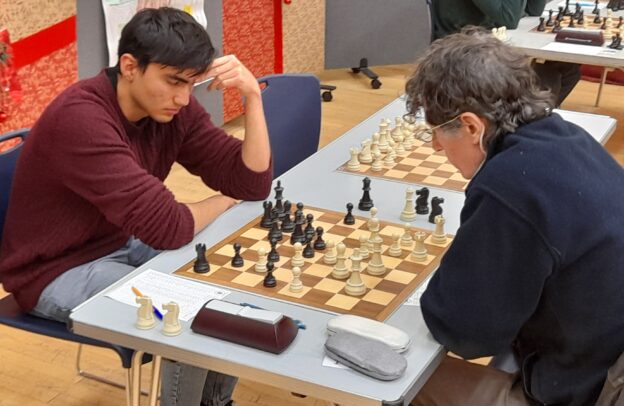
That left Jasper Tambini (pictured above, right) needing to win with White on board 2 against Neil Davies to save the match. Having had his attacking chances resisted, the game came down to a bishops-of-opposite-colour ending with White a pawn up. One pawn is not usually sufficient, but Jasper outplayed his opponent in the blitz finish to create chances. The moves at the critical juncture were not recorded, but we believe the following position was reached.

Now 1. e7 drew, because after 1… Kd7 2. b7 Bxb7 3. Kxb7 h4, the black pawn reached h2 forcing Bxh2 and allowing Kxe7 before the white king could guard the e-pawn. Instead 1. b7 would have won, because the black king cannot easily get at the white bishop and pawn, and the white king can get to d5 to guard the e-pawn. Straightforward in the cold light of day, but not so easy when you are playing on the increment and your mind is scrambled after a tense three-hour struggle.

So a match which could easily have been won 5-2 had been lost 4-3. Taking the two matches against Surbiton together, it is still a decent effort to split the points with a first team, but it could so easily have been better.   

Peter Andrews captains Kingston’s first and second teams in the Surrey League

Chmelev leads Kingston 4 to victory over Coulsdon

Kingston 4 v Coulsdon 3, Surrey League division 5 match played at the Richard Mayo Centre, United Reformed Church, Kingston on 1 December 2025

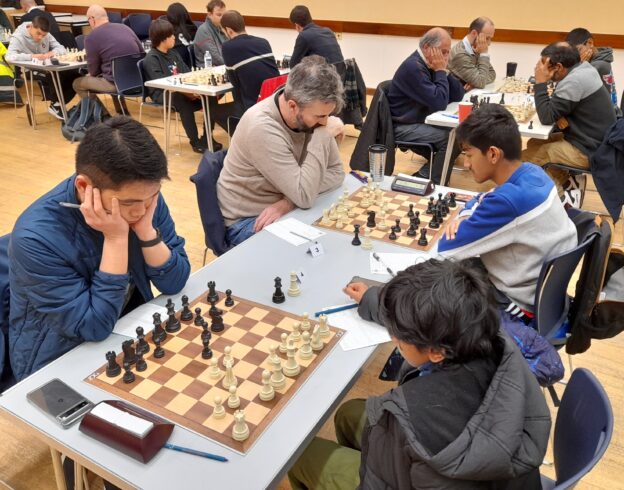
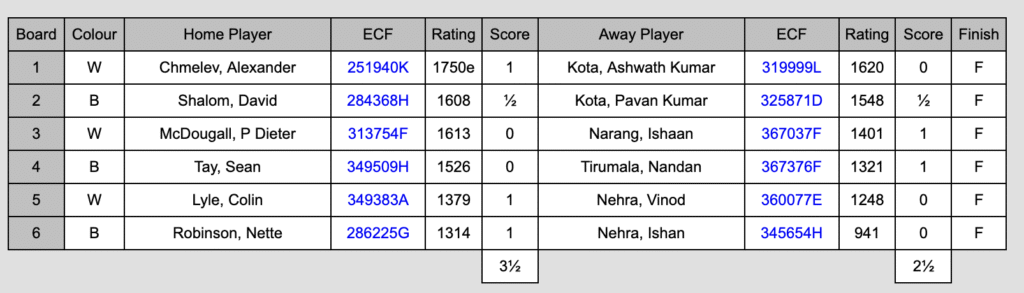
In a difficult week for Kingston – with defeats for the first team against Hammersmith and the second team against Surbiton – this victory for Kingston 4 against Coulsdon 3 in the Surrey Minor Trophy provided a chink of light. But it was mighty close against a young and enthusiastic Coulsdon team, with Kingston winning 3.5-2.5.

Alexander Chmelev, an excellent addition to the club this season, led the way with a win on board 1. Colin Lyle and Nette Robinson enjoyed good wins on boards 4 and 5, and it was left to David Shalom to secure the vital half-point with a draw on board 2. A great result for Ed Mospan and his team in an otherwise disappointing week for the club.

Stephen Moss