Author Archives: Peter Andrews

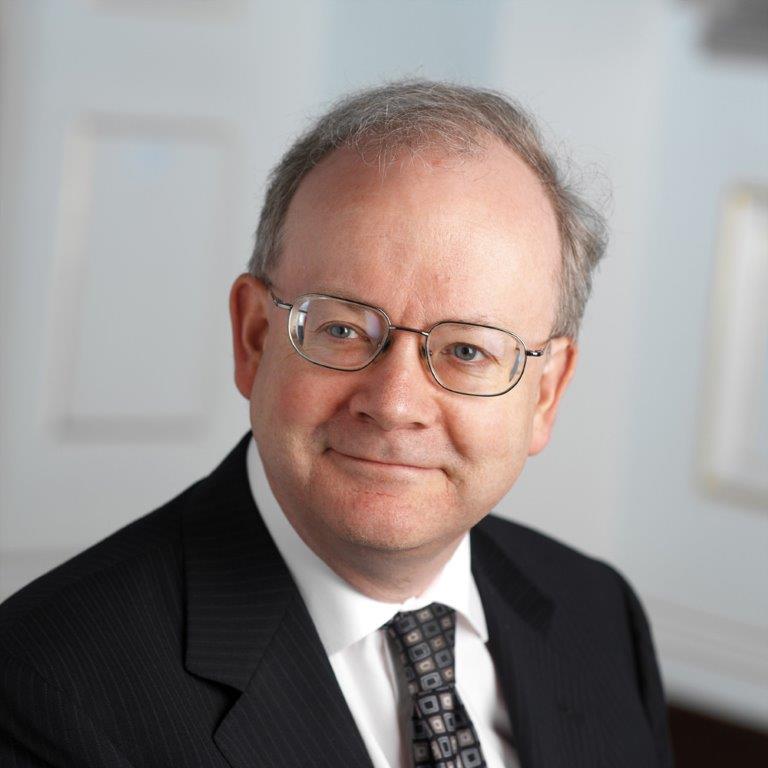
About Peter Andrews

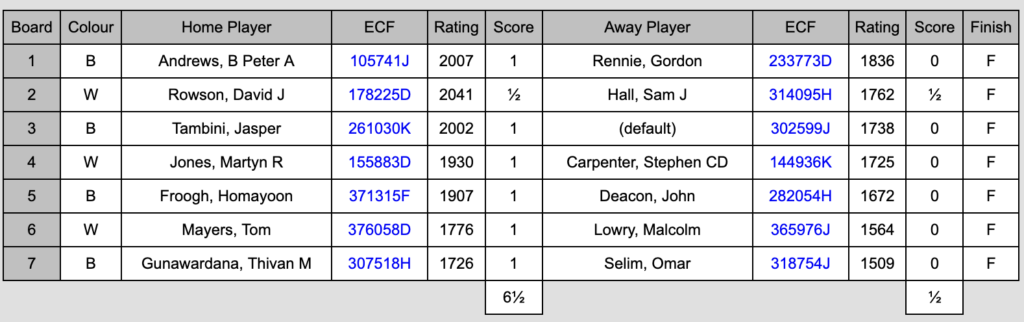
Peter is chair of Kingston and captains the club’s first and second teams in the Surrey League.

Chmelev saves the day for Kingston 2

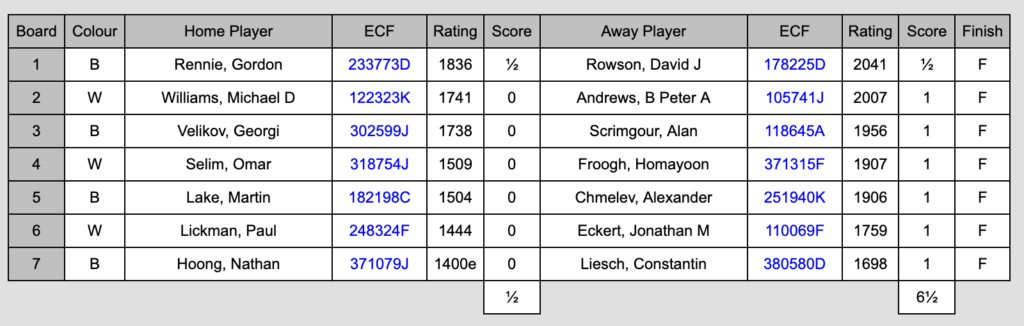
Kingston 2 v Guildford 2, Surrey League division 2 match played at the Richard Mayo Centre, United Reformed Church, Kingston on 9 February 2026
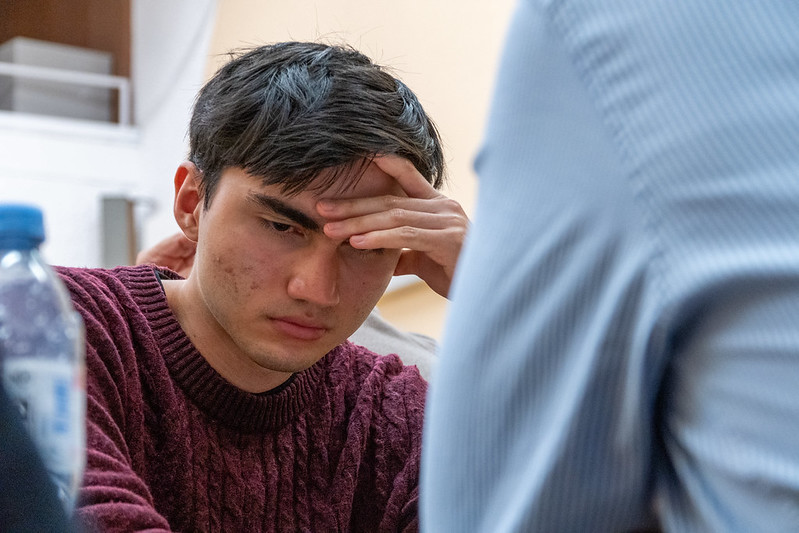
Kingston 2 had a somewhat reshaped team for this match. My main concern was that Guildford 2 would turn up with the strength of which they are capable and our new and newish players might then have a discouraging experience.

My worries were half mitigated before and at the start. Guildford’s captain Clive Frostick, himself a Kingston player in the 4NCL, was unable to make the journey. And although we would be heavily outgunned on the top 3 boards, the match-ups looked close on the other four, and given that our new players tend to be improvers, I thought they might sneak a few results. The toss didn’t help – we lost for the sixth time in 7 matches, which in seven- board matches counts for a bit.

On board 2, Alan Scrimgour made a quick draw with Guildford’s stand-in captain Adrian Wallace in a Spanish. The computer evaluation of the final position, a queenless middle game, was indeed level. There was plenty of material and play left for both sides, but Alan was happy to take a draw on one of the “uphill” boards, especially as the situation was starting to look encouraging elsewhere.

Jon Eckert drew first blood with White on board 6 against Alvin Petersen. The game hung on a mistake in the position below.

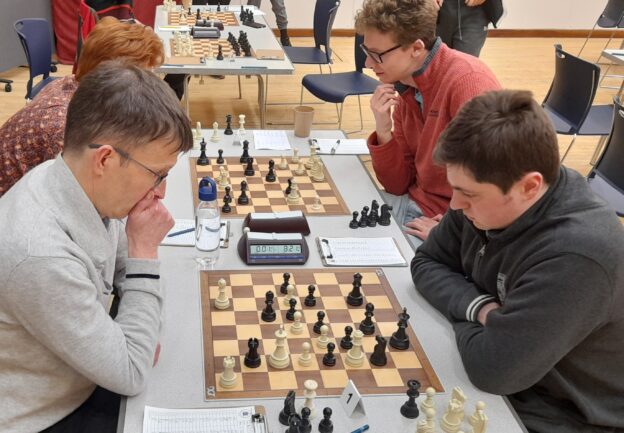
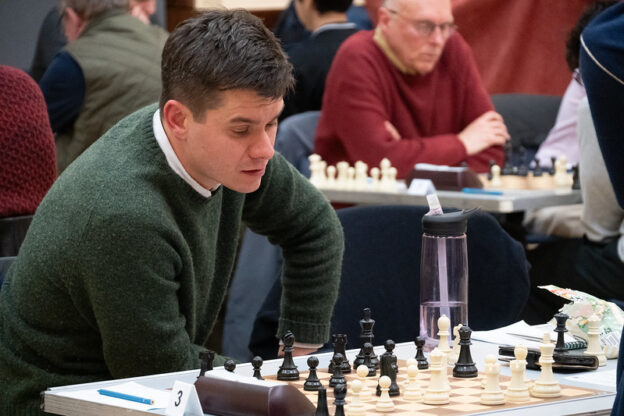
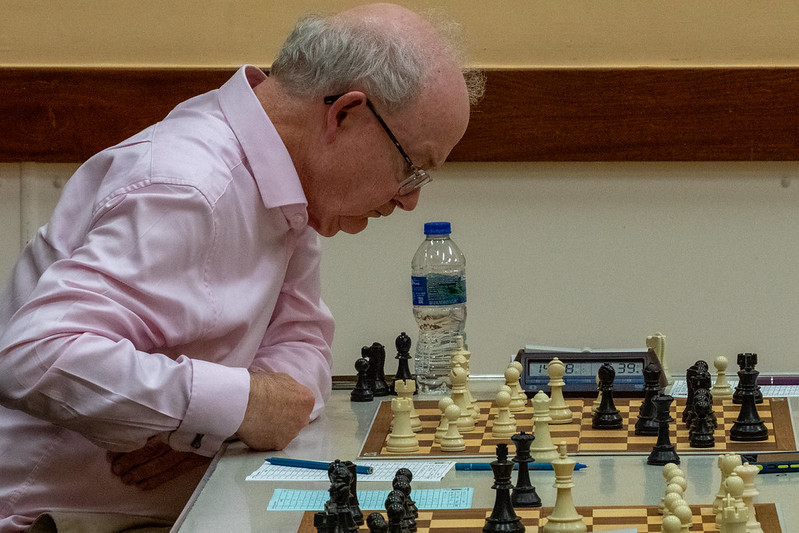
Next, with White on board 4, Martyn Jones (pictured above in a previous match) terminated Alistair Jennis’s threatening attack by spotting mate the other way.

Guildford hit back in a fluctuating and spectacular battle on board 3 between our Stephen Lovell, who had Black, and Tim Foster.

Around the same time, I succumbed with Black on board 1 to Matthew Dishman, in a game that showed the danger of allowing emotion to override calculation. Early over-optimism was succeeded by premature pessimism.

That meant scores were level with two games still in progress, in both of which the Kingston player was making his second-team debut. So they were both getting a full evening’s entertainment. Could they also get the points to get us over the line in the match?

Constantin Liesch, with Black on board 7 against Anthony Garrood, certainly had a memorable introduction to second-team chess, with a crowd around the board in the later stages of this exciting battle.

That left another second-team debutant, Alex Chmelev, needing to win with Black on board 5 against Guildford veteran Trevor Jones to save the match. Fortunately he had won a pawn around move 20, and by the time spectator attention turned to his board he had reached what looked to be a winning rook and pawn ending, with his king able to get in front of his passed pawn and to the queening square, the textbook condition to win.

It was a long slog – the game went some 80 moves – and there may have been a few detours off the textbook path, but all was well that ended well. So we added a matchpoint to our tally and deprived Guildford of one. Despite being outrated in at least half our matches to date, we stand top of division 2. As the old hands at the club remind us, it is not so long since Kingston 1 were pleased to reach such heights.

Peter Andrews is captain of the Kingston first and second teams in the Surrey League


Outrated Kingston 2 spring surprise at Epsom

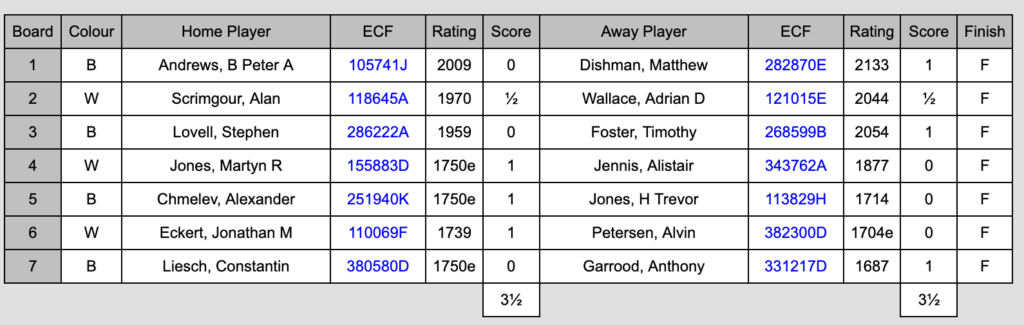
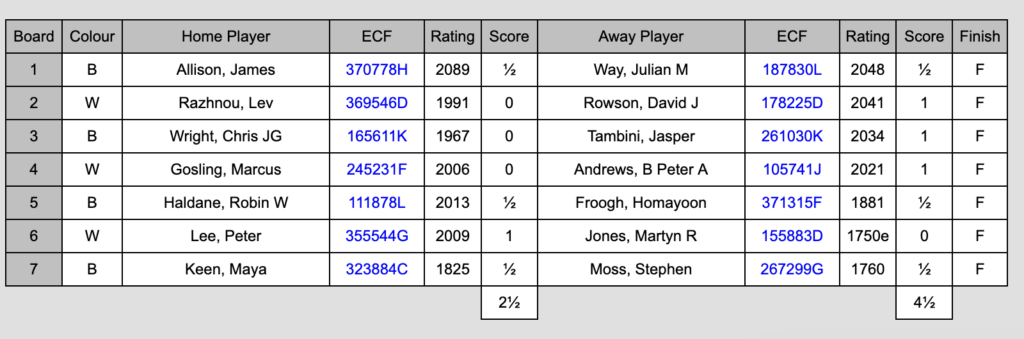
Epsom 2 v Kingston 2, Surrey League division 2 match played at the Epsom Christian Fellowship on 26 January 2026
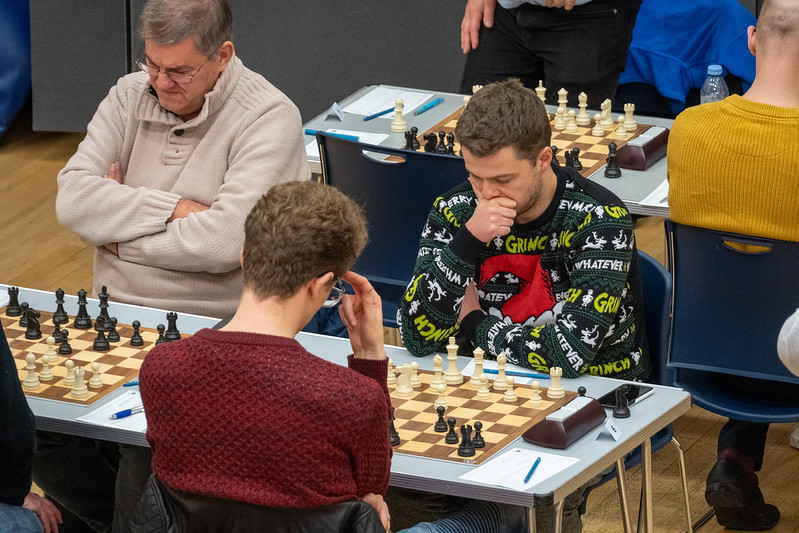
It had been only a fortnight since our tightly fought home draw v Epsom 2, and less than two months since Kingston 1 were defeated by Epsom 1, with three of our side for this latest match and four of theirs also present on that occasion. But to plagiarise the comedian Eric Morecambe for elite chess, we may have been playing the same people, but not necessarily in the same order.

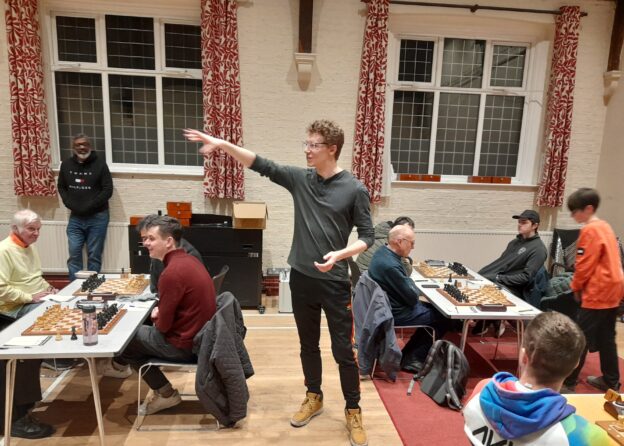
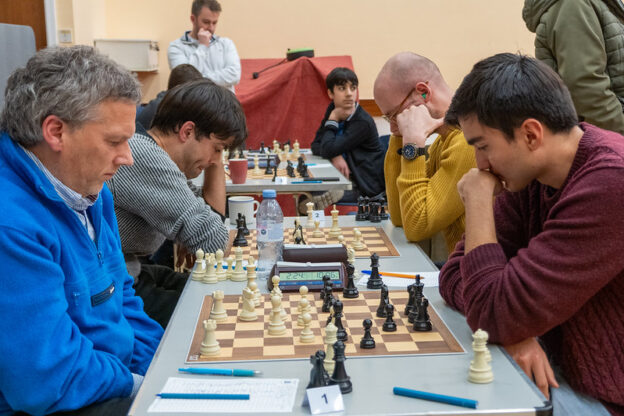
Epsom captain Marcus Gosling (pictured above, directing operations at the start of the match) used the full tolerance allowed by Surrey League rules to promote players in form, notably the fast-rising junior Lev Razhnou, who had added 100 points to his rating between early November and mid December. I had been one of his victims in that run, and had seen him grind down the Essex board 2 in a county U2050 match at the weekend in an endgame, usually a hallmark of class. So we reassured David Rowson, who was to face him, that if he got a result it would be one to treasure when Lev achieves stardom in a few years.

Martyn Jones on board 6 also drew a tough assignment, facing former British champion Peter Lee, while Stephen Moss, who had stepped in at a late stage for the unwell John Foley, was also outrated by his young opponent on board 7. We were clearly outrated on four boards, about evenly matched on two, and only had a significant advantage on board 3.

A challenging task was mitigated by winning the toss for the first time this season (in our 6th match), which gave us four Whites out of seven boards, and probably gave us the colours we wanted for the match-ups – three of our four outrated players had White, and in the middle order Rowson and I are just as likely to score with Black, while Jasper Tambini’s style may better suit White.       

Julian Way played a sensible if unexciting game against James Allison on top board giving us an early draw on one of our “uphill” boards. But Martyn Jones succumbed on board 6, though as he put it there were “plenty of learnings” against such an experienced opponent. I was unable to see much of the rest of the match because of the excitement in my own game on board 4 versus Gosling. Those of my team-mates who saw the game will probably have counted it as a win from early on, but given my previous game with Marcus it didn’t feel that way.

I emerged from my trance over this game to find that on board 3 Jasper Tambini had squashed Chris Wright in a game which carried a useful lesson about engine analysis.

On board 2, David Rowson’s game with Black against Lev Razhnou did not quite live up to its billing. There were some tactical slips on both sides, starting with David losing a pawn but taking the initiative in the middle game, and culminating in an ending in which his pawn advantage with a goodish bishop v knight and connected passed pawns on the kingside were winning, one might have thought easily. But even in endgames chess can be a difficult and cruel game. With both players in acute time trouble, White had one chance to turn the tables.

Thankfully I didn’t see that, or my nerves might not have been fit to drive home. As it was, I came round from my own game to find that we were now 3.5-1.5 ahead, with boards 5 and 7 still going. A draw from one of them would be sufficient to win the match.

On board 7, Stephen Moss had a fighting game with another rising Epsom junior, Maya Keen, in which he dodged several bullets.

Just as Stephen was congratulated by his team-mates for getting us over the line, Homayoon Froogh also delivered a draw. This was a fine result against Robin Haldane, a scourge of Kingston this season having already beaten Peter Hasson in the first-team match in December and Jasper Tambini in the second- team match in early January. Homayoon was never worse, and at the time it felt like a solid and accurate performance. So it was frustrating for him to show his effort to Mr Stockfish next day and find that he had missed an immediate win.

So we had won 4.5-2.5 despite being outrated, a great team effort celebrated with the doughnuts generously brought by Peter Lalic, who came to watch the end of the match. Almost all the games were hard and long, and several of them contained missed one-move opportunities to change the course of history. Which goes to show that chess is hard for humans, but that, along with humour between the teams and doughnuts, is what makes the game worth playing.  

Peter Andrews is Kingston captain in Surrey division 2

Epsom bring winter chill to Kingston

Kingston 1 v Epsom 1, Surrey League division 1 match played at the Richard Mayo Centre, United Reformed Church, Kingston on 8 December 2025

Epsom were worried enough about this match to use some disinformation tactics in advance – we had been led by our Epsom informant to believe that Graeme Buckley and Susan Lalić would not be in the line-up, but rather that they would feature an array of strong juniors. But it was only a minor surprise to find them entering the Richard Mayo Centre at about 7.20pm, and as it turned out it was not a failure to prepare for those two Masters which cost us the match, but rather a collapse on the lower boards.

Epsom had drafted in on board 2 Chris Russell, newish to Surrey but well established in leagues in central London, so no Lalić family clash. Susan Lalić had White on board 3 against fellow IM Peter Large, and that game was a fairly peaceful and quick draw. But the others all went the distance.

Peter Andrews got into early bother with White against talented Epsom junior Lev Razhnou. Photograph: Kyle Cajigas

My own game on board 8 against the fast-rising junior Lev Razhnou was an uphill struggle from early on which required my full attention, so the following account rests on the game scores rather than being able to report rising tension and depression through the evening.

The interest in my game lay in the evaluation of the position early and late on. Razhnou was tactically alert in the opening, and we soon reached the position in the diagram below in which I felt I was almost busted, affecting my mindset for the rest of the game.

I thought that I had done nobly to stay afloat as far as the position shown below after White’s 23rd move, and intermittent spectators felt the same.

Yet according to Stockfish, diagram 1 is only fractionally worse for White whereas soon after diagram 2 the roof fell in on the queenside. Black’s progress between the two diagrams came incrementally rather than in a stroke of brilliance on his part or incompetence on mine. Thereafter, I had some chance on the clock – he was down to three seconds at one point, and still thinking – but none on the board.

Wily veteran Robin Haldane. left. got the better of Peter Hasson with White on board 5. Photograph: Kyle Cajigas

Boards 4 and 5, Zain Patel with White v Allison and Peter Hasson with Black v Robin Haldane, were similar in that the Kingston player outrated their opponent, outplayed them in the first half of the game, and then managed to lose, Zain perhaps through complacency, deferring castling for too long, and Peter through an endgame error which must have reflected time pressure. Around the same time, David Rowson on board 7 seems to have agreed a draw in a winning endgame:

The game was agreed drawn here. But the evaluation is -6, ie Black is winning. As we have seen on other occasions, it can be hard for the side trying to win to find exact moves when time is short, whereas the losing side can just react. The technique is to use the bishop to control the long diagonal to the last black square in front of the pawn, ie a1 to h8, while the black king can prevent the white bishop from settling at a3. Note that it is more difficult to win such an ending when the passed pawn is a centre pawn, because then the weaker side has enough squares on the shorter diagonal to escape the king.

David Maycock forsook his usual fireworks and played a positional game à la Peter Lalić. Photograph: Kyle Cajigas

Things were going better on the top boards. On board 1, David Maycock beat Graham Buckley with Black, not with the usual attacking cascade, but in [Peter] Lalić fashion, heading for a queenless middle game and exploiting several tactical slips to win material.

On board 2, the man himself won another game in which his masterful endgame skills are instructive:

Jasper Tambini, in festive sweater, had a fleeting chance to win his game. Photograph: Kyle Cajigas

That win meant we had a chance to save a draw if Jasper Tambini, who had White, could beat Epsom president Marcus Gosling on board 6. He had one fleeting chance to do so, which both players had missed, and then lost by pressing too hard for the win in a drawn rook and pawn ending. This was the opportunity:

Epsom’s win throws the league wide open, with every team having lost at least one match, and we will need to be at full strength when we travel there on 30 March.  

Peter Andrews captains Kingston’s first and second teams in the Surrey League

Two bonus pictures by Kyle Cajigas, who photographed the evening’s games for an art project on which he is working

Surbiton 1 claim revenge win over Kingston 2

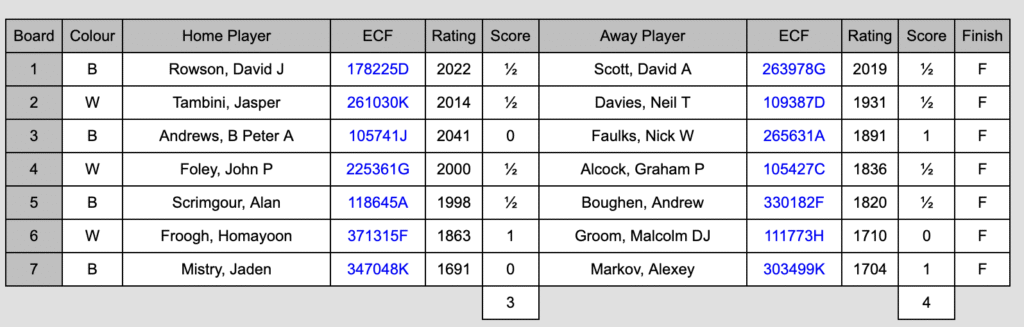
Kingston 2 v Surbiton 1, Surrey League division 2 match played at the Richard Mayo Centre, United Reformed Church, Kingston on 1 December 2025
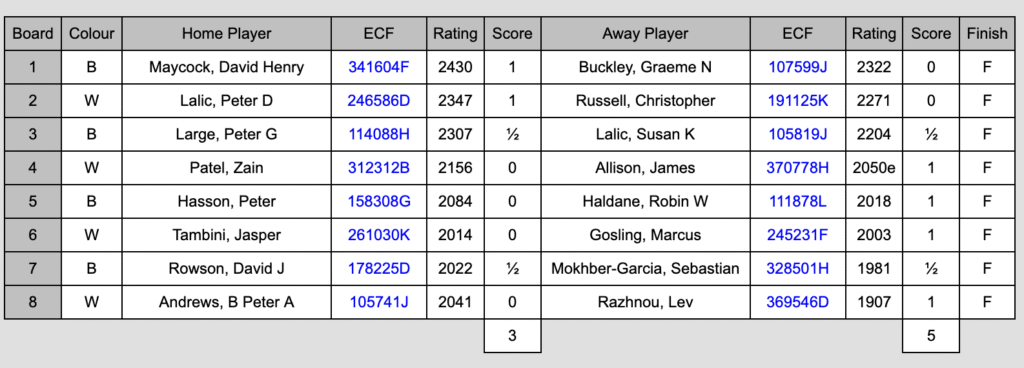
Having beaten Surbiton only 10 days earlier on their home ground, and with the likelihood that they would be weaker away from home, Kingston 2 approached this match with a degree of confidence. As we shall see, that confidence was justified on the ratings difference between the teams and on the run of play, but not in the final result.

For the fourth consecutive match, Kingston lost the toss in a seven-board Surrey Division 2 match, so having Black on four boards and White on three. Having an odd number of boards and a toss rather than predetermined colours which give a 50/50 split over the season does seem an anomaly. But we had overcome that disadvantage on the three previous occasions.

David Rowson quickly equalised with Black on board 1 against David Scott. Jaden Mistry, on board 7, reached what looked like a drawn rook and pawn ending in which his opponent Alexey Markov had a passed a-pawn but Jaden had a four to three majority on the kingside. Jaden pushed his majority and penetrated with his king, but perhaps pushed too hard for the win and went down to defeat. However, Homayoon Froogh soon netted the equaliser with a win on board 6 against Malcolm Groom. Having built up a strong and lasting kingside attack, he missed the chance of a spectacular sacrificial win here.

Instead, Homayoon took no chances and kept the pressure on, and was eventually rewarded when Black cracked and blundered a piece. 1-0

But there followed a series of disappointments in which, as football statisticians might say, expected goals failed to turn into the real thing. On board 5, Alan Scrimgour found a nice tactic to win a queen against Andrew Boughen.

With the white pieces on board 4, John Foley had found another of his trademark exchange sacrifices against Graham Alcock to reach a winning endgame. But a single mistake in the endgame cost the win.

My game with Black on board 3 against Nick Faulks was even worse. I have a substantial plus score against Nick, having a couple of times got away with murder, so he might regard this as evening up, but it was nevertheless galling with the match on the line.

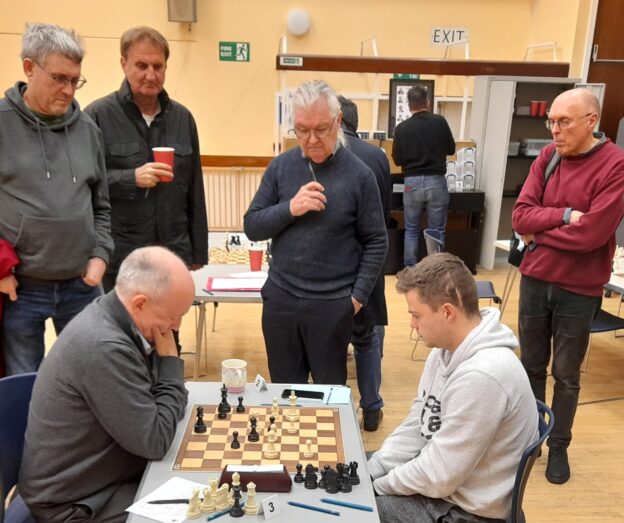
That left Jasper Tambini (pictured above, right) needing to win with White on board 2 against Neil Davies to save the match. Having had his attacking chances resisted, the game came down to a bishops-of-opposite-colour ending with White a pawn up. One pawn is not usually sufficient, but Jasper outplayed his opponent in the blitz finish to create chances. The moves at the critical juncture were not recorded, but we believe the following position was reached.

Now 1. e7 drew, because after 1… Kd7 2. b7 Bxb7 3. Kxb7 h4, the black pawn reached h2 forcing Bxh2 and allowing Kxe7 before the white king could guard the e-pawn. Instead 1. b7 would have won, because the black king cannot easily get at the white bishop and pawn, and the white king can get to d5 to guard the e-pawn. Straightforward in the cold light of day, but not so easy when you are playing on the increment and your mind is scrambled after a tense three-hour struggle.

So a match which could easily have been won 5-2 had been lost 4-3. Taking the two matches against Surbiton together, it is still a decent effort to split the points with a first team, but it could so easily have been better.   

Peter Andrews captains Kingston’s first and second teams in the Surrey League

Kingston 1 chalk up key victory at Guildford

Guildford 1 v Kingston 1, Surrey League division 1 match played at the Guildford Institute on 17 November 2025

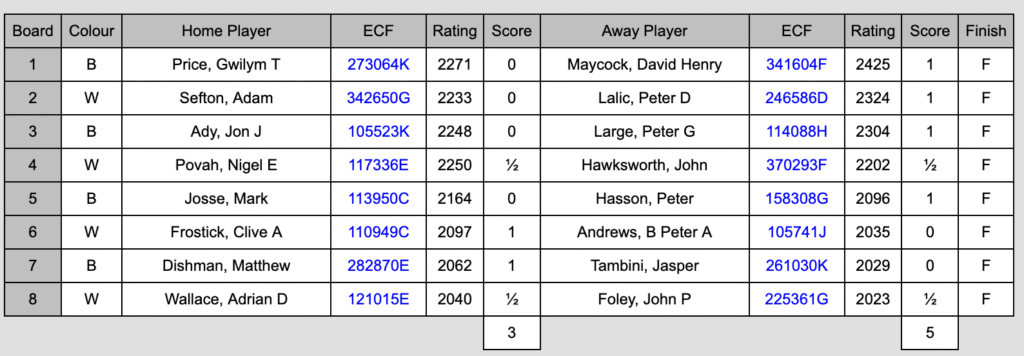
In Surrey League chess, as in most professional sport, the home side enjoys an advantage. In our case that is not because of crowd support or pressure on referees, but because it is easier to turn out the strongest possible team when there are no travel issues and when the match is on the night of one’s choosing. So away at Guildford – on paper our strongest rivals for the Division 1 title – was always likely to be a difficult and crucial match. And so it seemed when the teamsheets were exchanged, with Kingston having the rating advantage on boards 1-3, but Guildford having the edge on 4 to 8. For once I won the toss, giving Messrs Maycock and Lalić, at least, their preferred colours.

John Hawksworth was first to finish, with a solid draw against fellow IM Nigel Povah in which both players declined to push for more. But I let the side down in an error-strewn game against Clive Frostick. A brain fade in which I thought I might win two pieces for a rook with a zwischenzug but missed the most obvious reply left me with a compromised pawn structure. Trying to create chances, I sacrificed a pawn and succeeded in inducing Clive to blunder a piece. But he had some initiative for it, and in trying to unravel actively rather than acquiesce in a draw I carelessly allowed a mate which could only be avoided by giving up the queen.

David Maycock soon scored the equaliser on board 1 with White against Gwilym Price. Black had gradually got on top in this game, but David hit back resourcefully.

The remaining games were all heading for endgames and time trouble, with not much certainty about the outcomes (and given that the players mostly stopped recording under the five-minute rule, not much clarity about what actually happened).

On board 5, Peter Hasson won an ending against Mark Josse in which he was a piece up but Mark had two advanced passed pawns which had bypassed Peter’s king as it stormed up the board. Peter managed to combine his rook, knight, king and advanced d-pawn to produce mating threats to advance the pawn, sufficient to win before Mark queened his infantry.

On board 6, Jasper Tambini’s game with Matthew Dishman was level for a long time, but his attempt to attack by pushing kingside pawns left his own king decisively vulnerable in the major piece ending.

The board 3 game between IM Peter Large and Guildford FM Jon Ady was baffling to the occasional viewer. At one stage, Peter seemed to be on the back foot against a sacrificial attack, threatened both down open kingside files and potentially on the back row. But he devised a clever major piece defence along the third rank which addressed all the threats, and the next time I looked he was a rook up and the attack had burned out, so Kingston had taken the lead again.

On board 2, Peter Lalić had Black against the fast-rising junior Adam Sefton, who had recently defeated Peter’s mother when Guildford visited Epsom. So the win was not only crucial in the match but important in terms psychologists understand. Yet again, Peter’s endgame technique depriving the opponent of useful moves was decisive.

The last game to finish was John Foley’s with Black on board 8 against Adrian Wallace (pictured above). John’s cause looked hopeless when he went into an ending of rook and bishop v rook and knight three pawns down. He had some activity, and regained one of the pawns, but a rook ending two pawns down is still generally lost. However, one of the pawns was a rook’s pawn, which gives the weaker side some hope, as did the clock situation, with John’s opponent often down to a few seconds before moving. As John’s king was forced out from in front of the other pawn, the position below crystallised.

White was in his own words “unable to work it out given the time” and conceded the draw. Some of us were sceptical, but it seems that the position really is a draw.

• If white moves his king up the board to support queening, the black king stops him escaping to the opposite side of the pawn from the black rook, so he can’t use the pawn to block checks.
• If he hangs close to the pawn, eg 1. Ke6 Rh6+ 2. Ke7 Re7+, Black can keep checking.
• If he moves to the right towards the rook, then if the king gets to f7, Rh7+  forces it back to e8 or e6 else the pawn is lost, so he can’t get to the g-file to stop the checks.
• And if he goes to f6 intending Kg7, then after 1. Kf6 Rh6+  2. Kg7 Rd6 wins the pawn.
• If the white king goes backwards hoping to use his rook to stop the checks, then while he stays on the c-file (or further to the right) Black can keep checking, and as soon as he goes to the b-file Black will be able to move his R to the d-file behind the pawn, winning it, eg at some stage the black rook checks the white king on the fourth rank, 1. Kc3 Rh3+, 2 Kb4 Rd3.
• And once the d-pawn is lost, the ending with the black king in front of the a-pawn is dead drawn, whether or not the rooks stay on the board or are exchanged.

Thankfully that drama was only gilt on the gingerbread with the match win already secured, but it was another illustration of the importance of endgames, and the different sort of visualisation which may be needed there.

Peter Andrews captains Kingston’s first and second teams in the Surrey League

Kingston whitewash Wallington in Lauder Trophy

Wallington v Kingston, Lauder Trophy quarter-final match played at Wallington United Reformed Church on 5 November 2025

There was a scary moment before the start of this match when the Kingston players entered the playing room and found our very own Peter Lalić chilling with the Wallington players. Fortunately – for me at least – he was only there to watch the opening stages at his most local club. For Kingston second-team players to face him for  a fourth time in six weeks would have been tough. There would have been room for him within the rating limit of 10,500 for the Wallington team, which had no one over 1700.

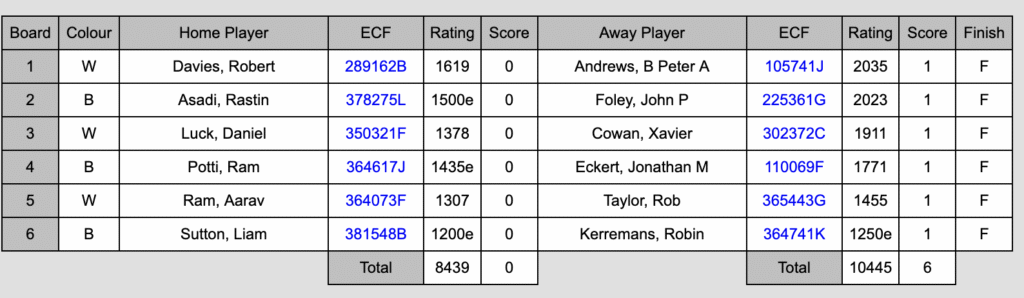
Jon Eckert, Rob Taylor and Robin Kerremans on boards 4 to 6 all won fairly quickly. Jon soon went a piece up, and Rob’s classical play with Black squashed his opponent with a big centre which left no room for the white knights to get out of the way of the rest of the army. Robin Kerremans played the English, despite which his opponent had a slight edge for a while. But Black’s advantage was short-lived, and Robin quickly turned the tables to win the black queen in the course of a mating attack.

John Foley (pictured above) had sacrificed an exchange in the style of Tigran Petrosian in Monday’s league game against Ashtead 1, and now sacrificed another one, this time in the style of Paul Morphy in the famous Opera House game against the Duke of Brunswick and Count Isouard.

I had a much less clear-cut game with Black against Robert Davies on board 1. I had a slight edge almost throughout, but the engine reveals that the advantage was much less than I had thought until my opponent slipped up in the tactics.

Xavier Cowan, who made his Kingston debut only on Monday, was last to finish, with Black against Daniel Luck on board 3. Daniel must be one of the younger club officials in the Surrey League, and is already the Wallington fixture secretary and their match captain for the Lauder and two Surrey league teams, so he has taken on a lot and we wish him well. Xavier has not taken long to figure out that exchange sacrifices are the club trademark.

So the result was what tennis followers would call a bagel (6-0), not surprising given the rating difference, but we have already seen this season, for instance in the recent first-team match against Wimbledon, that in games with a high tactical element almost anyone can go wrong. The Lauder Trophy semi-final will be an away match against the winner of Chessington v Epsom, and must be played by the end of February.

Peter Andrews is Kingston captain in the Lauder Trophy

Foley the hero as Kingston 2 edge past Ashtead 1

Kingston 2 v Ashtead 1, Surrey League division 2 match played at the Richard Mayo Centre, United Reformed Church, Kingston on 3 November 2025
Ashtead are the “yo-yo team” in division 2 of the Surrey League, having been relegated from division 1 last season and promoted the season before. So on paper this was one of our toughest matches. Ashtead substantially outrated us on boards 1 to 3, thanks to Kingston’s own Peter Lalić making his third appearance of the season against the second-team squad (the other two in the Thames Valley League for our own first team). However, Ashtead were missing some of their middle-order batting, so we had the rating advantage on the lower boards.

First to finish was David Rowson on board 5. David has previously had several draws with White against Bertie Barlow, so he was pleased to outplay him with Black from a level position.

David’s win enabled me to agree a draw with White against Phil Brooks on board 2 in a position where there was still plenty of play but which was unclear and where we were both a little uncomfortable. And soon afterwards Jasper Tambini drew with Black on board 3 against Dan Rosen in a game that had more clearly run its course. He was never worse, and indeed had had a fleeting opportunity to be better – a solid effort.

Xavier Cowan was making his debut for Kingston, although he is a familiar opponent for several of us in the Thames Valley League, where he captains the Ealing second team. With Black against Platon Razis on board 7, Xavier had a strange-looking pawn structure more reminiscent of a rugby scrum than a free-flowing set of threequarters, but as so often it was piece activity which was decisive.

Alan Scrimgour agreed a draw with White against Chris Perks on board 6, standing better but short of time, which ensured that we could not lose the match. And John Foley (pictured above, left) brought home the bacon with a win with White against Tom Barton on board 4 which reminded us of former world champion Tigran Petrosian.

Meanwhile, on board 1 Julian Way with Black had fended off Peter Lalić’s initiative to reach an equal late middle game in which one slip under mutual time pressure cost the game.

Disappointing for Julian, but a good effort against a player who is currently in excellent form and moving through the 2300s in the ECF rating list.

So after two matches Kingston 2 are top of the division 2 table. We are unlikely to be able to turn out teams regularly as strong as we have for these early matches, but it is very encouraging that already the usual struggle against relegation seems unlikely to materialise. And longer-standing members will remember that it is only a few years since we were pleased when Kingston 1 seemed secure in Surrey division 2. 

Peter Andrews captains Kingston’s first and second teams in the Surrey League

Kingston 1 struggle to beat Wimbledon 1

Kingston 1 v Wimbledon 1, Surrey League division 1 match played at the Richard Mayo Centre, United Reformed Church, Kingston on 27 October 2025

David Rowson was kind enough to captain this match, as I was returning from Paris and could not guarantee reaching the venue before the start time. Happily Eurostar was on time, and I was able to attend. Indeed, with David Maycock struggling to arrive before the default time, I was nearly required to substitute on board 1. Had I done so, I would have outrated the Wimbledon board 1, an illustration of the huge disparity between the ratings of the two teams, an average of over 300 points a board. The story of the night was that Wimbledon, depleted by the absence of several players at a tournament in Guernsey, nearly overcame that difference.

The early skirmishes favoured Kingston. On board 1, David Maycock with White overcame his initial deficit on the clock to win decisive material on move 17, upon which Marcus Baker immediately resigned. Then Zain Patel, also with White on board 3, exploited Tony Hughes’ inaccurate implementation of a correct idea.

Then things went off track. Stephen Carpenter sacrificed a piece unsoundly against Jasper Tambini, who had Black, on board 6, but Jasper moved his king to the wrong square allowing the white queen a crucial check, depriving the defence of a critical tempo and leading to mate. Next, Peter Hasson, with Black on board 4, chose the wrong capture in complications against Gordon Rennie and lost a piece.

Meanwhile, John Foley was in increasing difficulty with White on board 7.  When the match line-ups were circulated, George Lin had warned on WhatsaApp that Djan Sennaroglu was a dangerous junior, having been one of William Lin’s main rivals for the recent British Under-10 championship – they had drawn their individual game. But by then John had switched off his phone, and perhaps underestimated an opponent ostensibly 300 rating points below him.  The youngster had an edge from early on, despite apparently not needing to spend much time at the board. He eventually reached a minor piece ending two pawns up and duly converted it. The match was decidedly not going according to plan.

On board 8, David Rowson with Black faced Omar Selim’s drawish Scotch, but David got on top after the queens were exchanged:

That made the score 3-3. Both board 2 (Neil Cannon v Peter Lalić, who had Black) and board 5 (Julian Way with White against John Polanyk) looked around equal, although unbalanced. Could at least one of our players make their higher ratings count? In the event, they both did. With both players running short of time, Neil Cannon made several slips which allowed Peter to win material, eventually a queen. So a draw from Julian would be sufficient. He is a highly experienced endgame player, and duly delivered, although we have no record of the last 20-plus moves.

So we had won after all, albeit with a sharp reminder that it may take only one mistake to lose a game, even if one is the higher-rated player. Wimbledon should be applauded for a gutsy effort despite being below strength, and clearly Djan is an extremely promising junior who will appear on higher boards in future seasons. Wimbledon captain Gordon Rennie claimed a “moral” victory, and we grant him that. Happily we take the actual victory, though it was a worrisome evening.

Peter Andrews captains Kingston’s first and second teams in the Surrey League

Kingston 2 triumph at Guildford in close encounter

Guildford 2 v Kingston 2, Surrey League division 2 match played at the Guildford Institute on 20 October 2025
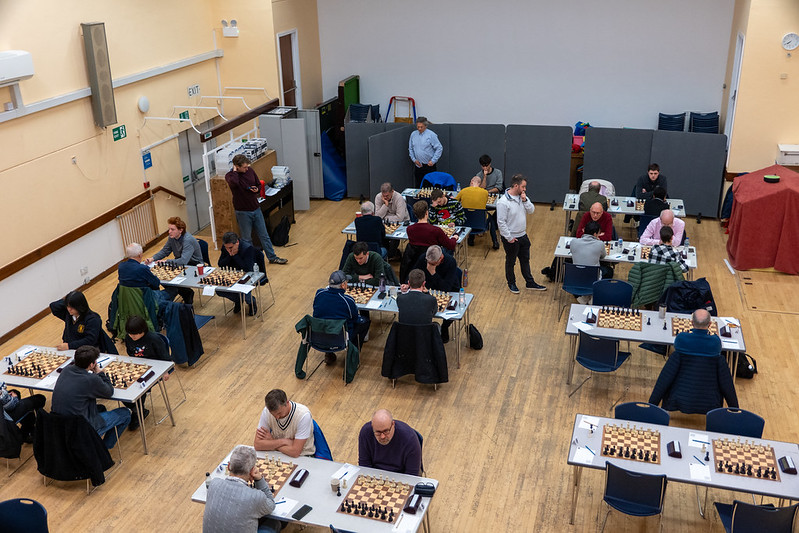
Two very solid-looking teams lined up for this one, with Guildford 2 having the rating advantage on the top four boards and Kingston 2 on boards 5 to 7. I lost the toss, a significant advantage for Guildford in a closely balanced match with an odd number of boards.

Most of the games were long battles, so the outcome was unclear until Guildford’s impressive crop of juniors had gone home. The relatively early finishes were draws. On board 5, David Rowson (with Black) and his opponent Malcolm Twigger-Ross both missed a tactic which would have won a pawn for White, but David was soon able to stabilise for a draw. On board 4, the game between John Foley, who had White, and Adrian Wallace lacked the mistakes that make for excitement, and soon reached a drawn rook and pawn ending.

On board 1, Peter Hasson and Clive Frostick have faced each other several times before, and were perhaps drained after their successful efforts for Kingston/CSC’s second team at the 4NCL over the weekend. Peter lost a pawn but got some major piece activity and the white advantage dwindled away in time trouble to a drawn rook ending. 

The first decisive result came on board 2, where Guildford’s Tim Foster made several aggressive decisions and I was conscious of needing to use the white pieces even though a draw would have been a useful result judging from the ratings. The outcome was a slugfest which did not lack the mistakes which make for excitement.

One up with three to play was looking good. Stephen Moss on board 7, with Black against Anton Barysenka, had struggled to find a plan in a game where he had the worst of the minor pieces, a bishop on b7 whose only role in life was to defend isolated pawns on d5 and a6. Understandably he fell short of time, and to add to the psychological pressure, his board was nearest to the café, where the post-mortems were sufficiently loud to impinge on the playing area. But after he relieved his feelings on the chess pathologists, and finding that losing a pawn resulted in the exchange of the bad bishop, he was able to simplify to a draw with a neat little tactic.

Soon after this, Alan Scrimgour on board 6, with White against Ian Deswarte, notched the decisive point by converting an advantage which had evolved from positional superiority out of the opening to material superiority in the endgame. There was just one moment when this progression could have come unstuck.

With Jasper Tambini on board 3 having come through a turbulent middle game with Black against Matthew Dishman to go into a much better endgame, a Whatsapp message informed our distant fans that we were going to win 5-2. That turned out to be an overstatement.

And after the excitement, Black has a much better endgame, a pawn up and with White having three isolated pawns to worry about. This, though, was not the end of the story and the resourceful Guildford player was not going to make it easy for Jasper.

Nevertheless a draw with Black against Matthew Dishman is a good result, and 4.5-2.5, with everyone contributing, an excellent win in a match we lost comfortably last season. Our morale survived even the frustration of the night closures on the A3 on the consequently prolonged return journey.

Peter Andrews captains Kingston’s first and second teams in the Surrey League

Maycock v Banerjee

Kingston 1 start Surrey campaign with emphatic win

Kingston 1 v Coulsdon 1, Surrey League division 1 match played at the Richard Mayo Centre, United Reformed Church, Kingston on 13 October 2025

Coulsdon were severely handicapped in this match by a train stoppage in the Waterloo and Clapham Junction area. Their board 7 defaulted, and several other players lost time which might have proved valuable later, although we made a concession to the circumstances by agreeing to start 10 minutes late. On paper, they were significantly weaker than Kingston below board 1, and weaker than we would expect them to be at home. Nevertheless, halfway through the evening the match could easily have been close, but Kingston pulled away in the closing stages.

The first to finish was Zain Patel, making his very welcome debut for us in local league chess with White against Ishan Ramdewar, and this one was crushing from an early stage.

Zain Patel made his debut for Kingston in local club chess and started with a crushing win. Photograph: John Foley

The Surrey League is privileged to have young entertainers of national status like David Maycock and Supratit Banerjee (pictured at the top of the report) turning out on Monday evenings, and they did not disappoint.

As an interesting psychological footnote, we are indebted to Supratit for the score of this game. The final moves were played more or less on the increment by both players, and David’s score ran out a few moves before the end. Supratit’s was neat and complete, despite the time shortage, the complexity of the game, and even though he had been close to lost for several moves. Some of us barely ever have a complete score of a game that goes the distance. Moral – the best players do not allow their emotions to override their ability to think.

The spectators had expected an early conclusion on board 8, where Jasper Tambini had opened up White’s kingside. But Stockfish actually gave Coulsdon’s Paul Jackson the advantage at this point, and Jasper needed a second round of tactics to win:

On board 3, Peter Large with White survived a moment of real danger against Mark Smith:

On board 6, with Black, Peter Hasson blocked the kingside against Martin Faulkner’s numerical superiority on that side, and was able to spare his queen for a raid which snaffled the a-pawn. It didn’t look like much, but after over 70 moves, it turned out to be enough to win the rook and pawn ending.

John Hawksworth was less fortunate with Black on board 4. He achieved a slight edge against Ian Calvert’s notorious 1. b3, and went into the rook and pawn ending a pawn up. But with both players down to around a minute, he missed a fleeting opportunity to penetrate with his king, and the endgame resolved into a textbook draw with R+P v R with the defending king in front of the pawn, so Black’s extra pawn could not be forced home.  As an aside, this is an ending which comes up often enough to be worth looking up in a book – anyone can draw it against an experienced IM if they know the right plan.

Peter Lalić (left, with his signature green earplugs) and David Maycock back in the old routine. Photograph: John Foley

Peter Lalić on board 2, with Black against Evaldas Baltrunas, also reached what looked like a drawn ending, this time with a knight each. But I had experienced his skill with knights in the ending at first hand last week, so had not given up on the win. Peter’s endgame play has been compared to Capablanca’s.* That may be an overstatement, but he does find chances others do not see.

And so a long and well-contested match finished with a rather flattering 7-1 scoreline to Kingston, which may be useful if the battle for the league title is tight at the end of the season. But let’s not get ahead of ourselves.

* My batting has been compared to Don Bradman’s, ie “it’s not as good”, but I don’t think that was meant in Peter’s case.

Peter Andrews is chair of Kingston and captains the club’s first and second teams in the Surrey League