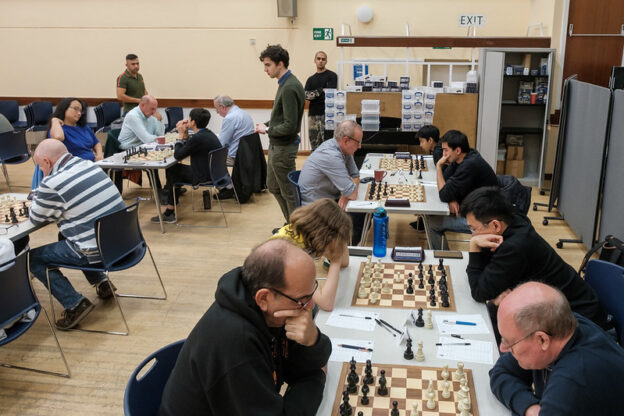
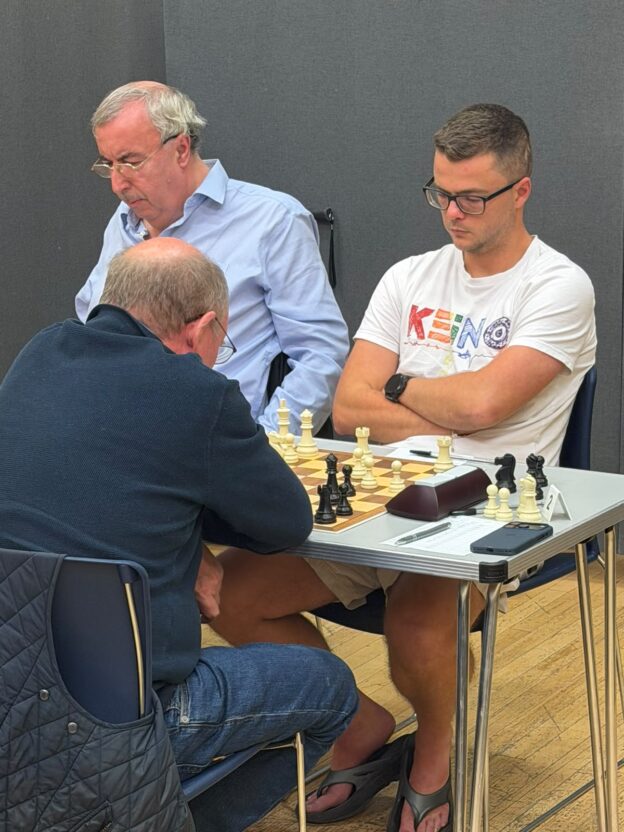
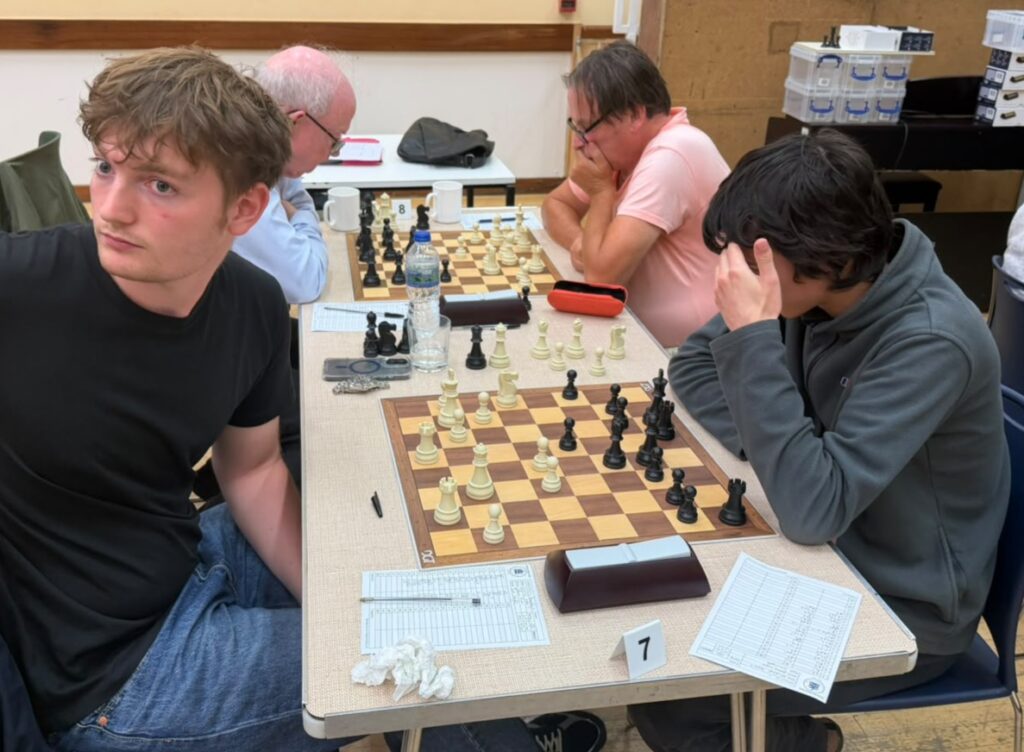
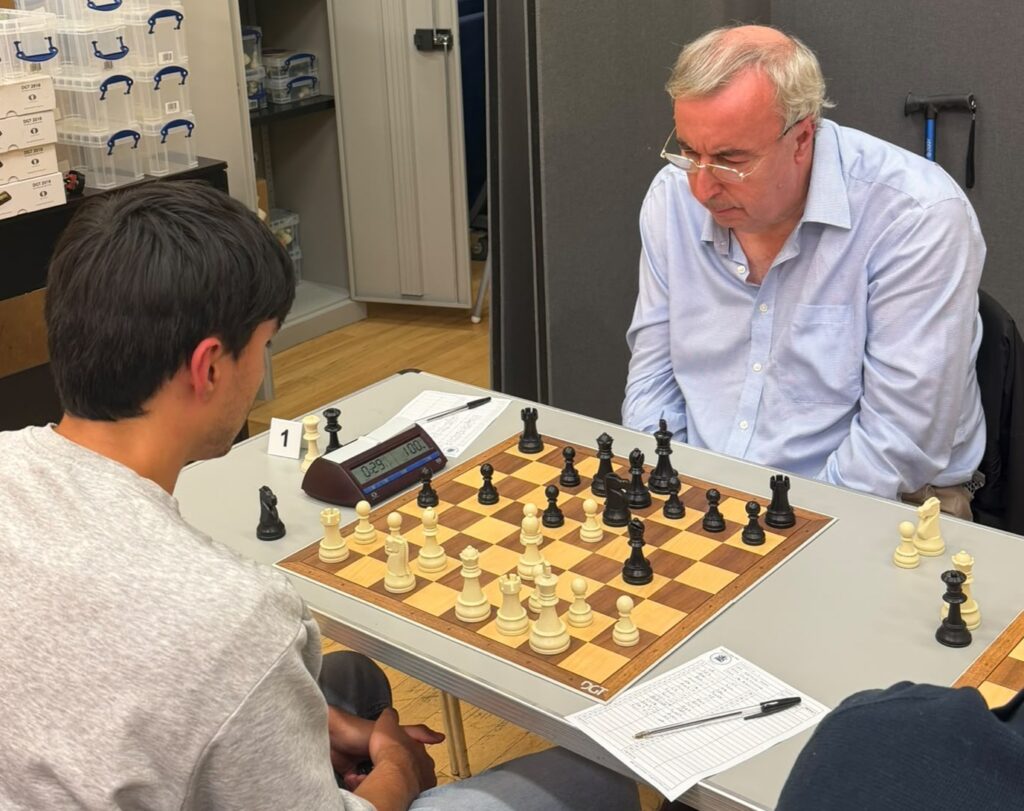
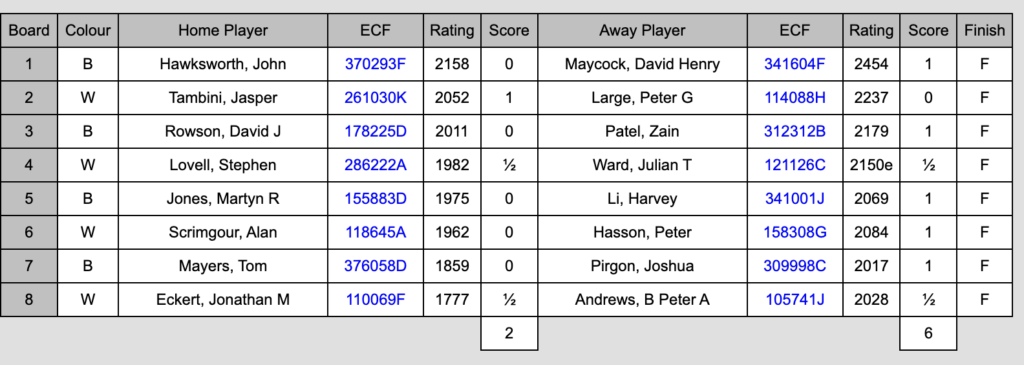
Surrey v Essex under-2050 county match, Cheam Parochial Rooms, 17 October 2026
My favourite form of chess is the county match. It starts at a leisurely time on a Saturday afternoon. We play a classical time control which allows some real thought. I find evening league chess too busy and error-prone and 4NCL rather pressurised due to not wanting to let down one’s team-mates. Also, to be honest, I love to drop by at the La Petite Boulangerie opposite the Parochial Rooms for a delightful taste of France before every game.
In the first stage of the county championships, Surrey must compete against the other Southern Counties Chess Union teams – Essex, Kent and Middlesex. These are usually tough scraps against regular opponents. If we reach the national stage, we usually face the mighty teams from Yorkshire or Lancashire. Winning the county championships is quite an honour. There are different levels: Open, under-2050, under-1850, under-1650, under-1450, so players of all strengths can participate.
The main challenge for SCCU matches is to get all the players to the venue, which means getting across the other side of London – no mean task. Surrey won this closely fought match 9-7 with everybody present. Thanks to Surrey captain Graham Alcock for using his organisational ability to get the team together. The other county match played on the same day saw Middlesex lose 9-7 to Kent due to three players defaulting, which could have reversed the result of the match.
This game entertained the spectators so I promised to annotate it. I need to remind myself from time to time that I was once a decent player.
Kingston A v Kingston B, Thames Valley division 1 match played at the Richard Mayo Centre, United Reformed Church, Kingston on 12 October 2026
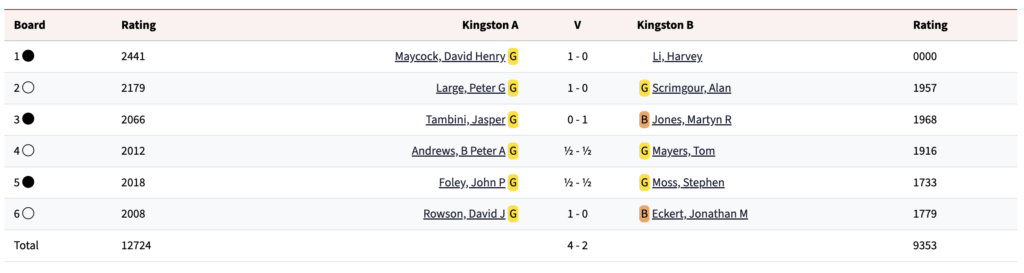
After the two intra-club battles in the Surrey League in September, two intranecine battles in the Thames Valley League were top of the agenda for October. The cast list was a little different, with teams of only six rather than eight, but the drama was higher, with the final result in doubt for some time. The match featured two epic games, for which I shall keep you in suspense because they were late finishers.
Stephen Moss and John Foley have known each other since they met at Oxford some 50 years ago, but apparently had never played a classical game against each other, until they met on board 5. The game was a “bloodless” draw – a success for Stephen, as the lower-rated player, and for John as Black.
The board 6 game between David Rowson and Jon Eckert included a neat trap set by David. Jon avoided it, but found White had an edge anyway.
White’s continued to press and eventually, a pawn down and facing a dangerous passed d-pawn (see position below), Black resigned. But later engine analysis suggested the resignation is premature as Black has significant counterplay against the pawn on f2 and White will need to redeploy his rooks to activate the passed pawn. The post-mortems will continue, but the scoresheet recorded 1-0 to Kingston A.
My game on board 4 with Tom Mayers hung on decisions made just after the tactical skirmishes had ended in my favour.
On board 2, Peter Large made little progress with White against solid play from Alan Scrimgour until the transition from middlegame to endgame, when he exploited an isolated pawn and the remains of Alan’s queenside pawn storm to win two pawns, which was decisive.
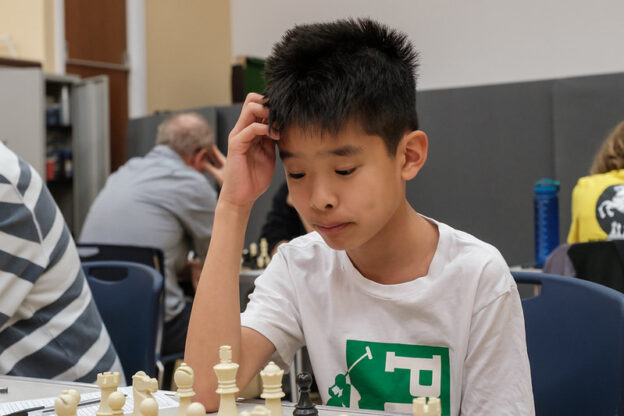
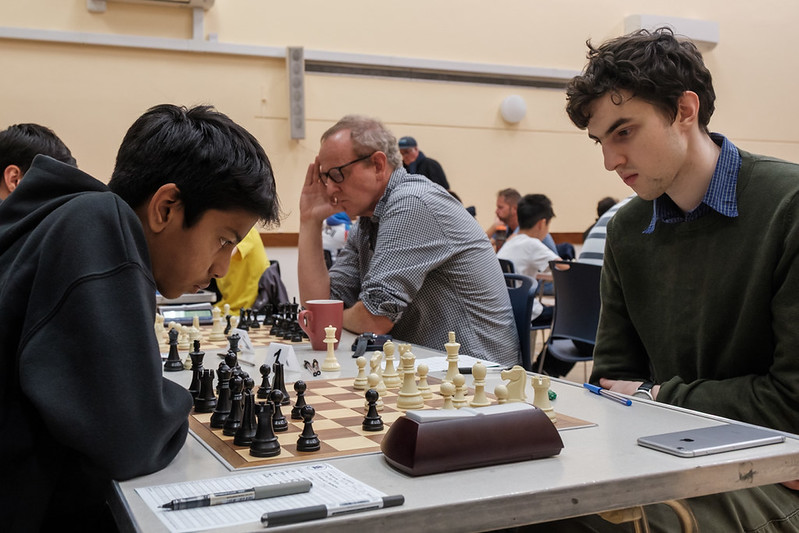
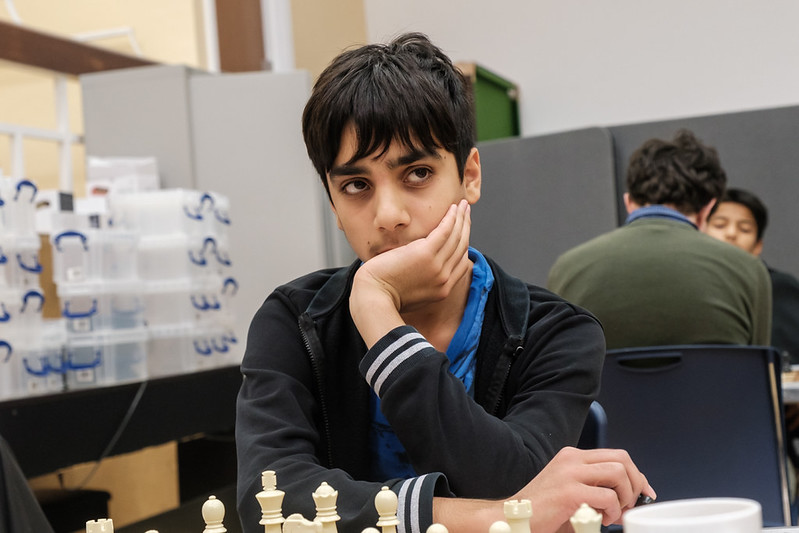
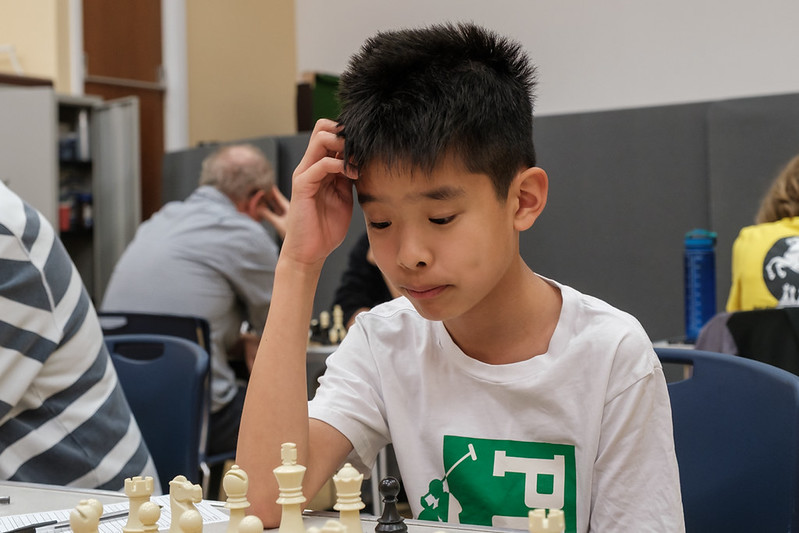
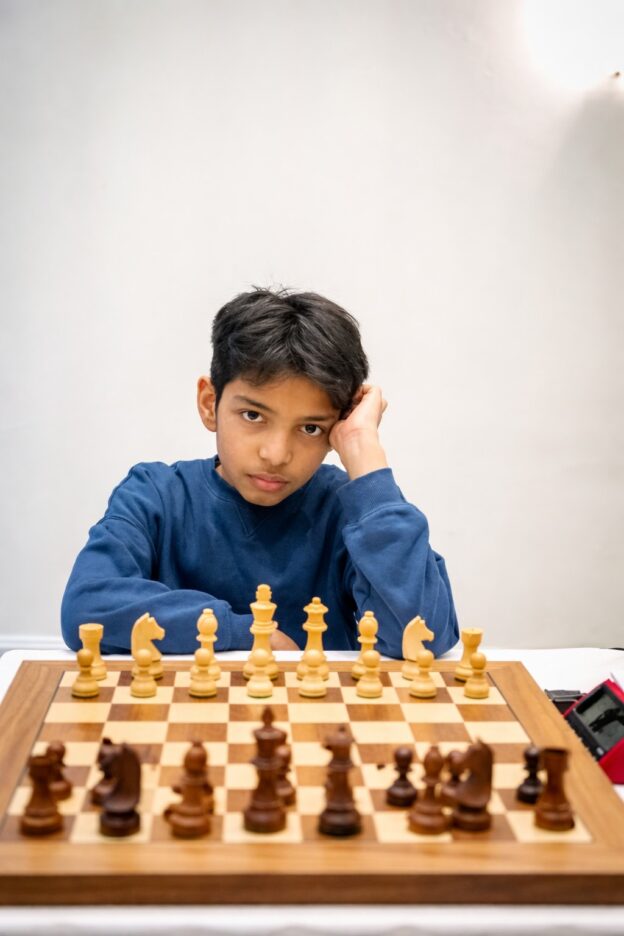
On board 1, David Maycock was once again drawn against Harvey Li (pictured above), this time with Black. Afterwards, David described the game as “up and down”, and I concur.
Frustrating for young Harvey to come so close against David a second time, but he can be encouraged by going 60 moves with an ECF 2450 player, and there is always a good deal to learn from such an eventful game.
That win gave the A team an unassailable 4-1 lead, but the B team, in the shape of Martyn Jones against Jasper Tambini, hit back on board 3. This was an extraordinary game in which both sides were clearly winning at different stages until it resolved into an unbalanced endgame evaluated by my machine as equal. Martyn must have outplayed Jasper in it, but how is not recorded – understandably, given the high-jeopardy opening and middlegame, both sides were short of time in the ending. Both players have a reputation as good box office, which games such as this can only reinforce.
So in the end a 4-2 win for the A team. We like to believe there will be a fair few teams in Thames Valley division 1 which do not get as many as the two scored by the B team. The sort of match which stimulates enthusiasm, so roll on next week when As and Bs meet again in the last of these fraternal battles for the season.
Dominic Fogg and Miles O’Brien were joint winners of the club’s first evening rapidplay, played atthe Richard Mayo Centre, United Reformed Church, Kingston on 12 October 2026
When Kingston moved to the United Reformed Church last season, we decided to start offering rated friendlies at classical time controls to members of the club. This has proved a significant success, thanks to the unstinting work of Ed Mospan – who organises the pairings and rates the games – and fellow club-night organiser Genc Tasbasi.
Monday 12 October saw an important step forward in this plan to offer members more than the usual diet of club matches and casual chess: the inaugural evening rapidplay, played over three rounds as an experiment to see if it could be run alongside two league matches and eight classical rated friendlies.
That meant we had 24 players engaged in league chess, 16 playing friendlies at a time control of 75 minutes and 10 seconds, and another 16 who chose to play in the rapidplay tournament. It meant a very full house, an enormous amount of work for the indefatigable Ed Mospan, and a lot of shushing from me as I tried to keep noise levels down to a reasonable level.
The rapidplay tournament, won jointly by Dominic Fogg and Miles O’Brien with 3/3, was deemed a great success. My only observation was that we needed a fourth round to determine an outright winner. Three rounds at 10 minutes plus a five-second increment meant a fairly early finish, so it should be possible to get at least one more round in and possibly two if the field expands to, say, 24 and an extra round is required to establish a winner.
It would also be possible to adjust the time control to make it a little less blitzy. Again it is a personal opinion and Ed, as controller, will have the final say, but 15+5 strikes me as a better intermediate version of the game between blitz and classical. We will now review the experiment and make any necessary refinements in time for a tournament planned for 9 November.
The rapidplay games are rated and offer serious competition, but they avoid the situation where a major blunder in the opening in a game slated to last three hours means you get a very early finish or an evening of back-to-the-wall torture with no real prospect of reversing the initial error. With a four- or five-round rapidplay, you accept the loss, reset the pieces and go again with even greater determination.
From the New Year, the hope is to make the rapidplays regular events, though with members still being given the option of a classical rated friendly every Monday if they are not engaged in a league match and that is their preference. The club committee will discuss how to combine the different formats to best effect and without causing undue disturbance to matches, especially after 10pm when time trouble kicks in, nerves jangle and brains tend to freeze.
Kingston 4 v Ashtead 2, Surrey League division 4 match played atthe Richard Mayo Centre, United Reformed Church, Kingston on 12 October 2026
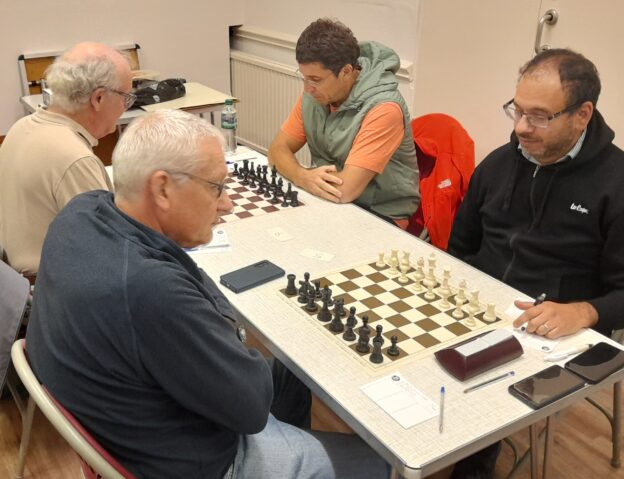
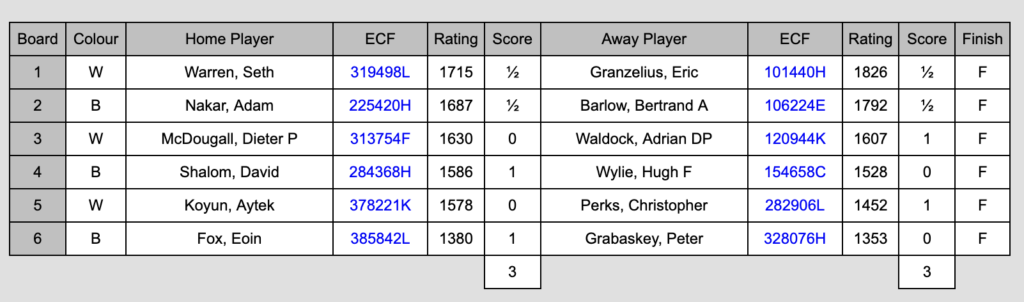
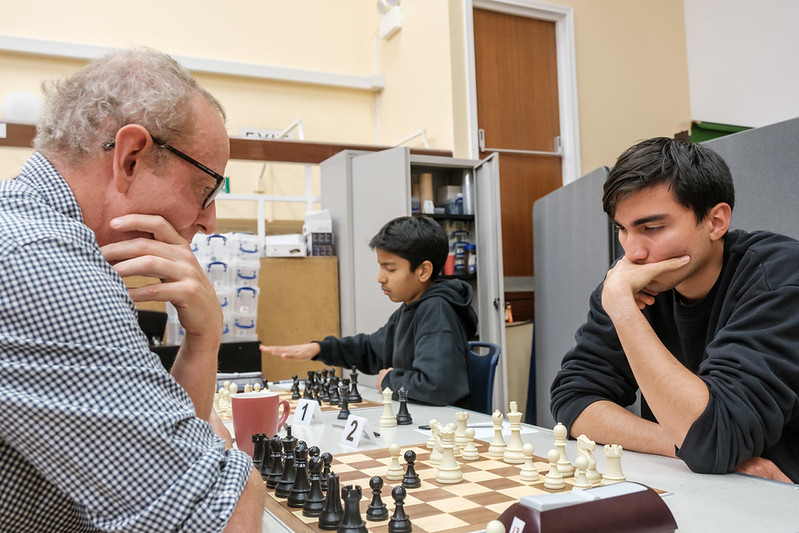
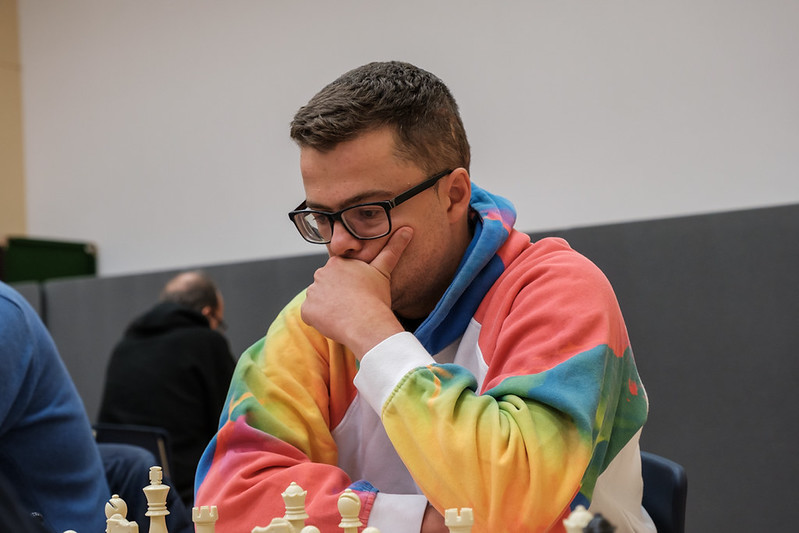
On paper, Ashtead 2 had a significant advantage over Kingston 4, on the higher boards at least, but you would not have guessed it from the initial balance of the play. Kingston quickly went 1-0 with a rapid win by David Shalom, and Adam Nakar (pictured above, right) accepted an early draw offer from old campaigner Bertie Barlow to maintain the advantage. So far, so good.
Seth Warren got an excellent draw on board 1 against the highly rated Eric Granzelius, and Eion Fox continued his recent good run of form with a draw with Black against Peter Grabaskey on board 6. Could a surprise win be on the cards? In the end, it was close but no cigar.
Dieter McDougall played well against Ashtead captain Adrian Waldock on board 4, but Adrian knew the match was at stake and pressed hard for a win, which he duly obtained, and Chris Perks’ hard-fought win on board 5 against Aytek Koyun in the last game to finish then levelled the match. A fair outcome to a spirited encounter.
Dorking 1 v Kingston 3, Surrey League division 3 matchplayed at Crossways Community Baptist Church, Dorking on 8 October
The Ellam Trophy, division 3 of the Surrey League, is not to be trifled with. It is a tough division, which includes three first teams and a couple of strong second teams. Kingston have a team in the Ellam for the first time in several years, and, since this is our third team, survival will be the name of the game.
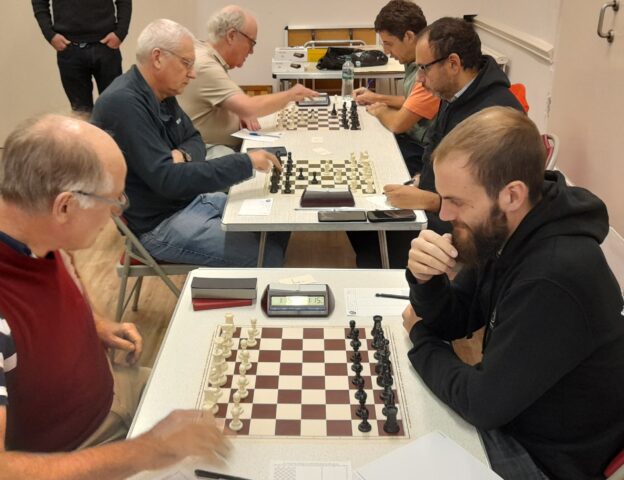
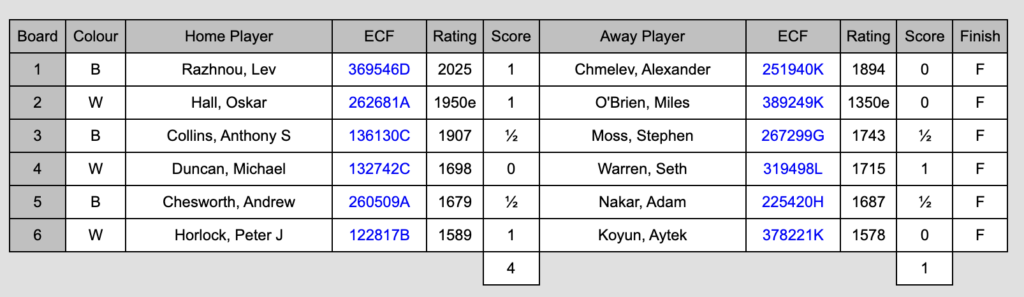
We lost our opening fixture 4-2 to Dorking, but were by no means disgraced. Captain Seth Warren (pictured above, right) secured a point with Black on board 3 against Michael Duncan. I was pleased to draw with Anthony Collins on board 3, though would have won if I’d known how to mate with bishop and knight against bare king in the maximum 50 moves (an embarrassing gap in my endgame knowledge; sadly one of many). Adam Nakar secured a more orthodox draw on board 5.
Alexander Chmelev lost a complex bishop endgame to the highly rated Lev Razhnov on board 1, and Miles O’Brien fought hard against the equally capable Oskar Hall with Black on board 2. A good learning exercise for one of Kingston’s very promising juniors. The pivotal game was on board 6, where Aytek Koyun had Black against the experienced Peter Horlock. Aytek, with a well-advanced pawn, had winning chances, but they slipped away in time trouble and in the end, still pressing for a win that probably wasn’t there, he lost.
So 4-2, a score which became 4-1 when Kingston were (perhaps harshly) docked a point for playing young Miles off his provisional ECF rating of 1750 rather than the very pessimistic Surrey estimate of 1350. Seth Warren admitted he had infringed the rules on his debut as captain, but it seems rather unfair to be penalised for being too honest about a player’s ability. Since the match result was not affected, we decided not to appeal to the Supreme Court, but it would be extremely annoying at the end of the season to be relegated by a game point.
Kingston v Guildford, semi-final of the Alexander Cup, played at the Richard Mayo Centre, United Reformed Church, Kingston on 5 October 2026
This was a very different Kingston team from the one which beat Guildford and secured a fifth successive Alexander Cup title back in May. We were missing six top-class players from that great match, which makes our achievement in beating a very strong Guildford team by the same score, 6.5-3.5, all the more impressive.
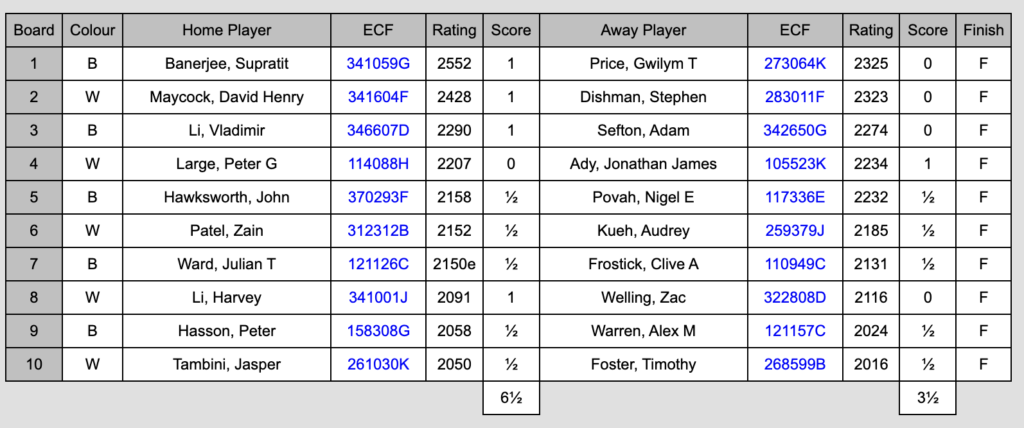
We had the great benefit of IM Supratit Banerjee on board 1 and he played a beautifully orchestrated game to beat Gwilym Price, whose ECF rating is 2330, with Black – a vital victory. Supratit has kindly annotated the game. A tremendous demonstration of his deep analytical strength, maturity and the willingness to question engine evaluations which is the hallmark of the potential super-GM.
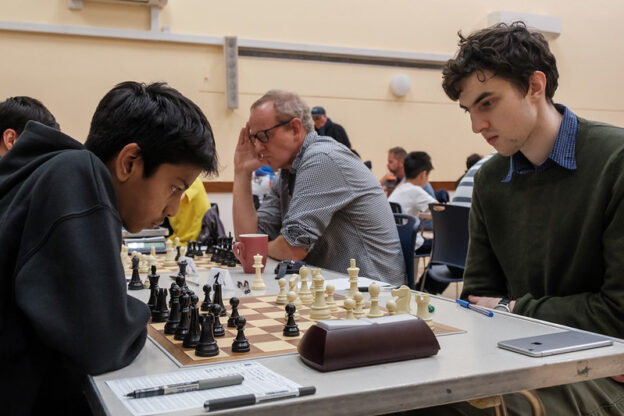
IM Supratit Banerjee (left) takes on Guildford’s Gwilym Price in a crucial encounter on board 1
The teams were generally very evenly matched, but we hoped we might have an edge on the top boards and so it proved. David Maycock and Stephen Dishman had an intense battle, but, as time became critical, David’s precision in what was effectively a blitz finish prevailed.
David had White and as always played an interesting line against FM Dishman’s Caro-Kann. Dishman had the better of the middlegame and was squeezing FM Maycock effectively, but time’s wingèd chariot muscled its way into the picture and the Guildford player blundered in time trouble, with David as quick as ever to see the opportunity. But the blunder did not come out of the blue. It emerged from a much subtler error a few moves earlier, and the sequence is instructive.
The battle between FMs Dishman and Maycock was unclear for a long period, but David prevailed in a time scramble
FM Vladimir Li, in his first competitive classical game for a year, showed very little rustiness in beating the highly rated junior Adam Sefton in another Caro-Kann.
FM Vladimir Li made a successful return to competitive chess with a victory over highly rated junior Adam Sefton
Guildford got a point back on board 4, where FM Jon Ady got the better of IM Peter Large in a Nimzo-Larsen Attack which, after some manoeuvring in the early middlegame, suddenly turned into a slugfest. The tactics became bewildering and the evaluation oscillated as time started to run short, but in the end White was overwhelmed and forced to resign, A commendable win for FM Ady with Black – and one which kept Guildford in the hunt.
The encounter between IM Peter Large (right) and FM Jon Ady became a wild tactical battle in which Ady ultimately prevailed
There were two more IMs in action on board 5 – Nigel Povah for Guildford and Kingston’s John Hawksworth. IM Povah had White and went a pawn up, but John had compensation in the shape of bishop v knight and greater activity, and he was able to neutralise the pawn and draw – a very satisfactory result with Black. John has kindly supplied some instructive comments on the game, which we pick up on Black’s 13th move.
John Hawksworth drew with Black against Nigel Povah in the critical battle of the IMs on board 5
Zain Patel and Audrey Kueh also drew on board 6, and by then results appeared to be going our way so we were happy to bag another draw.
Zain Patel drew on board 6 with Guildford’s Audrey Kueh, a result which consolidated Kingston’s advantage
The board 7 encounter between Guildford captain Clive Frostick and Kingston’s Julian Ward, who was also returning to high-level chess after a break, was another draw and the last game to finish. Even though Kingston had already won the match by then, Julian pressed for a win a pawn up in a rook and pawn endgame, but you know what they say about such endings and so it proved.
Julian Ward, who has made a welcome return to chess after a lengthy break, drew with Guildford captain Clive Frostick
A pivotal game was the battle of the juniors on board 8 – Kingston’s Harvey Li against Guildford’s Zac Welling. Harvey is just 12, already rated 2000 elo and is a central player for the club’s future. His victory here, after an opening from which he emerged slightly worse, marked the moment when we believed we were going to win the match. The key moment in the game is shown below. Black’s Slav Defence had given him a decent advantage, but the outcome hinged on one blunder and Harvey’s sharp eye for a tactical opportunity.
Twelve-year-old Harvey Li produced a neat tactic to secure a vital victory against Guildford’s Zac Welling
On board 9, Alex Warren and Kingston’s Peter Hasson had a solid draw – another good result as the Kingston man had Black.
Peter Hasson was rock solid with Black on board 9 and secured an important draw against Alex Warren
On board 10, Jasper Tambini played in his usual aggressive, devil-may-care style, but Timothy Foster was up to every challenge and that also ended peacefully in the position shown below.
Jasper Tambini’s chess is as bright as his wardrobe, but Guildford’s Timothy Foster survived the technicolour assault
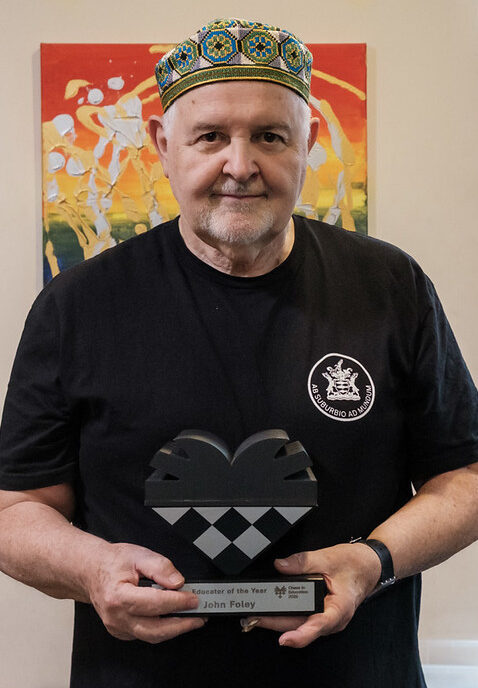
A wonderful occasion, recorded photographically by John Saunders (to whom thanks as ever). Thanks, too, for support from Kingston honorary president John Foley, just back from the Olympiad in Samarkand wearing a very fetching Uzbek hat and proudly clutching his Fide chess educator of the year award. Many congratulations to John from everyone at the club on this richly deserved award.
John Foley, back from the Olympiad in Samarkand, shows off his award – and Uzbek hat
We now progress, rather rapidly, to the final, where we will meet Epsom or Wimbledon, who contest the other semi-final. Only five clubs entered the Alexander Cup this year, reflecting what appears to be a growing gap between big clubs and smaller clubs who struggle to put out competitive 10-board teams.
This trend will be something for the league to consider, especially with the recent sad demise of Wallington Chess Club after being in operation for more than 140 years. Their decline and now disappearance is a warning to clubs everywhere. You cannot rest for a moment. Checkmate may be just around the corner.
Kingston v Guildford, semi-final of the Alexander Cup played atthe Richard Mayo Centre, United Reformed Church, Kingston on 5 October 2026
This was the board 1 match-up between Gwilym Price, a very capable player with an ECF rating of 2330, and IM Supratit Banerjee (pictured above left) in the semi-final of the Alexander Cup. Twelve-year-old Supratit has kindly supplied the annotations, which underline not just the depth of his chess thinking but the clarity and precision of his writing. Supratit won the game and Kingston went on to win the match 6.5-3.5.
First and second teams at Dudley; third and fourth teams at Bedford, 10/11 October 2026
Photo: IM Supratit Banerjee
The first weekend of the 2026/27 season saw a revamped squad. Kate Cooke stepped down after a decade carefully stewarding our 4NCL efforts to achieve one team in Division 1, one in Division 2 and one in Division 4. Our first team were runners-up in Division 1 last season, setting the bar extremely high.
We brought together a new management team for the squad. The squad manager is Chris Fegan from CSC, first-team captain is John Foley, second-team captain is Clive Frostick, third- and fourth-team captain is Julie Denning. We added another team in Division 4 in line with our strategy to end up with one team in each of the four divisions, enabling us to offer slots to players at all levels.
The composition of the first team changed in accordance with a reduced budget. We had to say “Do zobaczenia” (until we see you again) to our friends from Poland, GM Jakub Kosakowski and WIM Liwia Jarocka, and the German WFM Luisa Bashylina. All three were totally integrated into the team and we enjoyed many dinners, game analyses and casual blitz with them. We hope to reconnect as resources allow.
They have been replaced with some talented young English-registered players to give them a chance to develop their chess at the highest level. The biggest announcement of the weekend was that 12-year-old first-team player Supratit Banerjee (pictured above) was officially declared an international master. He has been joined in the team by 23-year-old IM Alex Golding and 13-year-old FM Qixiang Han. GM Harry Grieve, IM Vladyslav Larkin, FMs Ulysse Bottazzi, David Maycock and Roland Bezuidenhout, and WFM Eunice Hng are also all in their early or mid-20s, meaning the first-team squad is packed with talented young players, guided by GM Ameet Ghasi as “senior pro”.
The second team has also added an array of talented young players to its pool, notably James Golding, Shivam Sahoo, Raman Vashisht-Pigem and Sebastian Mokhber-Garcia, joining the ever present Zain Patel. Several of these players will be representing the squad at the European Club Cup in Montenegro next week under the name “Kingston Kings”. We wish them well in a tournament packed with world-class players.
The new name of the squad – CSC ChessPlus Kingston – reflects the economic compromise which makes the team possible. Chess in Schools and Communities (CSC) has long been a partner with Kingston. The original idea had been to provide a pipeline for juniors who had taken up chess through one of the CSC schools programmes. ChessPlus is the name of the chess education activity of John Foley. John was awarded the honour of FIDE Chess Educator of the Year during the Olympiad in Samarkand. Kingston Chess Club provides several players and the active involvement of chess impresario Stephen Moss, who was playing for the fourth team this weekend in Bedford. Chris Fegan and John Foley acted as team captains and reserves for the first and second teams.
Each of the four teams ended up with two points out of a possible four, which was a fair outcome given the strength of our opponents.
First team
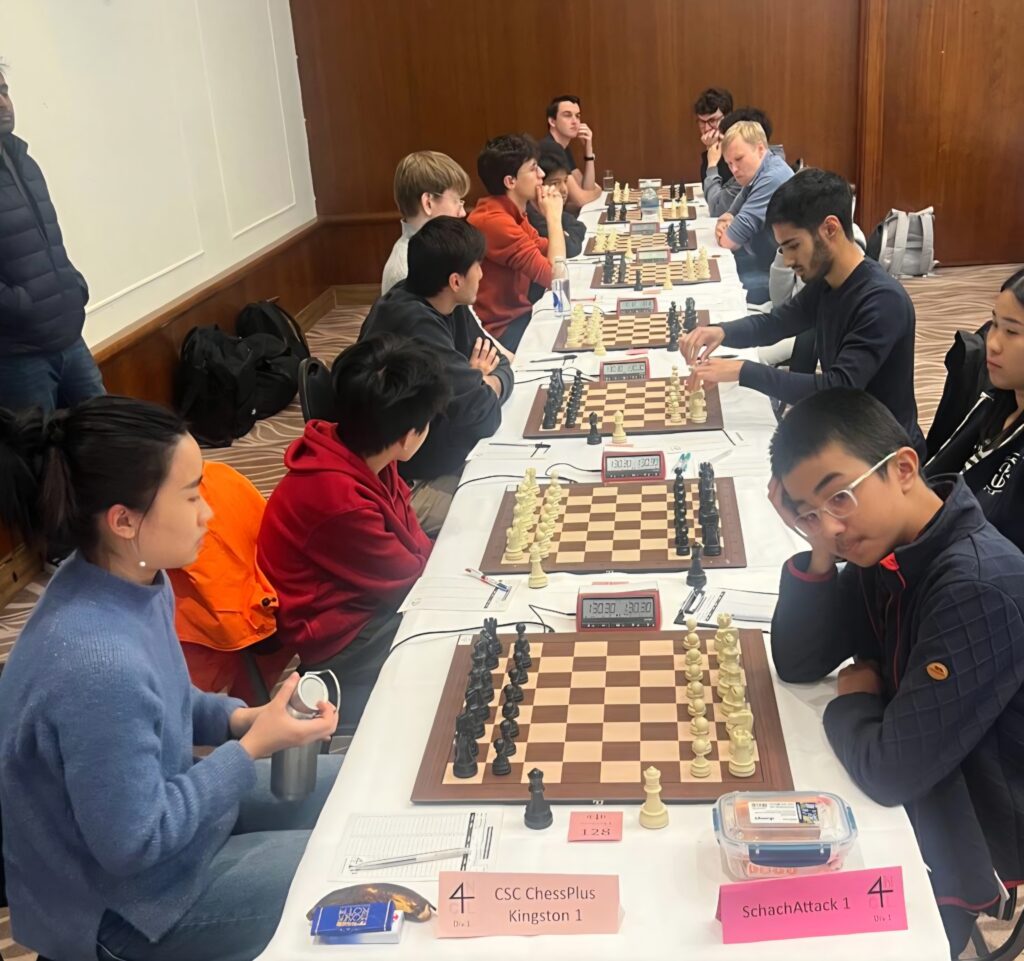
The first team preparing to start against Division 1 surprise package Schach Attack
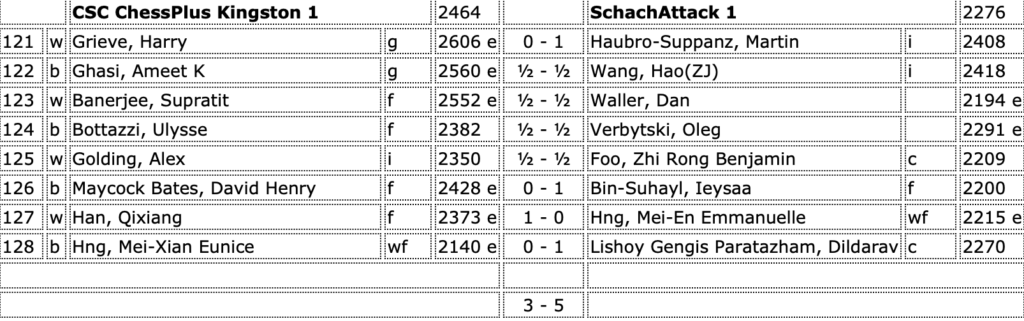
The first team’s opponents in the first round were SchachAttack 1, whom we comfortably outrated by an average of well over 100 points per board if we use FIde ratings. However, as everybody knows, ratings are an unreliable guide to match outcomes, and we lost the match 3-5. GM Harry Grieve lost on time on board 1 which was unfortunate as he did not seem to be in time trouble and was not losing on the board – he went into some sort of suspended animation. Qixiang Han won on his debut, a feat he repeated in the next round – the only first-teamer to score 2/2.
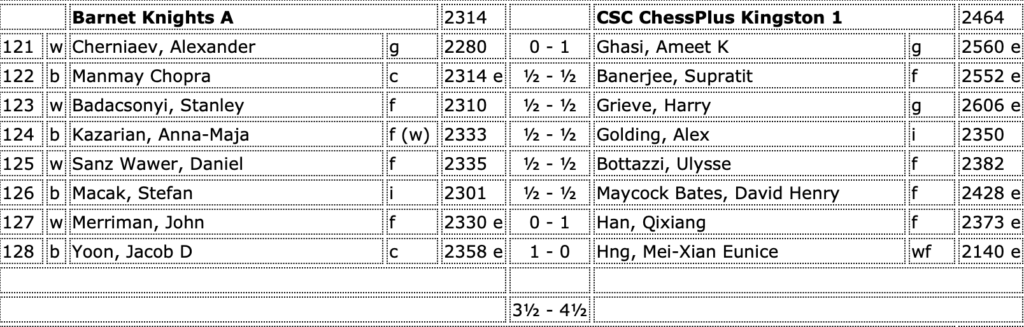
Matters improved on Sunday against Barnet Knights A. Our opponents almost reversed their team order from the previous round. Manmay Chopra went from board 8 to board 2 while Stefan Macak went in the other direction from board 2 to board 6. We had also jiggled our boards, so there was probably only limited preparation that counted.
GM Ameet Ghasi played Black for the second time in the weekend and achieved a solid position on top board. His opponent, GM Alexander Cherniaev, decided to open up the position, but this proved to the advantage of Black and the game ended with some sharp tactics in favour of Ameet. Qixiang Han was delighted to achieve two wins for the weekend. It was a game of mutual errors, but the usual motto applies – the loser is the last one to make a mistake.
The last game to finish – one of the last of the day in a virtually empty playing hall – was FM David Maycock v IM Stefan Macak. David had sacrificed the exchange to get a couple of pawns, including some dangerous advanced pawns in the ending. His opponent offered a draw in the following position. David accepted so that the team secured a victory.
Second team
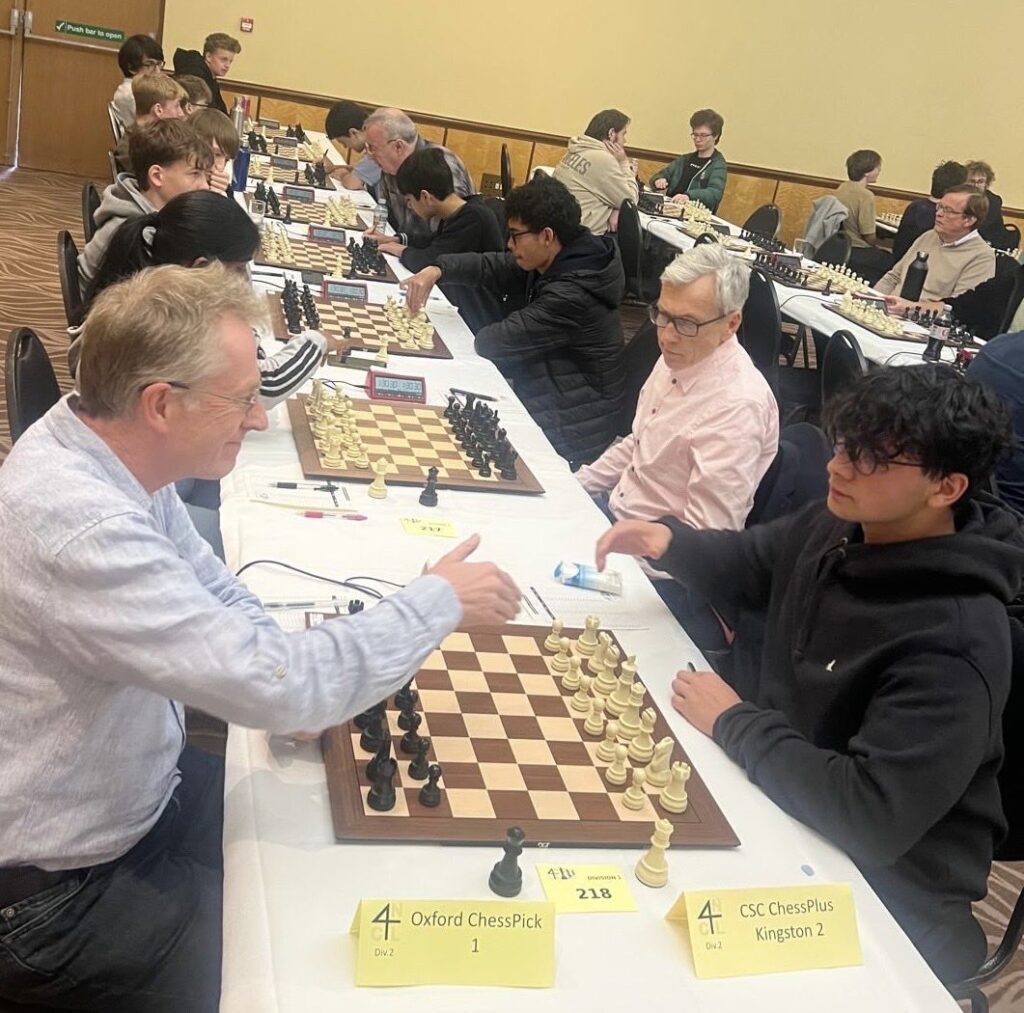
ChessPlus meets ChessPick: Second-team handshaking as we prepare to take on the very strong Oxford team
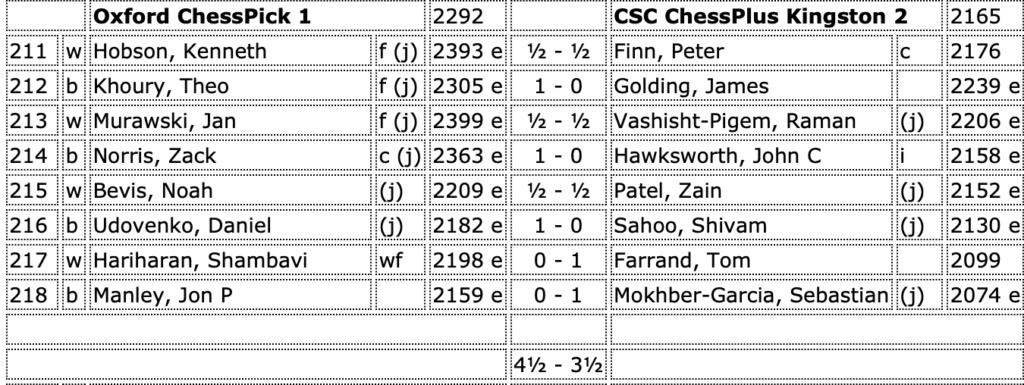
The second team opened against Oxford ChessPick 1. We had an almost completely new team and were outrated, so we did not place many expectations on the mainly young players. We lost by the painfully narrow margin 4½ – 3½.
It could have been different if young Zach Norris (Black, ECF 2363) had not calculated the rook endgame so accurately against our John Hawksworth. Credit to Zach for finding the winning idea of Rf5 and Rd5 with only two minutes left on his clock after four and a half hours’ play. Another rook endgame of fine margins.
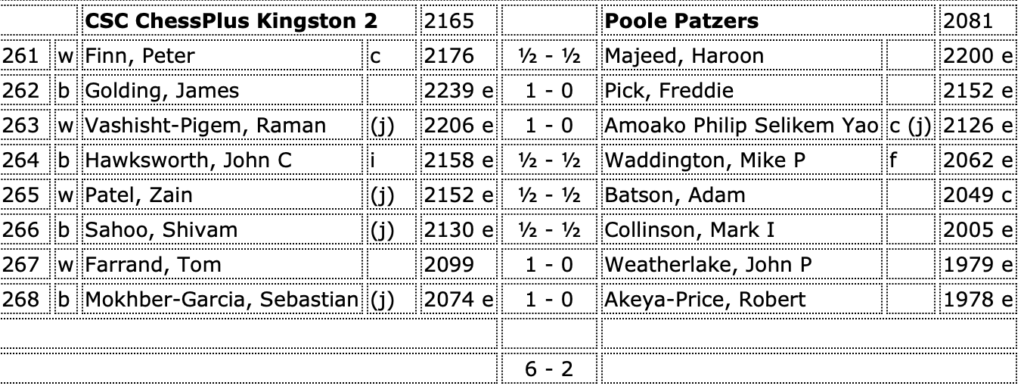
On Sunday, the second team faced Poole Patzers and, like the first team, made amends for the disappointment on Saturday and beat them 6-2. Tom Farrand and Sebastian Mokhber-Garcia both scored 2/2 during the weekend, joining Qixiang Han among the 100 percenters.
Third team
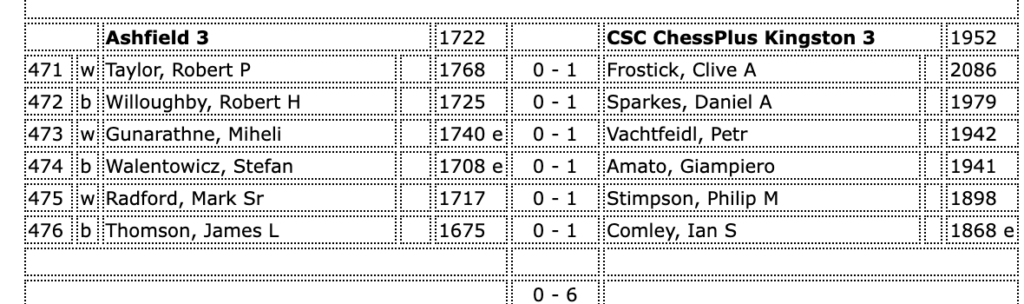
Meanwhile, in Bedford the third team enjoyed a tremendous Saturday, bagelling (as tennis- watchers like to say) Ashfield 3 by 6-0. The result was not entirely unexpected as we had an average rating advantage of 230 points a board, but the victory was very professionally delivered.
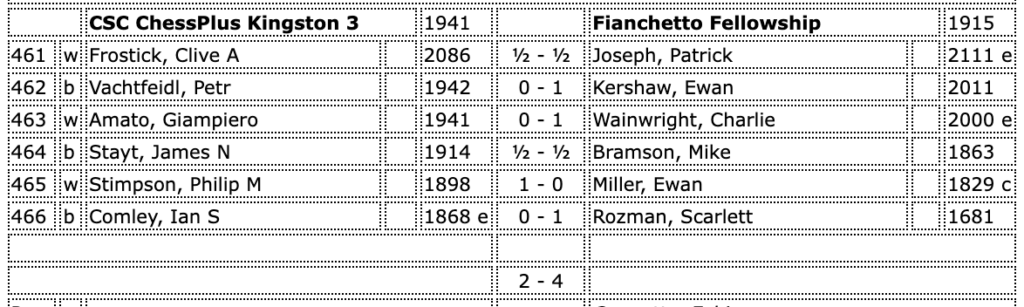
Sunday was a lot tougher – inevitable of course in a Swiss (DIvision 4 is a 36-team Swiss, whereas the other divisions are all-play-alls with team match-ups predetermined). We had a narrow rating advantage over Fianchetto Fellowship, but credit to them for beating us 4-2 on the day. Congratulations to Philip Stimpson on his 2/2 across the weekend. Perhaps we need to institute a player-of-the-weekend prize.
Fourth team
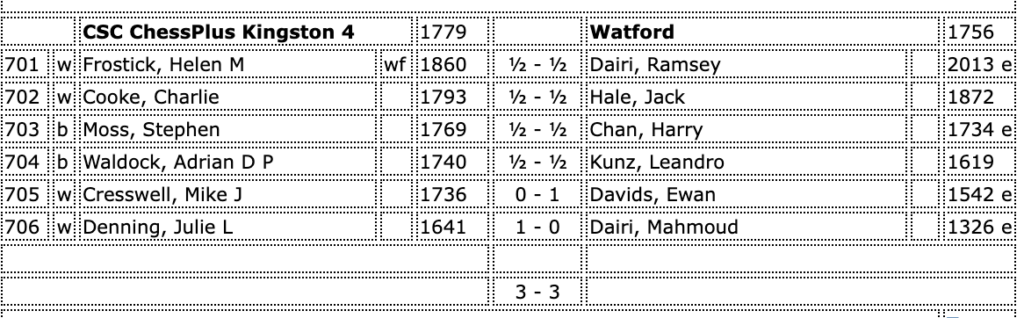
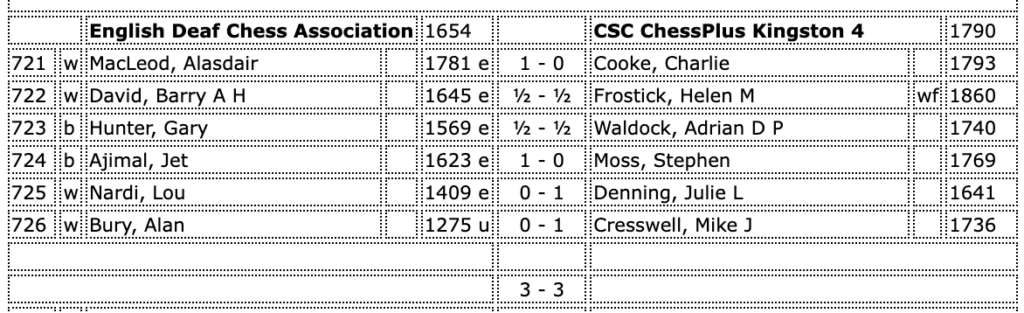
The fourth team were involved in a triangular match against two other clubs (Watford and the English Deaf), with three boards played against each on Saturday and Sunday, so nobody had much idea what was actually happening in terms of overall score. When the fog lifted it transpired that both matches had been drawn 3-3, which was deemed a satisfactory beginning.
Captain Julie Denning had a distinguished weekend, scoring 2/2 – the first time she has recorded 100 per cent across a weekend. When you consider she was making her debut as captain at 4NCL, this was a considerable achievement. Having two teams at each venue was also considered a success, despite the logistical complications, as the two halves of the squad now feel properly balanced. We really are all in this together.
There is now a three-month gap until the next round of matches on 23/24 January 2027, when the first and second teams will be in Bedford and the third and fourth teams in Peterborough. We have plenty of time to reflect on what went right and what went wrong, and to prepare for the challenges of the New Year. With a group of committed captains and a squad numbering 50, we believe we are ready for whatever lies ahead.
John Foley is honorary president of Kingston Chess Club and captains CSC ChessPlus Kingston in 4NCL Division 1.
South Norwood v Kingston, Lauder Trophy quarter-final played at West Thornton Community Centre, Thornton Heath on 1 October 2026
The Lauder Trophy is a knockout competition for teams of six restricted to a total rating of a maximum of 10,500 ECF rating points, a handicapping system which allows smaller clubs to compete on more-or-less level terms with larger ones. There is a premium on finding a selection which uses as much of the point count as possible, and on finding underrated players.
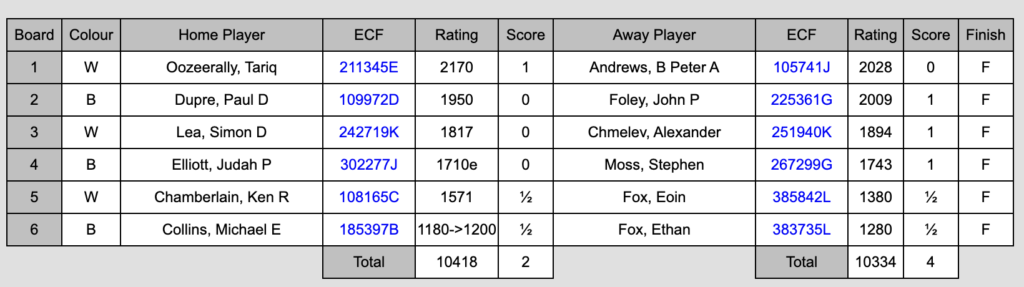
A Thursday night trip away to South Norwood makes availability and logistics a little more difficult. We arrived to find that South Norwood actually outrated us slightly – we were to face large deficits on boards 1 and 5, so needed the middle order to score well.
Alex Chmelev got us off to a good start on board 3. Playing Black against Simon Lea, the opening did not go well and he soon lost his a-pawn. But Simon did not choose the best way to win the pawn, struggled to extricate the knight which had led the raid, and then made several more mistakes which allowed Alex to win decisive material.
Eoin and Ethan Fox, on boards 5 and 6, had had good results in the summer simul games against David Maycock and Harry Grieve, and seemed to me to be underrated. Both had long games which went to the endgame, Eoin’s looking blocked and Ethan’s more open. In the event, both ended in draws, a terrific result for Eoin with Black against Ken Chamberlain, an experienced player who outrated him by around 200 points.
Wily Foxes: Brothers Eoin and Ethan secured important draws against South Norwood veterans on boards 5 and 6
In the same way that if there has been an unusually high-scoring Premier League football match a great many people will stay up to watch Match of the Day hoping it will be the first game, this report may have attracted readers who have heard on the grapevine or read on WhatsApp that Stephen Moss won on board 4 with the Muzio Gambit.
Everyone who saw the game on the night categorised it as a Muzio, but strictly speaking it is the Rosentreter Gambit, named after the gambit-loving German player Lieutenant-Colonel Adolf Rosentreter (1844-1920). It involves playing 4. d4 rather than 4. Bc4, the more usual Muzio version, though the theme of out-and-out attack homing in on f7 is the same. The gambit is the sort of wild stuff played in the 19th century when football teams still had five forwards. The game was the chess equivalent of conceding a couple of goals in the first few minutes and coming back to win. As with Premier League goalfests, this one had the respective managers tearing their hair out, but it was great entertainment and Stephen showed real enterprise to keep his initiative alive.
I was always fairly confident about board 2, where John Foley (pictured above, in Uzbek hat) had shaken off any jet lag from his recent visit to Samarkand to receive his honour as Fide chess educator of the year. He took an early advantage against Paul Dupré, missed one opportunity to drive it home, but then seized the chance to win a pawn and expose the black king when Paul unwisely castled queenside. This was the key passage of play.
John reminded me that there was an earlier occasion when he won a game against Paul in which Paul had castled queenside and John kingside. Indeed, John annotated it for the Games section, and it can be found here in all its glory. But that was a wildly exciting battle, whereas this was fairly plain sailing. And it was a reminder that in those days South Norwood 1 were among the division 2 establishment while Kingston 2 expected to struggle to survive there. In less than three years since, the two teams have moved in opposite directions. Good times and bad can change very quickly, in chess as in life.
I have deferred for as long as possible writing about my own game, which was the last to finish. On arrival, I was surprised to face Tariq Oozeerally, who had not played a game for South Norwood for more than two years, but is rated 2170 so with Black an uphill struggle loomed.
After a quiet opening, he went for the throat and I found a rebuttal. I thought I might be slightly better (rightly, as it turned out) and was tempted to offer a draw as I was behind on the clock and the other games looked OK. But for the same reasons he would probably have declined. In the end, time was critical. The closing stages were not recorded, so the reader will have to cope with the frustration you feel when you watch your side holding a good draw away at one of the big clubs on TV, go out to have a cuppa, and return to find the roof has fallen in while you were away. Here’s what I could capture of the action.
Galling. But overall a 4-2 win against the rating edge and away from home was a good effort. Some time over the next three months we shall have a home semi-final against Coulsdon.
Peter Andrews is Kingston Lauder Trophy captain and club chair
Kingston 2 v Kingston 1, Surrey League division 1 match played atthe Richard Mayo Centre, United Reformed Church, Kingston on 21 September 2026
A week after the first division 1 match between Kingston’s first and second teams came the return fixture, this time with Kingston 2 at home (the league designates a “home” team even when both teams are in effect at home). The toss once again gave the first team White on the odd boards. Both teams were a little stronger than in the earlier match. Most of the games were well contested and long, and the final score flattered the stronger side.
Three games finished relatively early. On board 5, young Harvey Li scored a quick win against Martyn Jones. In a standard-looking Queens Gambit Declined, a single wasted move allowing White to make the critical e4 break, and the resulting pressure led to a quick collapse.
On board 3, Zain Patel’s sharp eye (there is another example in the puzzles section of this month’s English Chess Federation online magazine Chess Moves, which is loaded with Kingston achievements) led to the win of a pawn against David Rowson. The extra pawn was an advanced passed d-pawn in the early stages of the endgame, and further tactics exploiting it to win a piece meant that the later stages were not required. Here is the critical stage of the game.
Between those two, on board 4, Stephen Lovell had held Julian Ward (who was making his Kingston debut) to a draw; Julian felt that he’d had a slight edge, made a slip and the game levelled out.
The board 8 game between Jon Eckert and myself was always close to level. I found a late middlegame trick to win a pawn, but Jon had compensation and soon found a trick to win it back, at which point a draw was agreed. Stockfish rated us both at 96% accuracy, unusually high at this level, which explains why the evaluation never changed much.
Alan Scrimgour and Peter Hasson both recommended their game on board 6 to me as an interesting one, but it seems that they both missed just how interesting the finish was!
Joshua Pirgon (left) and Tom Mayers fought out an exciting game brimming with ideas. Photograph: Ethan Fox
Joshua Pirgon v Tom Mayers on board 7 was another game recommended to me by the loser as a particularly interesting one. Tom prepared some very detailed notes on it afterwards – looking through games that you have lost, although painful, really is the way to learn. I subjected the game and the notes to the Stockfish engine on Lichess, and found some remarkable tactics all the way through.
I’m usually wary of showing openings in these columns for fear of facilitating preparation by other clubs against our players later. But in this case White’s opening disaster was an important part of the story of the game and is very unlikely to be repeated. So here is the whole of the game until it was decided as a contest: sit back and enjoy, with a scotch in your hand, a cold towel round your head, or Mozart in the background, as best helps you grapple with complexity. Although there are errors, that is inevitable in a game like this, and it reflects very well on the resourcefulness of two of our younger newcomers. It also proves, incidentally, that 1. b3 is not for herbivores wanting a quiet life.
Board 2, Jasper Tambini v Peter Large, was not quite the spectacle we might have expected from players with contrasting styles. I confess I had not realised Jasper had the London System in his armoury. But after a fairly even battle it livened up in the time scramble.
Jasper (pictured top right, next to John Hawksworth) commented afterwards that if he didn’t often win games from lost positions there wouldn’t be much point playing. This sudden turnaround was hard on Peter, but it did finally give the second team a win to celebrate.
John Hawksworth (right) lost on time when winning against the never-say-die David Maycock. Photograph: Ethan Fox
There was drama of a different kind on board 1, where David Maycock won on time against John Hawksworth in a position where Black had a winning advantage. John has undergone the painful therapy of producing a high-quality analysis for the Games section, so I will only note here that David’s determination and will to win even in bad positions are among the qualities which have made him one of the rocks of our success since he joined us five years ago.
So overall another win for Kingston 1, 6-2 this time, but no cause for complacency. We hope these matches have warmed everyone up for the crucial Alexander Cup battle against Guildford on Monday 5 October, and look forward with mixed feelings to the two derby matches in the Thames Valley League later in the month.
Peter Andrews is Kingston first-team captain and club chair