South Norwood v Kingston, Lauder Trophy quarter-final played at West Thornton Community Centre, Thornton Heath on 1 October 2026
The Lauder Trophy is a knockout competition for teams of six restricted to a total rating of a maximum of 10,500 ECF rating points, a handicapping system which allows smaller clubs to compete on more-or-less level terms with larger ones. There is a premium on finding a selection which uses as much of the point count as possible, and on finding underrated players.
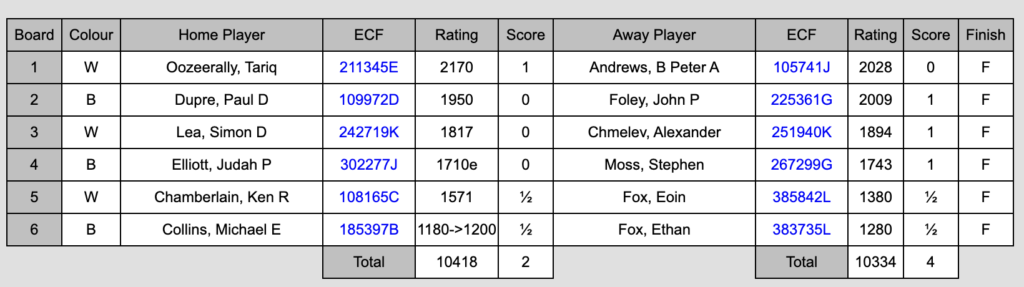
A Thursday night trip away to South Norwood makes availability and logistics a little more difficult. We arrived to find that South Norwood actually outrated us slightly – we were to face large deficits on boards 1 and 5, so needed the middle order to score well.
Alex Chmelev got us off to a good start on board 3. Playing Black against Simon Lea, the opening did not go well and he soon lost his a-pawn. But Simon did not choose the best way to win the pawn, struggled to extricate the knight which had led the raid, and then made several more mistakes which allowed Alex to win decisive material.
Eoin and Ethan Fox, on boards 5 and 6, had had good results in the summer simul games against David Maycock and Harry Grieve, and seemed to me to be underrated. Both had long games which went to the endgame, Eoin’s looking blocked and Ethan’s more open. In the event, both ended in draws, a terrific result for Eoin with Black against Ken Chamberlain, an experienced player who outrated him by around 200 points.
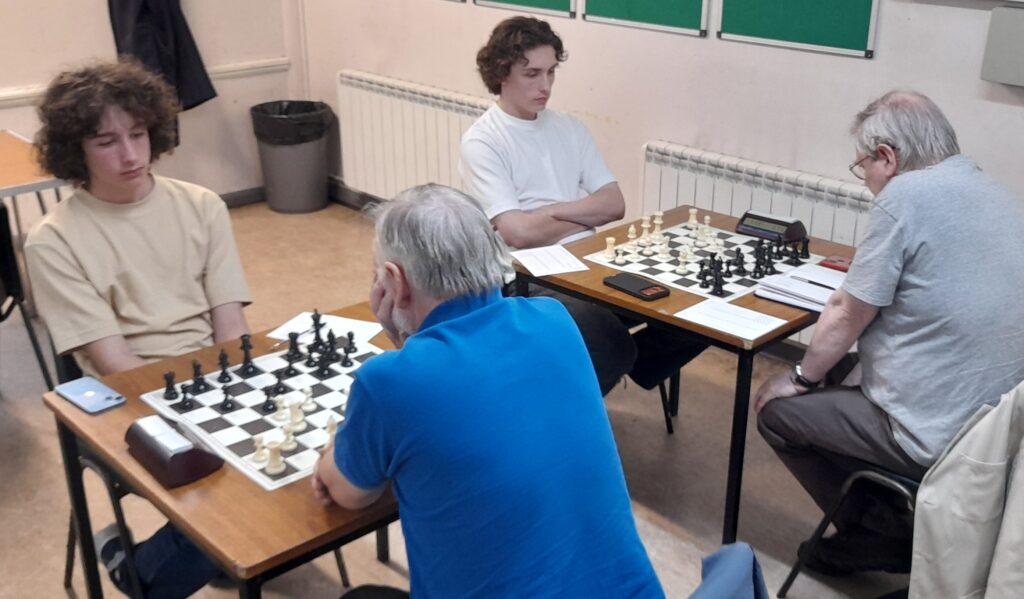
In the same way that if there has been an unusually high-scoring Premier League football match a great many people will stay up to watch Match of the Day hoping it will be the first game, this report may have attracted readers who have heard on the grapevine or read on WhatsApp that Stephen Moss won on board 4 with the Muzio Gambit.
Everyone who saw the game on the night categorised it as a Muzio, but strictly speaking it is the Rosentreter Gambit, named after the gambit-loving German player Lieutenant-Colonel Adolf Rosentreter (1844-1920). It involves playing 4. d4 rather than 4. Bc4, the more usual Muzio version, though the theme of out-and-out attack homing in on f7 is the same. The gambit is the sort of wild stuff played in the 19th century when football teams still had five forwards. The game was the chess equivalent of conceding a couple of goals in the first few minutes and coming back to win. As with Premier League goalfests, this one had the respective managers tearing their hair out, but it was great entertainment and Stephen showed real enterprise to keep his initiative alive.
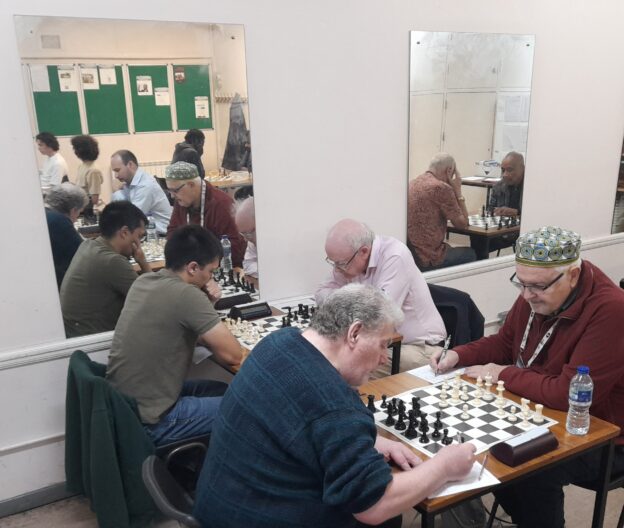
I was always fairly confident about board 2, where John Foley (pictured above, in Uzbek hat) had shaken off any jet lag from his recent visit to Samarkand to receive his honour as Fide chess educator of the year. He took an early advantage against Paul Dupré, missed one opportunity to drive it home, but then seized the chance to win a pawn and expose the black king when Paul unwisely castled queenside. This was the key passage of play.
John reminded me that there was an earlier occasion when he won a game against Paul in which Paul had castled queenside and John kingside. Indeed, John annotated it for the Games section, and it can be found here in all its glory. But that was a wildly exciting battle, whereas this was fairly plain sailing. And it was a reminder that in those days South Norwood 1 were among the division 2 establishment while Kingston 2 expected to struggle to survive there. In less than three years since, the two teams have moved in opposite directions. Good times and bad can change very quickly, in chess as in life.
I have deferred for as long as possible writing about my own game, which was the last to finish. On arrival, I was surprised to face Tariq Oozeerally, who had not played a game for South Norwood for more than two years, but is rated 2170 so with Black an uphill struggle loomed.
After a quiet opening, he went for the throat and I found a rebuttal. I thought I might be slightly better (rightly, as it turned out) and was tempted to offer a draw as I was behind on the clock and the other games looked OK. But for the same reasons he would probably have declined. In the end, time was critical. The closing stages were not recorded, so the reader will have to cope with the frustration you feel when you watch your side holding a good draw away at one of the big clubs on TV, go out to have a cuppa, and return to find the roof has fallen in while you were away. Here’s what I could capture of the action.
Galling. But overall a 4-2 win against the rating edge and away from home was a good effort. Some time over the next three months we shall have a home semi-final against Coulsdon.
Peter Andrews is Kingston Lauder Trophy captain and club chair