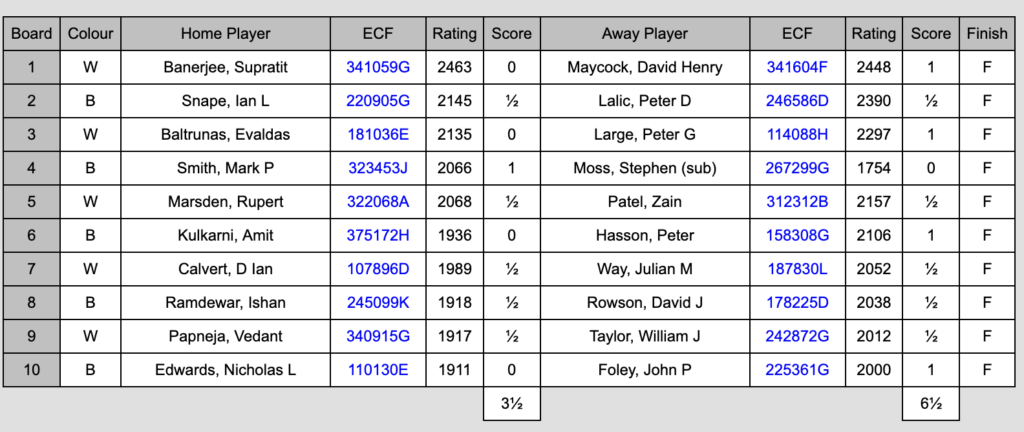
Coulsdon v Kingston, Alexander Cup semi-final played at Coulsdon Chess Club, Chipstead Valley Road, Coulsdon on 9 February 2026
The build-up to the Alexander Cup semi-final away to Coulsdon was not propitious for Kingston. Two players reported sick, though one managed to suppress his ailments for an evening and play. Young Zain Patel was also sick, but his illness worked to our advantage. He was too ill to fulfil a singing engagement, so was able to replace the player who really was too ill to make it to Coulsdon. The Lord giveth and the Lord taketh away.
A further complication was that we were playing Guildford 2 at home in Surrey division 2 on the same night. We needed strong players for that match as well. Fighting on two fronts is not easy. But the final blow came at 7.33pm, just as the match at Coulsdon was getting under way. The news was relayed via the club WhatsApp group that our 2200-plus board 4 was having a desperate journey south to Coulsdon and would not make it before the half-hour default time. There was only one reserve – a rather feeble player rated 1750. Yes, me. I would do my best, but outrated by 300 points we were almost certainly 1-0 down before we even started.
On board 7, Julian Way and Ian Calvert agreed a quick draw – a reasonable start as Julian had Black against the supersolid Calvert. David Rowson drew on board 8, as did Peter Lalić against the dangerous Ian Snape on board 2. I then went down to my expected defeat – thoroughly deserved as I played a singularly dull game and was out-techniqued by Coulsdon captain Mark Smith. That put Coulsdon 2-5-1.5 up and Kingston’s nerves were jangling.
Peter Hasson calmed those nerves to some degree with a smooth win on board 6 against Amit Kulkarni, whom he had beaten in the corresponding league match at Coulsdon the previous Monday – a useful dress rehearsal. “I had played the same opponent with the same colours in the league match a week earlier, when he suffered a positional opening disaster,” explained Peter afterwards. “This time he opted for something solid, but conceded White a big space advantage and was also burning time as he was not so familiar with the position.”
Peter’s win tied the score at 2.5-2.5 and it quickly became 3-3 when Zain Patel, who had been substantially worse in the opening, secured an important draw against fast-rising junior Rupert Marsden with Black on board 5. If we had lost that game, as had once seemed likely, it really would have been squeaky-bum time. Well played Zain! Did this match really hang on the dodgy state of your vocal cords?
The feeling was that Will Taylor, with Black on board 9, had winning chances against Vedant Papneja. But time was starting to press and Will, in his own words, “blundered into a perpetual on the increment”. That made it 3.5-3.5, and the match was still in the balance. I could barely bring myself to watch, but Peter Lalić, who was spectating and could actually work out what was going on, was looking confident. He was right to be so – the rest of the match proved to be one-way traffic.
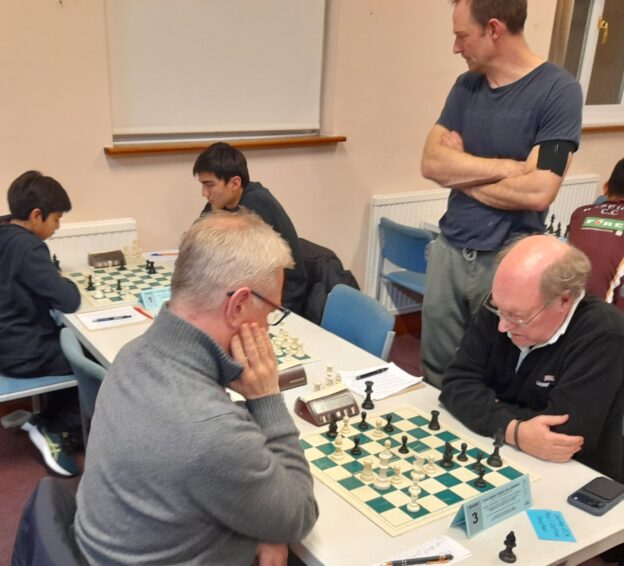
Peter Large (pictured above, right), had Black against Evaldas Baltrunas on board 3 and the game turned into a fascinating tussle, with much middle-game manoeuvring for an advantage. The endgame was tricky and, though Peter had a serviceable advantage, time was running short. Peter then played a knight check with such elan that his opponent assumed his hemmed-in king had been mated, missing the fact there was a flight square. Peter declared it “the strangest game I have played in my 58-year chess career”. Hallucinations, it seems, are part of chess, even at this elevated level.
On board 10, Kingston’s president and Alexander Cup captain John Foley played a masterful rook and pawn endgame to defeat the doughty Nick Edwards – a tremendous battle between two admirable players who have each been on the chess scene for more than half a century. After the game, John looked sheepishly pleased with his win, and he has instructively annotated it for the website’s Games section.
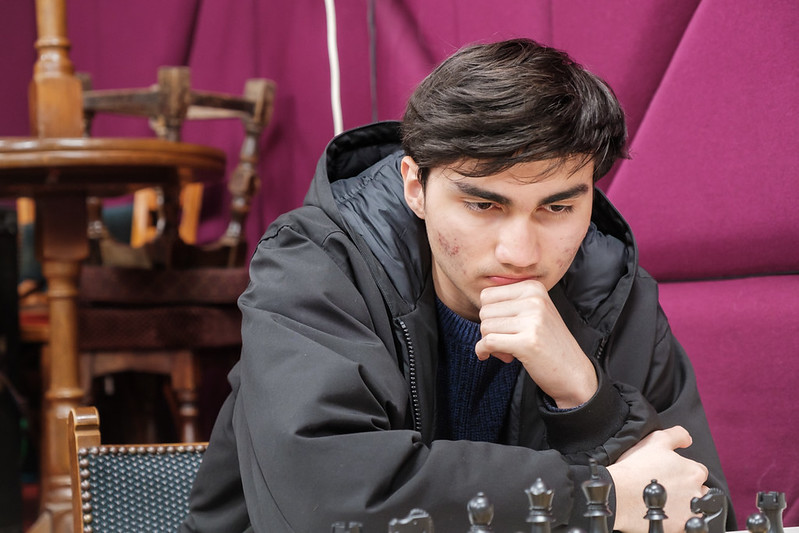
The marquee game was the board 1 match-up between Supratit Banerjee and David Maycock. David had beaten Supratit in the league match the previous week, but this time Supratit had the white pieces. Would that make a difference? David played a tricky sideline of the Philidor Defence – do we detect the influence of team-mate and sparring partner Peter Lalić? – and it worked out very well, allowing him easily to equalise in the opening. There followed some cagey positional chess, proving that David – who we usually think of as a purveyor of chess fireworks – can also play in a more pragmatic, wait-and-see style.
Now, after a series of games against each other in IM norm tournaments and the Surrey League, David and Supratit can revert to being team-mates in the 4NCL and the Thames Valley League. Kingston are very fortunate to have two such talents.
The wins by Peter Large, John Foley and David Maycock came in rapid succession and made the final score 6.5-3.5 to Kingston. The earlier travails were forgotten and we could at last rest easy. Until the final at least, where a very strong Guildford team awaits us. This eagerly anticipated match will take place at the neutral venue of Ashtead Chess Club on Tuesday 26 May. We thumped Guildford 8-2 in the final last year, but expect it to be much closer on this occasion as Guildford have added to their resources and are building a very powerful team.
The incentive for Kingston to retain the trophy is that it would complete a run of five successive Alexander Cup titles – something no team has ever done in the 100-year history of the competition. We feel the weight of history on our shoulders, but will that burden prove too great? Book your tickets for the final now; it is going to be intense … and we hope historic.
Stephen Moss is Kingston club captain