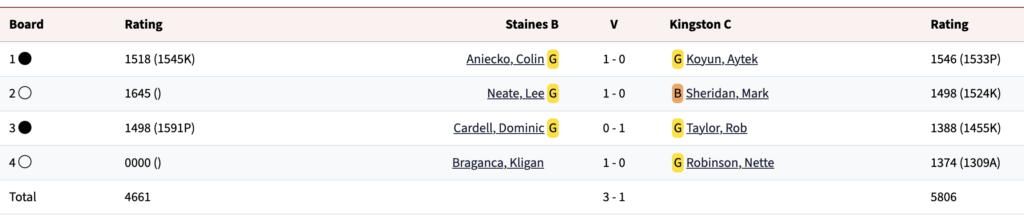
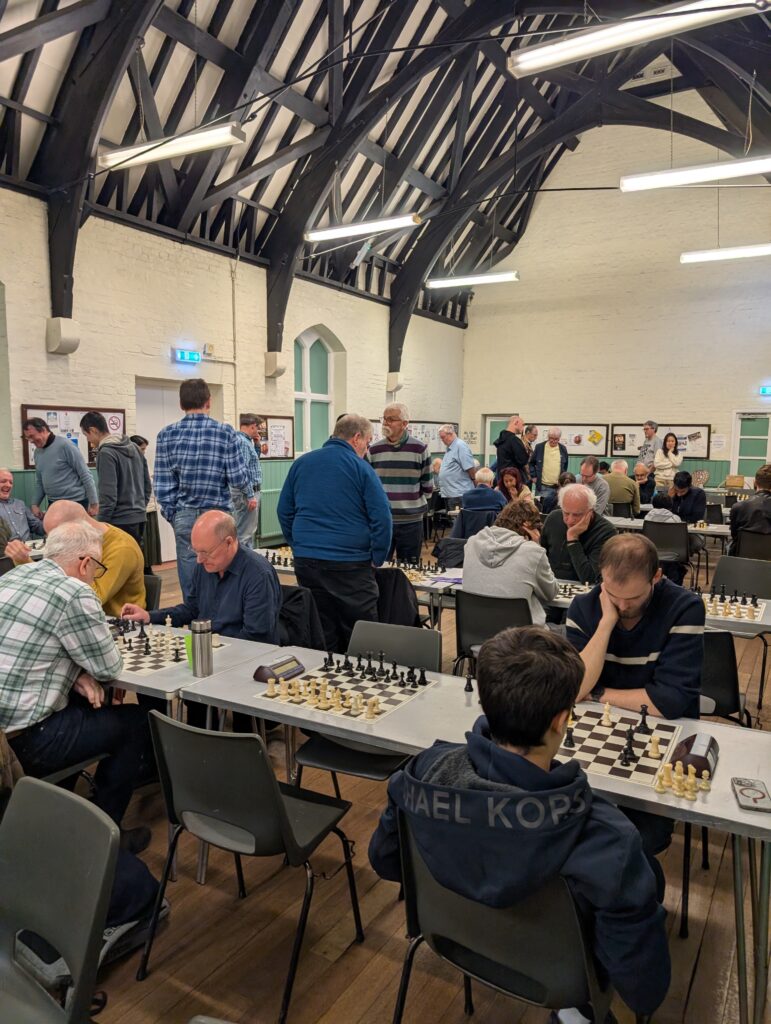
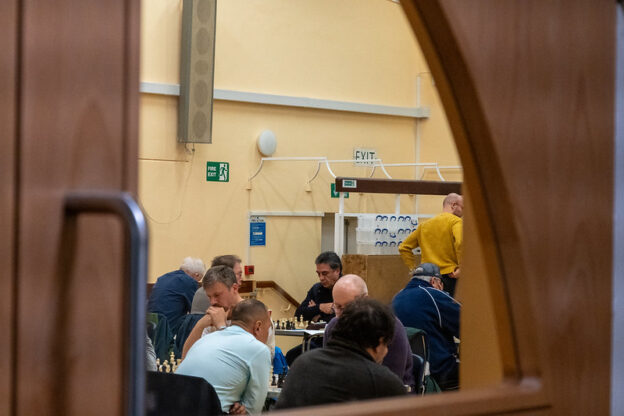
Staines B v Kingston C, Thames Valley League division X match played at The Literary Institute, 51 High Street, Egham on 26 March 2026
We don’t often visit Staines – one of the trickier journeys we face for away matches – so well done to this intrepid foursome for getting there. Rob Taylor was the star of the show. He captained in Jon Eckert’s absence and enjoyed a good win. His three team-mates were less successful as Kingston C went down to a 3-1 defeat, but it was pleasing to see Aytek Koyun making his league debut for the club on board 1.
Kingston 2 v Wimbledon 2, Surrey League division 2 match played at the Richard Mayo Centre, United Reformed Church, Kingston on 23 March 2026
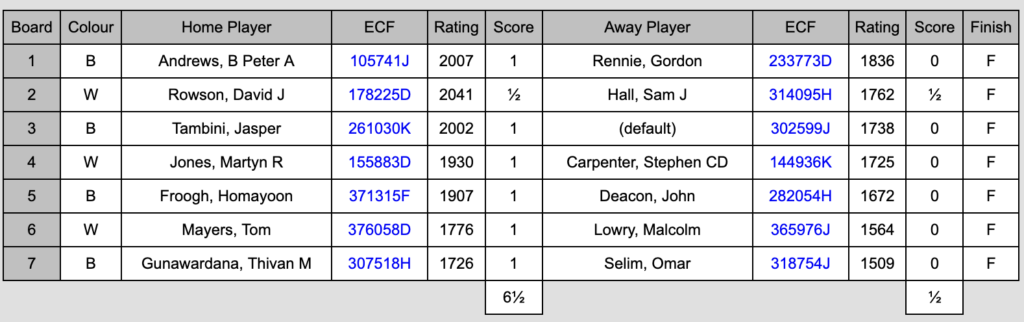
As in the away fixture a few weeks earlier, Kingston 2 had a big rating advantage against a Wimbledon 2 team depleted by nominations calls by their first team. So despite losing the toss we were confident of the win which would seal the Surrey League division 2 title barring a remarkable finish by Guildford 2. But expectation brings its own pressure.
Jasper Tambini had the first point on the board in half an hour when Wimbledon’s board 3 failed to appear. Tom Mayers, with White on board 6, followed with a nice finish against Malcolm Lowry.
Either side of Tom, Homayoon Froogh on board 5 and Thivan Gunawardana on board 7 showcased the Caro-Kann defence. Homayoon’s opponent, John Deacon, threw his kingside pawns up the board, gaining space but leaving his king with nowhere to go, and once the queens came off Homayoon was able to exploit the weakness of White’s pawns. Thivan’s game (below) was different – he was the one who gained the space advantage against Omar Selim, and he then won material when White tried to break out.
Martyn Jones, who has won a lot of games lately, added a mysterious one to the list with White against Stephen Carpenter on board 4. When the players stopped recording because they both had fewer than five minutes on the clock, they had reached a position which they both thought was about level – Martyn had just declined a draw. But Stockfish thinks White is losing here – evaluation worse than minus 2 – presumably based of White’s broken pawns, although with the black king so open White must have practical chances.
Martyn has not been able to reconstruct the rest of the game in detail, but he was able to play rook to d4 and b4 check, driving the black king to c8. Black then chased white kingside pawns and allowed the queen on c3 to h8, mating in two. In an open position and a time scramble, errors can easily overturn pre-existing advantages.
No such luck for David Rowson, who ran into tough resistance from Sam Hall on board 2. This was a slow burner for the first 20 moves or so, and then the advantage swung both ways, as usual with time running short.
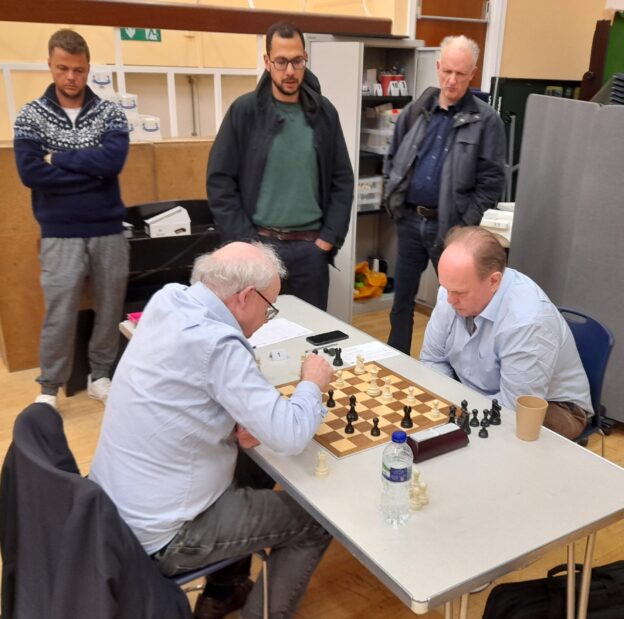
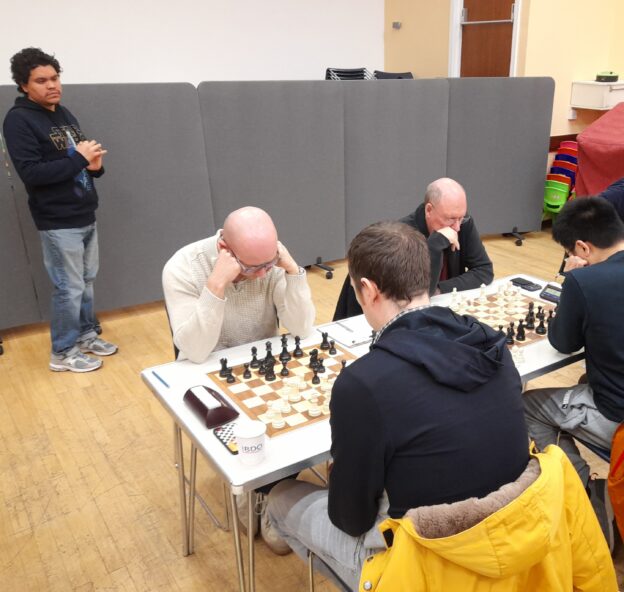
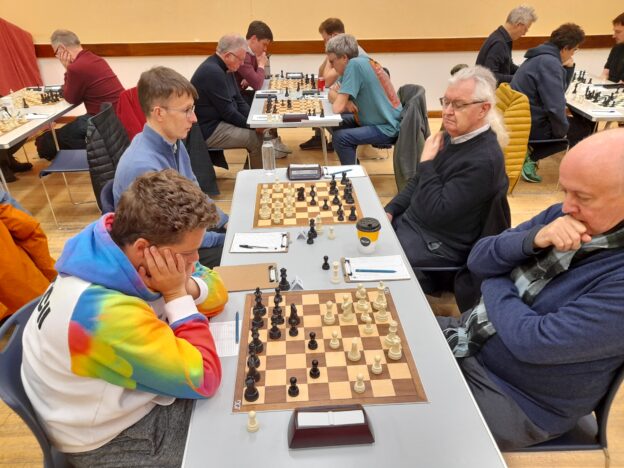
My own game with Black against Gordon Rennie on board 1 finished around the same time. Gordon has had to carry the management challenge posed by the loss of players and play higher-rated opponents in every match for Wimbledon, and he certainly makes a fight of it. This was the game with the most mutual jeopardy, judging by the spectators around the board towards the end (see photograph above) and the whisky I needed to sleep once I got home. Time trouble was of course a factor, but most of the critical phase of the game was recorded.
The result means that Kingston 2 cannot be overhauled on match points in division 2. Guildford 2 can catch us if we lose at Ashtead on 7 April and they win all their remaining matches, but to catch us on game points as well they would need something like three 6-1 wins, which in such a tight division is unlikely. We should not take the Ashtead match lightly – the day after our win against Wimbledon 2, they turned out a team with 2100+ rated Dan Rosen on board 4 – but it does look as though perhaps the most remarkable of our likely trophy successes this season is almost in the bag.
Peter Andrews is club chair and captain of Kingston 1 and Kingston 2 in the Surrey League
Kingston 4 v Surbiton 3, Surrey League division 5 match played at the Richard Mayo Centre, United Reformed Church, Kingston on 23 March 2026
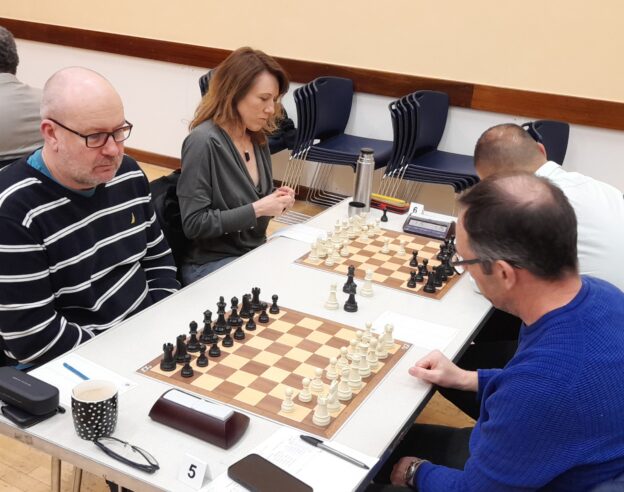
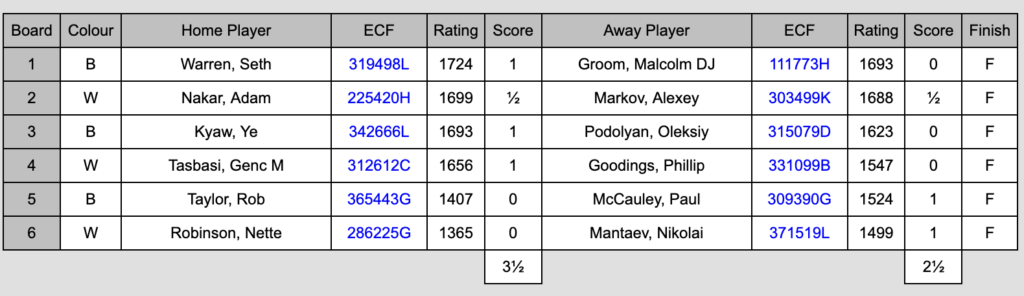
This was a well-contested local derby – Kingston and Surbiton are about three miles apart – between two very solid teams. Surbiton proved too strong on the bottom boards, with the canny Paul McCauley beating Rob Taylor (pictured, above left) with White on board 5 and Nikolai Mantaev getting the better of Nette Robinson with Black on 6. But it was a different story on the top boards.
Seth Warren had a fine victory over Surbiton veteran Malcolm Groom with Black on board 1, Ye Kyaw won against Oleksiy Podolyan on 3, and Genc Tasbasi ground out a crucial success against Surbiton captain Phil Goodings on 5. The vital half-point in a 3.5-2.5 win was supplied by Adam Nakar, who drew against the dangerous and tactically inclined Alexey Markov on board 2. This was a very good result for Adam, who hasn’t had a chance to play many games this season, and was enough for Kingston 4 to claim local bragging rights.
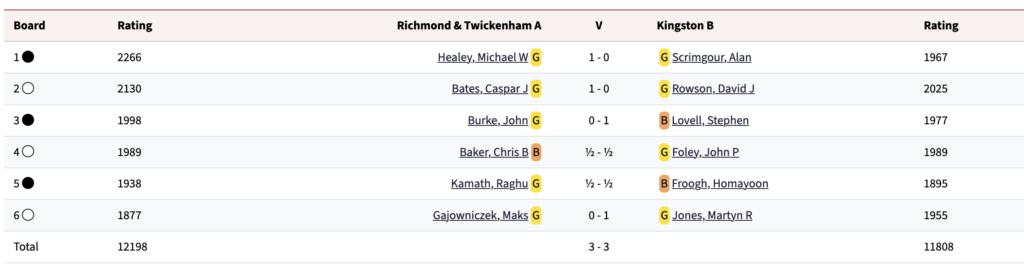
Richmond A v Kingston B, Thames Valley League division 2 match played at the Adelaide pub Teddington on 17 March 2025
Like Kingston B’s previous fixture, a narrow win against Surbiton A, this match at Richmond was a relegation clash. The two teams were quite similar in terms of average ratings, but Richmond were strong on the top two boards. In view of my recent poor form, Alan Scrimgour kindly agreed to take board 1 against Mike Healey.
I was also grateful to John Foley for stepping in to play at short notice, and it was John who secured the first half-point for us. He commented on an amusing aspect of his encounter: “I played an uneventful Caro-Kann, with an early draw. I thought at first it was Chris Baker IM. I was confused because I played CBIM previously and this person looked different.”
The evening’s other draw was that on board 5. Raghu Kamath played the Dutch Defence and had pressure on the half-open f-file, but Homayoon Froogh defended stoutly. In the following position, Black could have opened a second front on the queenside and centre by playing his pawns to b6 and c5.
The board 1 game between Alan Scrimgour, with White, and Mike Healey began as a Sicilian Defence, c3 variation (1. e4 c5 3. c3). It was level until this position was reached:
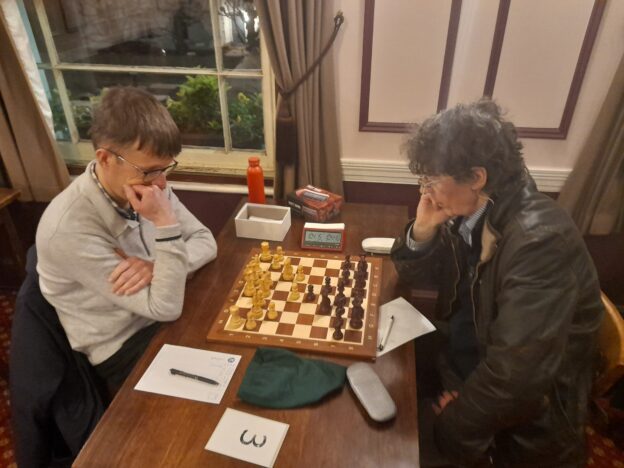
Kingston soon equalised the score thanks to Stephen Lovell’s win with White on board 3. Here his opponent, John Burke, has just played 17…N(f6)xNd5. Stephen (pictured above, left) had to decide how to recapture, and had three choices.
This left the match all square with two games outstanding – boards 2 and 6. Both these games seemed hard to call for one side or the other, but in the case of the board 2 game this was because the position might be described as on a knife edge, while on board 6 the game looked to be heading for a draw. One Interesting aspect of Gajowniczek v Jones on board 6 was that Martyn had played the Grunfeld Defence, which in my experience is rarely seen in club chess, though I don’t know why.
The action in my game was all on the queenside, as Casper Bates had a passed pawn on the b-file and I had one on the a-file. As we entered time trouble the question was whether either of us could win the opposition’s pawn or force a weakening in his position. Unfortunately, I played too quickly, without sufficient calculation, as is often my problem when in time trouble, and allowed Casper’s queen and knight to enter the heart of the position and give mate.
Disappointed, I looked at the match sheet and saw that someone had scored the board 6 game as a draw, which would have meant that we had also lost the match. However, it turned out that whoever had assumed a draw in that game had jumped the gun: the two players were still fighting it out, although the opposite-coloured bishop ending did appear dead drawn. Martyn, who thought I was either winning or drawing my game, had offered a draw, which Maks had rejected. Sadly for the Richmond player, moments later he lost on time, still in a theoretically drawn position. So Kingston B had very fortuitously drawn the match 3-3.
This result still leaves the relegation issue very much undecided. Richmond have 8 points, but only two matches left, and those are against Kingston A and Hammersmith A. Ealing and Kingston B both have 6 points, but we have an extra match in hand. At the bottom are Surbiton with 5 points, but they have played a match less than us. So it’s all to play for.
David Rowson is Kingston B captain in Thames Valley League division 1
Kingston v Epsom, Lauder Trophy semi-final played at the Richard Mayo Centre, United Reformed Church, Kingston on 16 March 2026
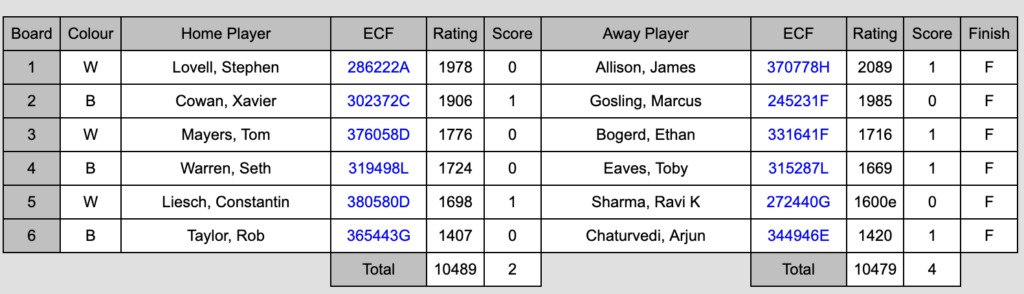
The Lauder Trophy is a knockout competition in which the total rating of the six-board team cannot exceed 10,500, ie an average of 1750 per board. The rating limit makes it likely that the matches are close, although it gives a small advantage to clubs with large player pools, giving them the best chance of getting as close as possible to the rating limit without exceeding it, and those with plenty of underrated players, especially fast- rising juniors, so as to get the biggest strength bang for the rating buck. This semi-final illustrated the point well: Kingston total rating 10,489, Epsom 10,479, but the latter had several juniors and no one older than their [to my elderly eyes] still youthful president, Marcus Gosling.
Kingston had White on the odd boards, and all the games were indeed well-contested. Epsom struck the first blow on board 6, where KIngston’s Rob Taylor got an advantage in the opening against Arjun Chaturvedi but lost the exchange when trying to regroup his attack. His position was good enough to prevent much progress, but White was eventually able to return the exchange for a pawn and win the bishop ending a pawn up.
Around the same time, Tom Mayers went down to Ethan Bogerd on board 3. Tom had won a pawn in the opening, for which Ethan had some initiative but probably not enough. Tom got active while retaining the pawn, and I was optimistic for a while, but an exchange went missing in the complications and Ethan finished off ruthlessly. Ethan had also won both his games against Kingston in the Thorpe Trophy two days earlier. Advantage Epsom, but the very promising Kingston newcomer Constantin Liesch then struck back on board 5.
On board 4, Seth Warren with Black against Toby Eaves had been slightly better in the early middle game. He then dropped a pawn but reached an ending with bishops of opposite colours which was objectively drawn. However, we have learned from one of our top players that positions in which only one side has winning chances, however slight, and can maintain them without risk can be humanly difficult to defend.
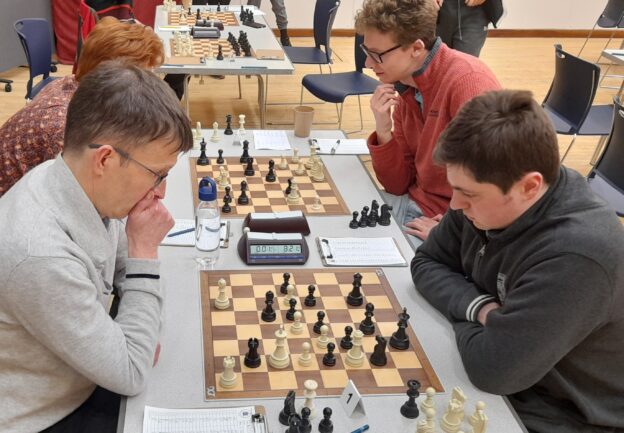
That left boards 1 and 2 in play, on both of which we were substantially outrated. Earlier on, I had not been optimistic about either. On board 1, Stephen Lovell (pictured above, left foreground) became a little cramped with White against James Allison, and although the position was sufficiently blocked that it was hard for Black to make progress, Allison eventually made a breakthrough on the queenside to win material, and found a trick to rebut Stephen’s attempted kingside counter. In the end Stephen lost on time, but the game was gone anyway.
On board 2, I was worried that Xavier Cowan’s knight on e4 had no obvious escape route and that Xavier would need tactics to prevent Marcus Gosling from eventually playing f3 to win it. That created tension, and characteristically caused Xavier to burn all his time, so that by the time the game exploded he was more or less on the increment. But with no time to think he produced a fireworks display.
A shame that however crushing a win may be it only counts one point, but nevertheless a nice way to end our involvement in this year’s competition. Well done to Epsom on their 4-2 victory. They now face Dorking in the final.
Peter Andrews is Kingston captain in the Lauder Trophy and chair of the club
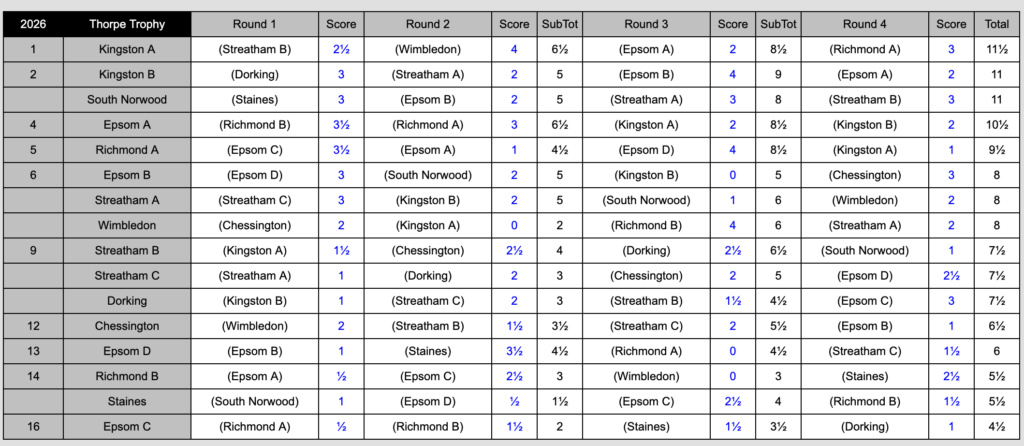
Kingston entered two teams in the Thorpe Trophy, played at Cheam on 14 March 2026. The A team retained the title and the B team came joint second, but there were a few alarms along the way
The Surrey League revived the long-dormant Thorpe Trophy – a four-round team rapidplay – in 2025, when a Kingston A team spearheaded by Peters Lalić and Large won it. The 2026 edition had the same result, but for much of the afternoon that conclusion was far from guaranteed.
The neat feature of the Thorpe is that the four-person teams have to have two players of unspecified rating – naturally teams select the strongest players they can muster – and two with a rapidplay rating below ECF 1750. It’s an excellent opportunity for players who usually play for different league teams to play alongside each other and in this case celebrate success together.
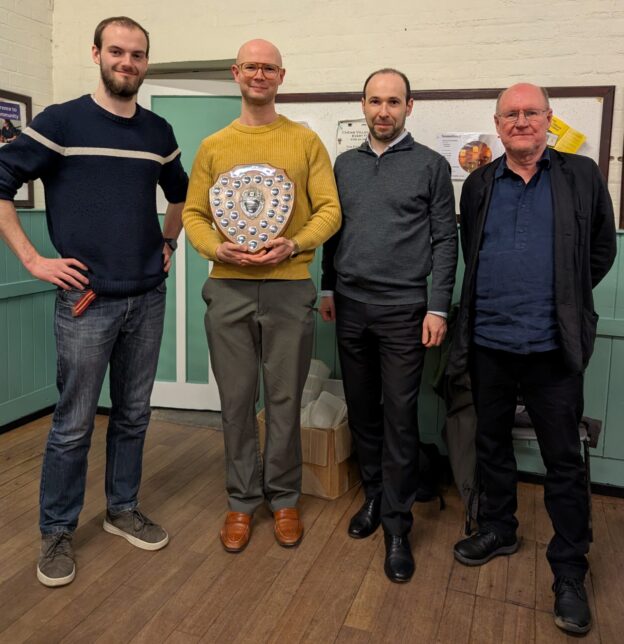
We had the tried-and-trusted pair of Lalić and Large back in harness for Kingston A, this time joined by Alexander Chmelev and Seth Warren (the winning team is pictured above, with left to right: Warren, Lalić, Chmelev and Large). Kingston A had FM Vladimir Li, making a welcome return to competitive chess, on board 1; Jasper Tambini on board 2; er, me on board 3; and Genc Tasbasi on board 4.
The Peters, well supported by Alex and Seth, both scored 3.5/4 to guide Kingston A to a tournament-winning 11.5/16 – the event is decided on game points – but the role of Vladimir in deciding the title must be emphasised. He scored a perfect 4/4, thus both propelling Kingston B into second place alongside South Norwood and also denying the main rivals of both the Kingston teams from garnering vital points. Jasper also performed well, scoring 3/4, and missed a mate in the game he did lose in round 2 to Graham Keane.
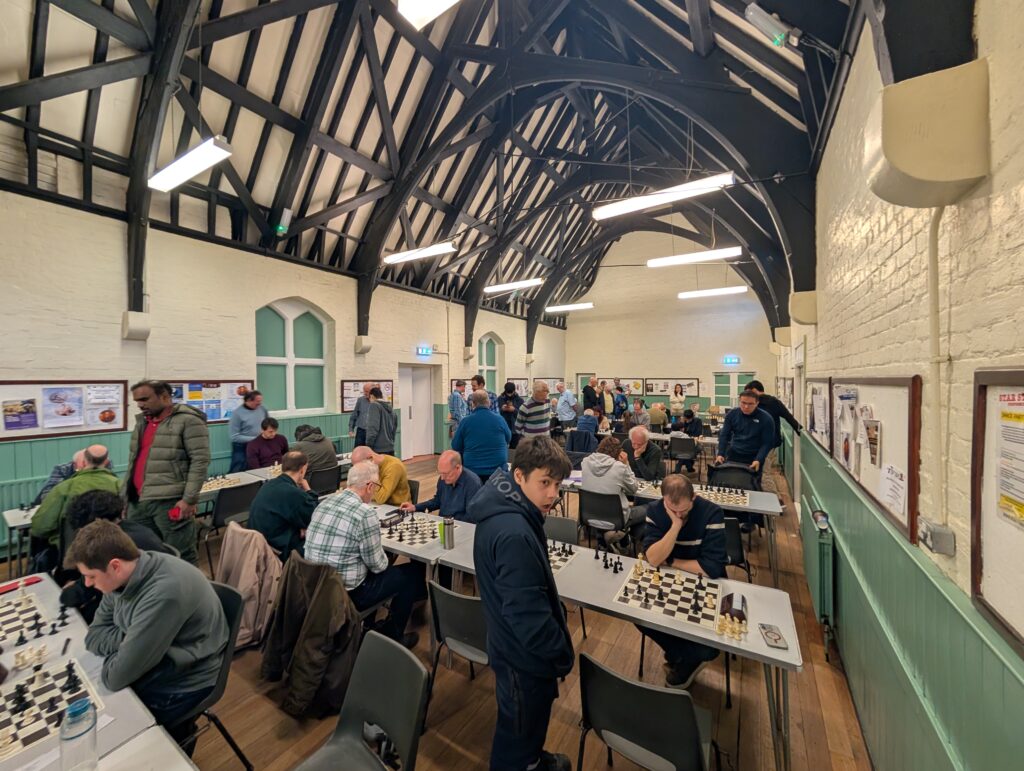
Living the Cheam: 16 teams from across Surrey gathered at the Parochial Hall to do battle for the Thorpe Trophy
The event had started relatively poorly for Kingston A, who managed to win by just 2.5-1.5 against Streatham B, with Streatham veteran Martin Smith getting a commendable draw against IM Peter Large. But they made up for that in round 2, thrashing Wimbledon 4-0, despite a surprise appearance for Wimbledon by Kingston chair Peter Andrews, filling in for an absent Wimbledon player. (The tournament is serious but also social, and we were happy to help out to fill the gap.)
Seth got an important win in this match and Alex Chmelev, who scored 3/4 across the four rounds, was proving rock-like. Kingston B were also performing well, though my loss on time when a rook up in round 2 against Streatham A was crucial in the final tally of game points (sorry team-mates).
Epsom A and Richmond A were always likely to be the main dangers to a repeat Kingston title victory, though South Norwood had also brought a strong team, headed by Marcus Osborne (who scored an excellent 3.5/4 on top board) and Paul Dupré, and were going well. Indeed, but for a surprise loss on board 3 to Streatham B in the final round, they would have won the trophy.
The final round: Peter Large and Seth Warren take on their opposite numbers from Richmond A in round 4
A key match-up came in round 3, when Kingston A took on the Epsom A. Despite being heavily outrated, Epsom A got a 2-2 draw to ensure that the last round would be a nail-biter. Peter Large beat James Allison, who has been a thorn in Kingston sides this year, but young Ethan Bogerd (who scored 4/4 in the tournament) beat Alex Chmelev to boost Epsom’s cause. Another Epsom youngster, Arnav Kumar, drew with Peter Lalić.
Kingston B beat Epsom B 4-0 in round 3 and were leading going into the final round, but vertigo may have kicked in – on my part at least. I played the all-conquering Ethan Bogerd with Black and, after surviving an early onslaught, had a winning endgame. Ethan offered me a draw, which I turned down, sure I had a simple win. But, playing on the increment – Ethan uses virtually no time and wanders round the playing room looking at other games – I blundered and lost. Moral: never play juniors at rapidplay.
My defeat gave Kingston A an opening in their match against Richmond A. Peter Large defeated Alastair Armstrong, Alex Chmelev completed an impressive afternoon with a win with Black over the very capable Raghu Kamath, and on board 1 Peter Lalić scored a crucial win with Black against the highly rated Caspar Bates. Peter has kindly reconstructed the game (few players record rapidplay games, but Peter has almost total recall).
As well as avoiding juniors in rapidplays, you should avoid Peter Lalic, whose accuracy levels remain remarkably high even at a time control of 20 minutes plus five-second increment.
All that was needed now for Kingston A to retain the trophy was for Kingston B to inflict sufficient damage on Epsom A to stop them coming through to pinch the title. Vladimir Li duly beat Arnav Kumar with Black on board 1 to record his fourth win of the afternoon, and Jasper Tambini then got a crucial point on board 2 against James Allison to ensure that Kingston A won the trophy and Kingston B came joint second.
Afterwards, Peter Large reminded us that it the denouement was remarkably similar to last year. “In 2025 Kingston A were a half-point behind Kingston B and a full point behind Epsom A going into the last round,” he pointed out. “In the last round Kingston B were paired with Epsom A and Kingston A played Richmond. Kingston A won the title because Kingston B obtained a 2-2 draw with Epsom. Jasper Tambini won the crucial game for Kingston B on board 2.” Groundhog Day indeed.
Thanks to tournament controller Graham Alcock for running the tournament, to Peter Andrews for bringing the trophy – happily, to be re-presented back to Kingston A – and to Genc Tasbasi for finding the time to take the excellent photographs in this report while doing his bit to secure joint second place for Kingston B. Multi-tasking which proved to be beyond me. I guess we will do it all again next March. Can we make it a hat-trick of wins?
Stephen Moss, Kingston club captain
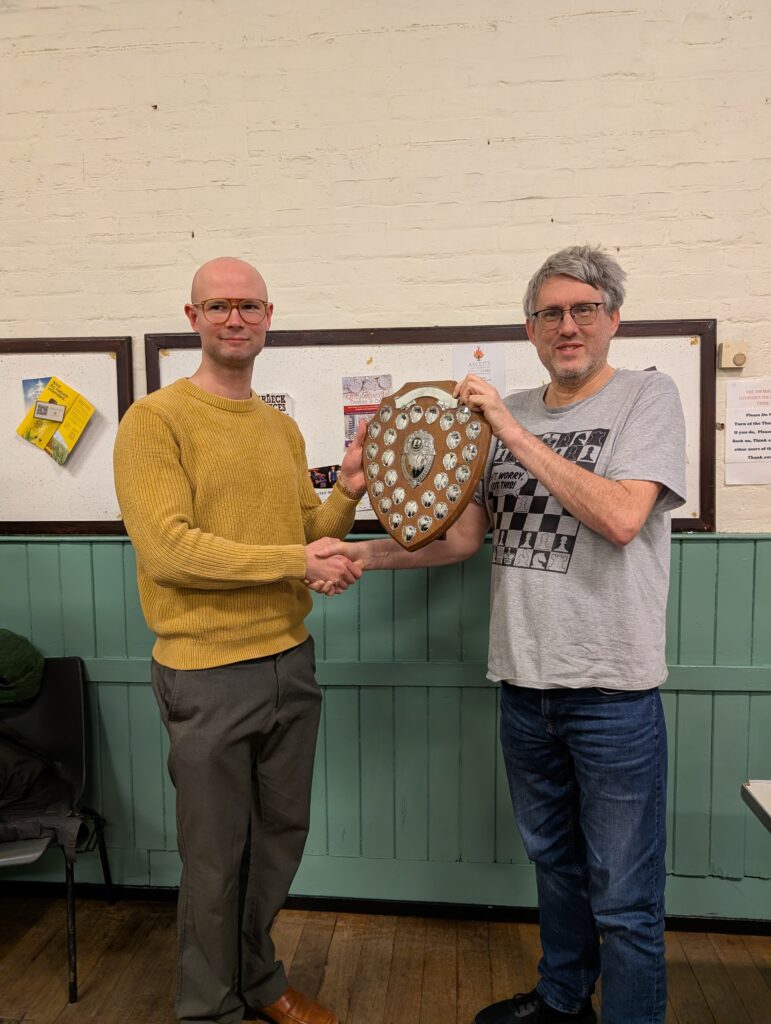
Tournament controller Graham Alcock (right) hands Kingston A board 1 Peter Lalić the Thorpe Trophy
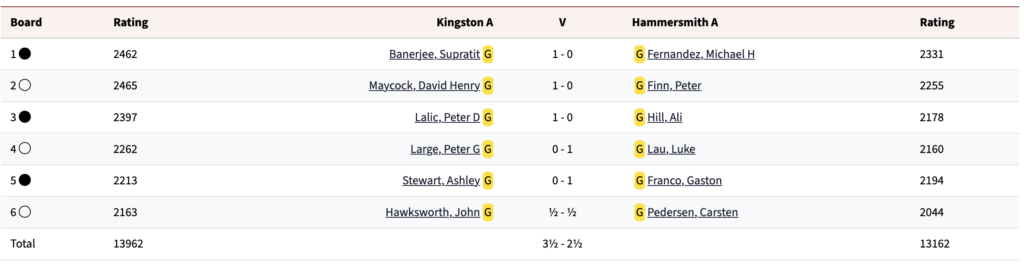
Kingston A v Hammersmith, Thames Valley League division 1 match played at the Richard Mayo Centre, United Reformed Church, Kingston on 9 March 2026
I have played for a lot of chess clubs in my time, but before this season I think I had only ever been a club captain once. That was back at Sheffield University. In those days we didn’t have round-robin emails, or emails at all, and we didn’t have mobile phones either. So getting a team together involved putting a piece of paper on the chess club noticeboard, and seeing who ticked it to say they were available. Occasionally Tony Miles, at the time the world junior chess champion, would turn out for us, if he was not playing abroad somewhere. And also Tony Kosten, who would later become a grandmaster, but who at that time had only been playing for a few years, having started his chess career late.
I mention this in order to put the next sentence into context. The Kingston A team I assembled to play our crucial Thames Valley League match against Hammersmith was the strongest team I have ever captained. We had an international master on board 6, and two of the top young talents in the country, Supratit Banerjee and David Maycock, on the top two boards. The rest of the team weren’t too bad either. Hammersmith had a strong team too, but surely we had enough firepower to beat them? Well, lets see. I will start at the bottom and work up.
On board 6 the international master hereinbefore mentioned, John Hawksworth, had White against Hammersmith’s captain, Carsten Pedersen. The game was a (nowadays rather unfashionable) Bogo-Indian, which was accurately played by both sides, and which ended in a draw after 24 moves – a good result for us given what was happening on other boards at the time. John is still playing his opening repertoire from the 1980s, which means he is very hard to beat but perhaps lacks a cutting edge sometimes. Maybe try something new from time to time?
Ash was very unlucky in this game. I suspect he was playing against Gaston’s computer-generated home prep. You might be tempted to try this line yourself – the Accelerated Dragon is very popular these days, especially amongst juniors, and your opponent is unlikely to have seen it before and will need to be very strong indeed to navigate the tactics that you will be familiar with. But beware – you will need to have something prepared if instead of 9…Nxe4 or xg4, Black plays 9…d5!
That brings us to my own game on board 4, where I had White against the talented and underrated (of course I would say that) Luke Lau. The game was decided by my tactical mistakes in the early middlegame.
So despite outrating Hammersmith on all three of the bottom boards, we had amassed only half a point. Fortunately, as I said earlier, we had some good players on the top three boards. On board 4, Peter Lalić (pictured above, left) had Black against his old friend Ali Hill. After 26 moves they reached this position, Hill having earlier declined a draw offer:
What happened now was something quite extraordinary. White has not defended in the best possible way, and Black is, I thought, at least slightly better. In addition, White was in time trouble. To win the match, we had to win this game. I therefore expected Peter to do his very best to win, even if that involved some risk, perhaps trying to break with …c5 or …g3 at some point. What happened was that Peter made no effort to win whatsoever. He just aimlessly moved backwards and forwards, taking care only to ensure the position was never repeated three times. I was both baffled and frustrated.
Light only began to dawn when Peter asked me what time the session ended. I eventually realised that he planned to leave the game to adjudication. He judged that the position was not just “slightly better for Black” but, with perfect play, winning. All he needed to do therefore was leave the position essentially unchanged, and leave the rest to Mr Stockfish. And, as we will see, he was absolutely right.
I have never seen a game of chess won in like manner before. In my opinion, it was a stroke of genius. It divided opinion though, some people going so far as to suggest that it was “against the spirit of the game”. Those people were of course cricket enthusiasts – we don’t have the “spirit of the game” concept in chess, we just have the rules. As I see it, Peter’s approach was no different to that of a football team 5-0 up, who pass the ball around in their own half for the last 15 minutes, having already done the hard work. Nobody thinks that is against the spirit of the game – they call it professional.
Be that as it may, after 30 moves of aimless shuffling the players arrived at the above position again, and time was called. Cutting a (very) long story short, I sent the position off to the Thames Valley League Adjudication Secretary (yes, there is such a role – he must be a busy man), but a week later Carsten notified me that Ali Hill had resigned. Stockfish 18 evaluates the final position as about -5 at a depth of 30 ply (you have to have a powerful computer and leave it switched on for a while). The analysis is complex and deep, but the main line goes 72 (I’m guessing the move number) …Bb4 (threat …Be1) 73. Rc1 g3+! 74. fxg3 Kg4 75. Rf1 Rf5! and White is in a kind of zugzwang. A rook move along the rank allows …Kf3, Rf2 allows …Be1, and Bc7 or Bd8 allows …Bd2. If 76. Ba7 Bd2 77. d5 cxd5 78. Bd4 Bb4, Black is still going to break in, either down the c-line or via f3. The more you look at the position, the more you realise, like Lalić and Stockfish, that it is hopeless for White.
The game on board 2 between David Maycock and Peter Finn was much clearer. In fact it was another game of limpid clarity and class by David, playing the white side of a Sveshnikov Sicilian and making it look as if Black never had a chance. I will give the whole game with just a few comments, because that is all it needs:
This is how chess should be played.
Finally, we reach board 1. My thunder has been stolen by John Saunders, as he has already annotated Supratit’s superb win with Black against Michael Fernandez, which you can see here.
Thus it was that, a week after the match started (see the story of Hill v Lalić above) we scraped a narrow 3.5-2.5 win over our main rivals in Thames Valley division 1, Hammersmith having taken over that role from Maidenhead. Our success so far this season has been down to our top 3 boards – Kingston is blessed to have such players. Supratit and David in particular are climbing up the ratings at a phenomenal rate, and it is a privilege to see them play. There are no limits to what Supratit may achieve. This is a golden age.
Peter Large is Kingston A captain in Thames Valley division 1
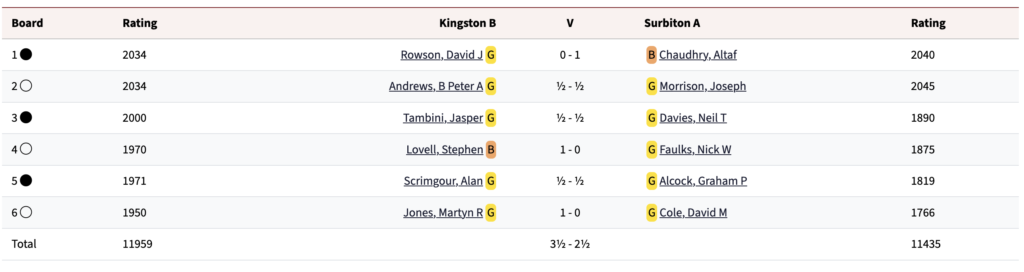
Kingston B v Surbiton A, Thames Valley League division 1 match played at the Richard Mayo Centre, United Reformed Church, Kingston on 9 March 2026
It’s sometimes said that relegation battles are not for the purist; I think the course of this match supports that view. The key point is not how you play, but whether you get the required result, and in the end this was what Kingston B achieved against Surbiton A. Two short draws, one longer one, a game that saw an unlikely turn-around, a game decided by a blunder, and my own game, about which the least said the better (though the reader will see below that I have said quite a lot).
The first game to finish was the board 5 encounter. It began as a c3 Sicilian Defence, but after the queens were exchanged the players decided there was little to be gained from playing on and agreed a draw. Following this, another draw, on board 2. As Peter Andrews pointed out, the drama here was only in what might have been. In the following position Black played 17…f6, but Peter noted that “Black was struggling for a plan here, and missed a nice pawn sacrifice pointed out by the machine: 17…. h5.” The analysis below shows what follows if White accepts the pawn sac.
This was also the result on board 3, but only after more than 40 moves. From a kind of Catalan Opening, numerous exchanges led to an ending in which Jasper Tambini (foreground, left, in photograph above), with Black, had a bishop against Neil Davies’s knight but ultimately could not make progress.
So three peaceful conclusions left the match all square, but the remaining games were much more contested. Martyn Jones, playing White, and David Cole dared to explore the complications and imbalances of the Winawer variation of the French Defence. As can happen in this opening, White’s queen hoovered up Black’s kingside pawns, but allowed Black to take his central pawns in return. The position here is unbalanced but roughly equal:
Martyn’s win put Kingston one game ahead, but the signs for the overall result were not promising as I was struggling to defend an inferior ending on board 1 and Stephen Lovell was the exchange and a pawn down on board 4.
Stephen had played the English Opening, but commented: “My opponent played a system I hadn’t encountered before, and I didn’t find the best way of meeting it.” This was the position after Nick Faulks had shored up his queenside by moving the a8 rook off the long diagonal and his pawn to b6 and taken a grip on the centre:
Due to the players’ shortage of time, the record of the moves ends in the position above, but this was the key result for Kingston B, as it ensured that we would win the match and made the result of my own game incidental.
As Black in another English Opening I had obtained what I thought were promising chances, but accepted exchanges which eventually resulted in a fairly level position:
My dissatisfaction with the way my game had gone was offset by the fact that we had won the match, an important step towards possible safety from relegation in Thames Valley division 1. I’ll take another few chaotic encounters like this if we can get the results we need.
David Rowson is Kingston B captain in Thames Valley League division 1
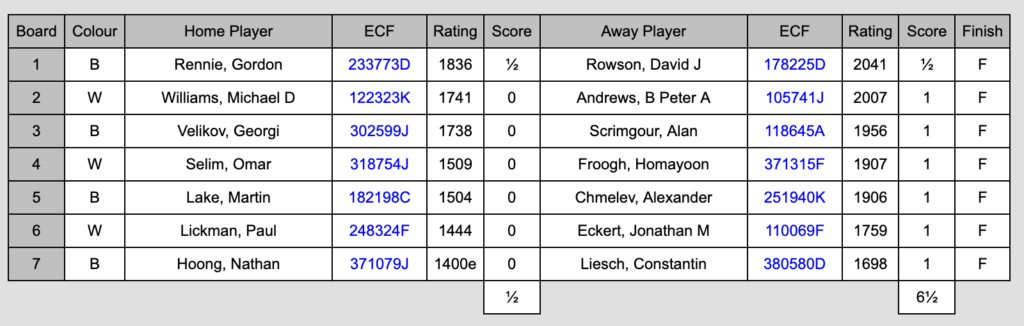
Wimbledon 2 v Kingston 2, Surrey League division 2 match played at St Winefride’s Church Hall, Wimbledon on 5 March 2026
Wimbledon 2 have been depleted by the requirement for several hitherto regular players to be nominated for their first team, which has been stricken by long-term illness and players moving on. So even though we were able to share some match opportunities around the second team squad, the teamsheets showed that we had a huge rating advantage. Winning the toss loaded the dice further in our favour.
For once I had the shortest game, freeing me to consume more coffee than was optimal for sleep on a chess night and allowing me to keep the wider club informed of later developments by WhatsApp. My opponent, playing White, went downhill in an unusual line, and resigned after just 15 moves in the horrid position shown below.
Next to finish was Jon Eckert on board 6, on home ground in the French Defence. White tied himself in knots trying to hold on to an extra pawn and Jon progressively undermined the fragile structure.
On board 5, Alex Chmelev also got an advantage early on and cashed in.
Homayoon Froogh’s game on board 4, where he had Black against Omar Selim, looked tight for longer. But as the board opened up, Homayoon’s two rooks and two bishops were much stronger than White’s two rooks and two knights, and he won large amounts of material with a combination of pins. At 4-0 we were over the line in the match within two hours of the start.
Board 1 was a tense battle between David Rowson and Gordon Rennie, a familiar opponent. David won a pawn, but in the rook and bishop v rook and knight ending both sides had a queenside passed pawn with some activity. David sacrificed the exchange for Black’s passed pawn, leaving him with a bishop and two pawns for a rook. Objectively this was enough to win, but under some time pressure David did not quite trust his calculation and agreed a draw.
Board 7 looked like the game with the most mutual jeopardy, but Kingston newcomer Constantin Liesch, who had White against Nathan Hoong, seems to like it that way, and after a middle game in which both sides had chances he finished with a fine sacrificial attack.
Board 3 was, as had always seemed likely, last to finish. In a c3 Sicilian, Alan Scrimgour built up pressure against various weak points in the black position while pre-empting any possible counterplay, so it was difficult for Black to find sensible moves (and the machine has not much better advice in hindsight).
So the final score was 6.5-0.5. Not too surprising given the rating difference between the teams, but convincingly delivered. With only two matches to go, one of them the return against a weakened Wimbledon 2, we are now odds on to win division 2, which would be a tremendous achievement only four years after the first team did so, and all the more so given that we have been outrated in several close matches.
It poses a dilemma – should we take promotion to division 1, which would be a very tough challenge, not least on the organisational front, with two eight-board teams in Surrey and possibly two six-board teams in Thames Valley division 1, or should we seek to decline it, or should the answer depend on whether the TVL B team stays in that first division? These issues lie ahead, but for now we can enjoy some hard-earned success, and look to drive it home in the last two matches.
Peter Andrews is captain of Kingston 1 and Kingston 2 in the Surrey League
Kingston C v Surbiton D, Thames Valley League division X match played at the Richard Mayo Centre, United Reformed Church, Kingston on 2 March 2026
It has been an up-and-down season for Kingston C, and this was one of the downs, losing 3-1 to a well-organised Surbiton D team. Surbiton skipper Phil Goodings got the better of Sean Tay in a tight encounter on board 1; Kim Cross beat Anqi Yang on board 3; and Harry Roberts edged out Robert Chmiest on board 4. That left Nette Robinson, as so often this season, to save Kingston’s blushes with a win with White against the tricky Nikolai Mantaev on board 2. Congrats to Nette on her excellent recent run.