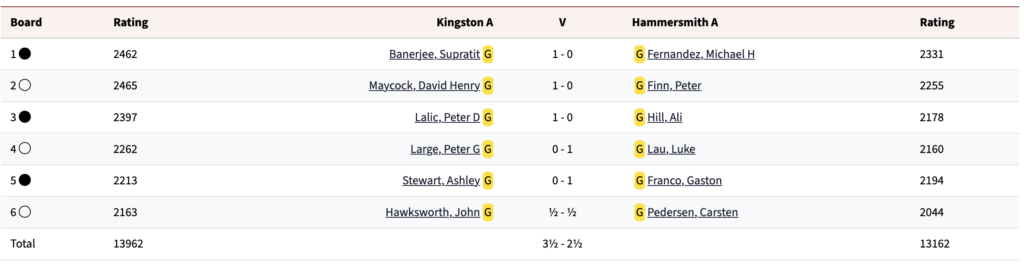
Kingston A v Hammersmith, Thames Valley League division 1 match played at the Richard Mayo Centre, United Reformed Church, Kingston on 9 March 2026
I have played for a lot of chess clubs in my time, but before this season I think I had only ever been a club captain once. That was back at Sheffield University. In those days we didn’t have round-robin emails, or emails at all, and we didn’t have mobile phones either. So getting a team together involved putting a piece of paper on the chess club noticeboard, and seeing who ticked it to say they were available. Occasionally Tony Miles, at the time the world junior chess champion, would turn out for us, if he was not playing abroad somewhere. And also Tony Kosten, who would later become a grandmaster, but who at that time had only been playing for a few years, having started his chess career late.
I mention this in order to put the next sentence into context. The Kingston A team I assembled to play our crucial Thames Valley League match against Hammersmith was the strongest team I have ever captained. We had an international master on board 6, and two of the top young talents in the country, Supratit Banerjee and David Maycock, on the top two boards. The rest of the team weren’t too bad either. Hammersmith had a strong team too, but surely we had enough firepower to beat them? Well, lets see. I will start at the bottom and work up.
On board 6 the international master hereinbefore mentioned, John Hawksworth, had White against Hammersmith’s captain, Carsten Pedersen. The game was a (nowadays rather unfashionable) Bogo-Indian, which was accurately played by both sides, and which ended in a draw after 24 moves – a good result for us given what was happening on other boards at the time. John is still playing his opening repertoire from the 1980s, which means he is very hard to beat but perhaps lacks a cutting edge sometimes. Maybe try something new from time to time?
Ash was very unlucky in this game. I suspect he was playing against Gaston’s computer-generated home prep. You might be tempted to try this line yourself – the Accelerated Dragon is very popular these days, especially amongst juniors, and your opponent is unlikely to have seen it before and will need to be very strong indeed to navigate the tactics that you will be familiar with. But beware – you will need to have something prepared if instead of 9….Nxe4 or xg4, black plays 9….d5!
That brings us to my own game on board 4, where I had White against the talented and underrated (of course I would say that) Luke Lau. The game was decided by my tactical mistakes in the early middlegame.
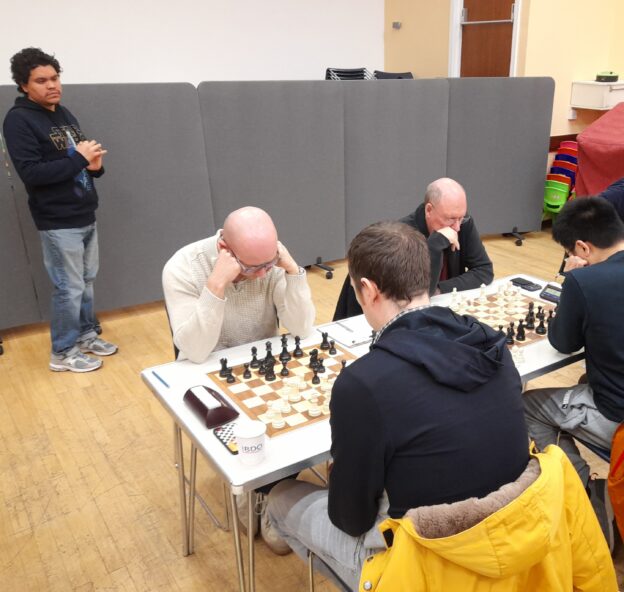
So despite outrating Hammersmith on all three of the bottom boards, we had amassed only half a point. Fortunately, as I said earlier, we had some good players on the top three boards. On board 4, Peter Lalić (pictured above, left) had Black against his old friend Ali Hill. After 26 moves they reached this position, Hill having earlier declined a draw offer:
What happened now was something quite extraordinary. White has not defended in the best possible way, and Black is, I thought, at least slightly better. In addition, White was in time trouble. To win the match, we had to win this game. I therefore expected Peter to do his very best to win, even if that involved some risk, perhaps trying to break with …c5 or …g3 at some point. What happened was that Peter made no effort to win whatsoever. He just aimlessly moved backwards and forwards, taking care only to ensure the position was never repeated three times. I was both baffled and frustrated.
Light only began to dawn when Peter asked me what time the session ended. I eventually realised that he planned to leave the game to adjudication. He judged that the position was not just “slightly better for Black” but, with perfect play, winning. All he needed to do therefore was leave the position essentially unchanged, and leave the rest to Mr Stockfish. And, as we will see, he was absolutely right.
I have never seen a game of chess won in like manner before. In my opinion, it was a stroke of genius. It divided opinion though, some people going so far as to suggest that it was “against the spirit of the game”. Those people were of course cricket enthusiasts – we don’t have the “spirit of the game” concept in chess, we just have the rules. As I see it, Peter’s approach was no different to that of a football team 5-0 up, who pass the ball around in their own half for the last 15 minutes, having already done the hard work. Nobody thinks that is against the spirit of the game – they call it professional.
Be that as it may, after 30 moves of aimless shuffling the players arrived at the above position again, and time was called. Cutting a (very) long story short, I sent the position off to the Thames Valley League Adjudication Secretary (yes, there is such a role – he must be a busy man), but a week later Carsten notified me that Ali Hill had resigned. Stockfish 18 evaluates the final position as about -5 at a depth of 30 ply (you have to have a powerful computer and leave it switched on for a while). The analysis is complex and deep, but the main line goes 72 (I’m guessing the move number) …Bb4 (threat …Be1) 73. Rc1 g3+! 74. fxg3 Kg4 75. Rf1 Rf5! and White is in a kind of zugzwang. A rook move along the rank allows …Kf3, Rf2 allows …Be1, and Bc7 or Bd8 allows …Bd2. If 76. Ba7 Bd2 77. d5 cxd5 78. Bd4 Bb4, Black is still going to break in, either down the c-line or via f3. The more you look at the position, the more you realise, like Lalić and Stockfish, that it is hopeless for White.
The game on board 2 between David Maycock and Peter Finn was much clearer. In fact it was another game of limpid clarity and class by David, playing the white side of a Sveshnikov Sicilian and making it look as if Black never had a chance. I will give the whole game with just a few comments, because that is all it needs:
This is how chess should be played.
Finally, we reach board 1. My thunder has been stolen by John Saunders, as he has already annotated Supratit’s superb win with Black against Michael Fernandez, which you can see here.
Thus it was that, a week after the match started (see the story of Hill v Lalić above) we scraped a narrow 3.5-2.5 win over our main rivals in Thames Valley division 1, Hammersmith having taken over that role from Maidenhead. Our success so far this season has been down to our top 3 boards – Kingston is blessed to have such players. Supratit and David in particular are climbing up the ratings at a phenomenal rate, and it is a privilege to see them play. There are no limits to what Supratit may achieve. This is a golden age.
Peter Large is Kingston A captain in Thames Valley division 1